
When there’s a major upheaval, journalists look to two trusties for the right words, Churchill and Shakespeare. Here’s Shakespeare in Richard II:
’This blessèd plot, this earth, this realm, this
England… that was wont to conquer others
Hath made a shameful conquest of itself.’
Fast forward from the Percys’ mediaeval Northern powerhouse. We see the parallel of a 2024-elected Labour Government, failing to deliver visible progress on many fronts within two years, despite a large parliamentary majority.
The Party has lost support from within and across the public realm. It is Reform and other populist interests who are benefiting from large-scale voter revolt, while the historic parties in opposition are not.
The new City Region Mayors are the democratic equivalent of the Middle Ages’ Barons. So enter, stage north, Andy Burnham, the most visible and charismatic of the Mayors.
Manchester ascendant
Manchester, the modern House of Lancaster, has been the powerhouse base for Andy Burnham, now newly elected as an MP, to challenge the ruling ‘House of Westminster’.
Sir Keir Starmer, the outgoing Party Leader and Prime Minister, has effectively stepped aside to allow a smooth transition. Nominations for the Labour leadership close on July 16th. If Andy Burnham is the only candidate he will be formally declared the party leader the following day, and Prime Minister on July 20th.
In the past 10 years Andy Burnham has led changes to the city region’s economy and working practices, and now wants to extend ‘Manchesterism’ across Britain. It is the attitudes, priorities, and practices of Westminster and Whitehall which he most dislikes.
He desires a “more collaborative” Westminster, not led on by party Whips, to address the current "fragmented, disjointed" political environment. As mayor, he put "place first, not party first", focused on "problem solving and not point scoring" and "long term, not short term".
Having made it to London (by train of course) to be sworn in again as an MP, he returned to Manchester and delivered on Monday 29th June a keynote speech on his vision of what Labour can really achieve. Appropriately, the venue was the People’s History Museum.
He said the question he wants to answer is: "What hope can we have that it will be different this time?... After 10 years of political turbulence since Brexit" and 20 years "of falling living standards" since the financial crash, "Westminster hasn't been working for people, and it hasn't been working for a very long time".
He adds: "My generation of politicians, including me, must take responsibility - we haven't been good enough." He wants "to build the broadest possible coalition of people" to build Britain back up "to where we want it to be". He wants Manchester’s ‘place first’ political culture to become the norm.
His multiple targets
Fundamental reset in how Britain is governed
Away from a centralised, top-down model: “…a more streamlined state with a clearer purpose to power up all parts of the country and… focus on growth and regeneration, good growth.” He committed to an inclusive government team that reflects all parts of the party and the country, for broad representation.
Good growth in every postcode
Significant devolution to transfer authority from Whitehall to local levels, to nurture economic growth from the ground up. Giving local leaders (such as Mayors) the power and money to make their own decisions, with far greater control over economic development, investment and public services.
A No.10 in the North
Change will be driven through the prime minister’s office in an extended operation “based here in Manchester”, where the new Manchester Digital Campus at Ancoats is a probable location. “But here’s the important thing; it will only be based here. The job of No. 10 North will be to make power flow into the Midlands, into the South West, into the East of England and yes, into London.”
No. 10 North is particularly to help the regions with three tasks: reform of utilities; reindustrialisation and regeneration of places, as part of a long term economic strategy; and to help all places set new growth ambitions, to be assisted by:
- equivalent living conditions in all parts of Britain, as in the German Basic Law.
- place-based collaboration to be the new operating principle for UK plc, with all government departments and agencies to support strategic and local authorities with staffing and resources.
- greater public control of essential services like water, housing, energy, and transport, across the UK.
10-year plan to raise living standards
Andy Burnham says the country is "in a housing trap", which is having a "ruinous" impact on the UK's public finances. "No.10 North will oversee the biggest council house building programme since the post-war period". He will seek to regenerate the nation's towns and high streets – also to reform business rates to support pubs and high street businesses, asking "shouldn't we make high streets a symbol of Britain's renaissance?"
“We will support every region to set clear and credible industrial ambitions and provide the support to achieve them, encouraging more across UK partnership between places with complementary industrial clusters.”
As Cambridge and Manchester have done on life sciences, we will consolidate public and private investment at a place-based level and help all areas establish good growth funds, as we have done here in Greater Manchester.
Reform how government contracts are awarded
To support more UK jobs and industry, in order to get more apprenticeships and work placements in return, and to help our own British-based suppliers become more stable and competitive. “We will make sure that all eligible public contracts are subject to proper social value weighting. [Also] we need to safeguard sovereign manufacturing and production capability across the country in critical sectors like steel, defence, energy, food, and farming.”
Major reform to the further and higher education system
It should no longer be wholly focused on the university route. Greater Manchester’s Baccalaureate (MBacc) was introduced in 2024-25, and offers pathways into employment through technical education for young people in the region.
Henri Murison, Chief Executive of the Northern Powerhouse Partnership, welcomed Andy Burnham’s proposals in advance: they could be “the key to solving the UKs perilous public finances which are bad today, but over coming decades could get a lot worse”.
“Having worked with Andy for many years I have confidence that with a strong group of economic advisors and wider No. 10 operation in part based in Manchester, that he can through devolution and the deployment of public and private investment deliver ongoing reductions in the cost of out of work benefits and ill health linked to poverty.”
How familiar is all this?
Long memories will recall Harold Wilson’s ambitions for technological revolution, and for a new Department of Economic Affairs to reset public finances and improve the economic strength of the regions. So some of Andy Burnham’s proposals have a previous and unconcluded history.
However, where his current ambitions are focused, is on what he sees as a bigger malaise: a failing British economy, ‘Westminster’ becoming synonymous with ‘reduced public trust in politics’, and Whitehall’s continuing resistance to devolution. This is a political and cultural case for devolution, not just an economic one – where Andy Burnham can genuinely say he has seen the differences for the past 10 years, and has striven to do something about it.
He comments that a stark imbalance in resources between national and local government is "holding back growth", describing local government as "threadbare" since the pandemic. He says this is not just bad for councils and the areas they serve, but everywhere. “It is actually bad for national government too, because we will never get the growth up to the level Britain needs, unless every single postcode in the land is set up to contribute to it.”
Rail’s future relevance?
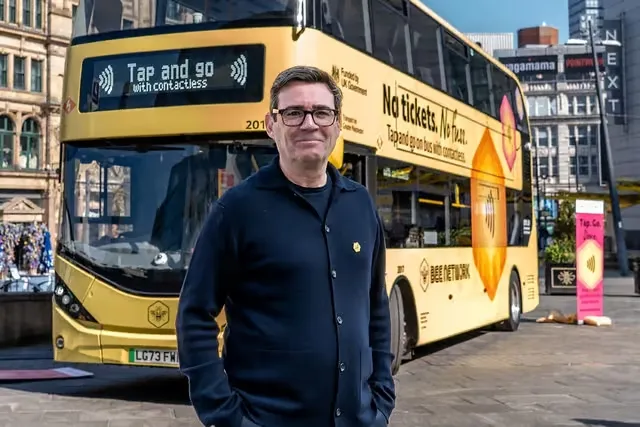
What does Andy Burnham’s speech mean for rail? He gave only two fleeting references to transport – one about it being a necessary community and growth ingredient within public control, and second with a favourable mention towards the Bee Network. He is proud of Manchester’s local transport network including Metrolink and the de-franchised, TfL-style Bee buses. However there was nothing specifically on rail, as a mode mention.
Financially too, rail might not look for more OpEx or CapEx, as he’s going to play by the Treasury/Office of Budget Responsibility rules, and he is backing more, urgent defence spending. Maybe there can be more discretionary spend from the financially-freed devolved regions and authorities, as and when they get their acts together – it would be their choices and their decisions.
So where is the rail industry’s input to these opportunities for regional betterment? Is the industry still too busy reorganizing to get widely engaged in strategic regional planning and opportunities for rail-supported economic growth? It is self-evident that raising the status of Manchester with a No.10 North (to be the digital English capital?) will increase the strategic case to strengthen rail links to Manchester. Not just to/from London (investment in a ‘not-HS2’ expansion), but a more widespread Northern Powerhouse geography, as he showed (above) with the geographical directions of policy transformation from Manchester.
There is a rail freight corollary, that strengthening such links and regional investment priorities might assist or hinder the capacity and movement of rail freight flows where they are currently bottlenecked, such as on the WCML approaching the North West. Equally, the desire to re-industrialise parts of England – however that is to be achieved – should increase the underlying merit of improved rail freight links.
Who pays?
The underlying argument is that ultimately better and more economically advantageous governance will pay for itself and more. There is always a transitional cost, though. Andy Burnham says he wants devolution “backed by the stability that comes from sound public
finances … and the discipline of our current fiscal rules”.
The HM Treasury take on all this will be vital, as will the view of the Office of Budget Responsibility. The Prime Minster is also the First Lord of the Treasury, yet Harold Wilson’s Department of Economic Affairs did not survive the Treasury ripostes from within the Whitehall ‘machine’. So how Andy Burnham manages the Treasury perspectives will be fundamental to his success if he becomes PM on July 20th.
Meanwhile the Leader of the Opposition, Kemi Badenoch, has warned that the new Prime Ministerial mission risks the middle classes having to pay for his policies with more taxes.
Let’s conclude with another quote from Richard II:
‘All my treasury
Is yet but unfelt thanks, which, more enriched,
Shall be your love and Labour’s recompense.’
This article was originally published in Rail Freight Group Newsletter No. 178, July 2026, in the Westminster Update column, or perhaps Manchester Update in this edition.