On Tuesday (16th December 2025) the UK government announced that, subject to a 12-week consultation, it would implement a raft of radical reforms to English planning through the National Planning Policy Framework. If it is delivered, it would be the most transformative reform to the planning system since the introduction of the Town and Country Planning Act and green belts in the late 1940s...
Crossrails
Luckily, there is a surprisingly easy solution to rail overcrowding in London: crossrails. Most of Britain’s railways were built in the 1840s and 50s, at which time it was almost impossible to tunnel a railway under a city centre. As a result, London’s railways generally terminate at a big station on the edge of the centre, like Waterloo or Victoria.
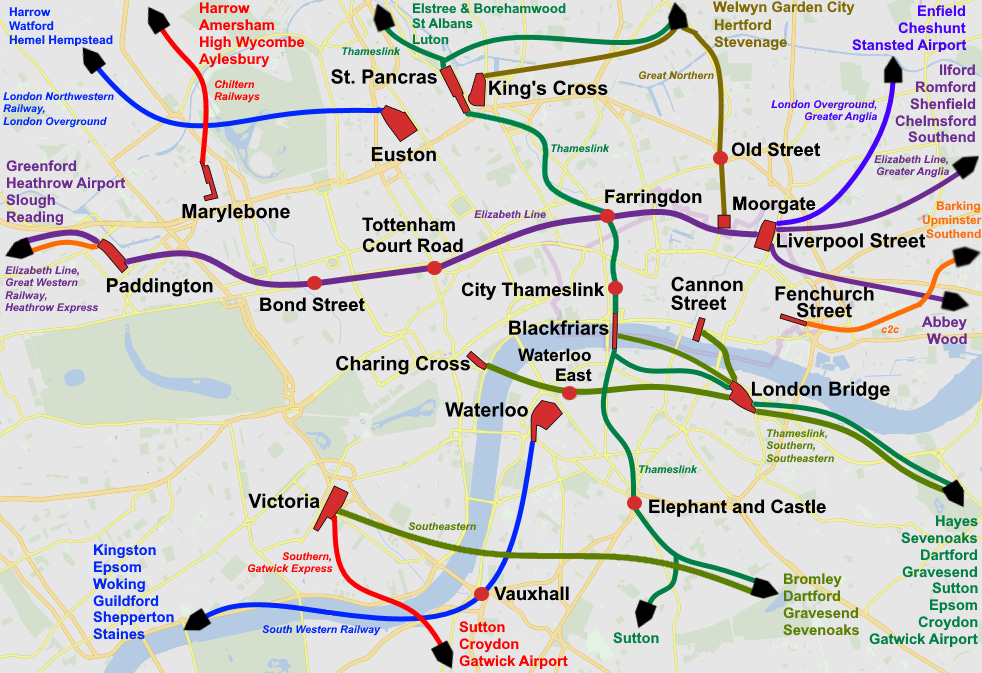
This was the best the Victorians could do with the technology available to them, but it imposes a low ceiling on capacity. Terminating a train takes far longer than stopping and carrying on, especially in the centre, where most passengers are going. Many more platforms are thus required at a terminus station than there are pairs of lines going in if platform capacity is not to become the binding constraint on the capacity of the entire network. For example, Waterloo has four pairs of lines going in, which could carry perhaps 96 trains per hour, but only 24 platforms, which turn around no more than 42 trains per hour. Terminus capacity at Waterloo thus halves the total capacity of the enormous rail network that fans out from it, compromising the transport system of the whole of southwest London and much of southern England.
Click to continue reading:
 Ben Southwood