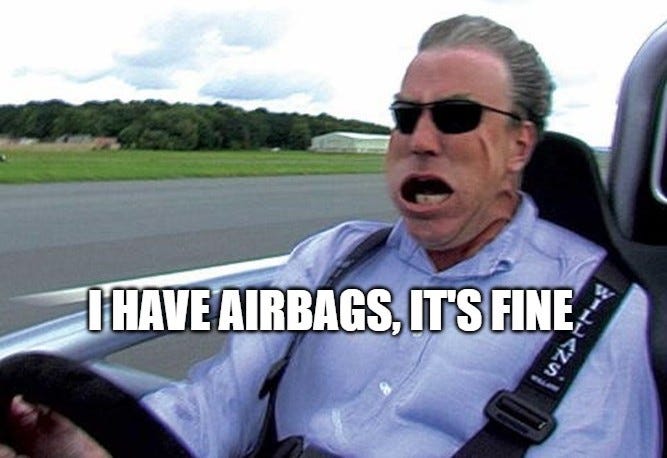
Picture yourself standing on the curb in front of your house. You’ve got your feet together, you rise onto your tiptoes, stretch both arms up over your head, and jump straight up and land back on the curb. Now imagine the same exercise on the edge of a 5-story roof. None of us would do it, even though we know we’re capable of jumping straight up and landing in the same spot. We’d all take a pass because the consequence of a minor slipup is death. The risk-to-reward ratio simply isn’t worth it. Humans constantly perform risk compensation. We adjust behavior based on how safe we perceive an environment to be, often without realizing it.
...
Not every decision is life-or-death, but the pattern holds: perceived safety changes behavior. Risk compensation gets complicated fast, because humans are wonderfully irrational. But we’re consistently willing to push the edges of “risky” when something (speed, convenience, comfort) makes the risk feel worth taking.
Sam Peltzman, an economist at the University of Chicago, published research in 1975, arguing that automobile safety regulations were largely offset by riskier driving behavior. In other words, as cars had more safety features, people’s driving behavior would get worse because “my car is safe.”
Click to continue reading:
 Andy Boenau