
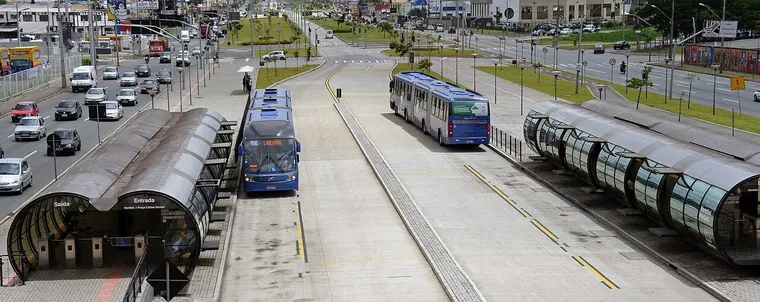
Provided that you don’t mind comparing apples and articulated rubber-tyred oranges, you can make a compelling argument that London has fewer tube stations than the eighth-largest city in Brazil. The British capital has 272; Curitiba at least 357. Not bad for a city a barely one fifth the size.
These are not, of course, the same things. Curitiba’s ‘Estação Tubo’ are rather more literal than London’s version – physical tubes of steel and glass, like something out of a work of modernist sci-fi – and are served by buses rather than trains. But they, too, are a key part of a revolutionary new transport network that changed their city and inspired others far beyond, and became an icon of the place that invented them, too. The airport gift shop is even shaped like one. That, right there, is impact.
Jaime Lerner, the father of the city’s transport network, was not an obvious candidate to change the world. In later life he’d be convicted, twice, for corruption, and would only avoid jail because of his age. He wasn’t even elected to his post as the city’s mayor, but appointed to it in 1971 by a military dictatorship that was, in the words back in 2015 of (one time CityMetric [online magazine] Latin America correspondent) Drew Ree, “confident that the young architect wouldn’t challenge [the] political order”. In office, though, Lerner changed everything. He radically rewrote his city’s planning policies, abandoning plans to widen the roads, and pedestrianising chunks of the city centre instead. Rather than turning drainage canals into concrete channels, he turned them into parks that doubled as flood meadows, and left them to be tended by (my favourite detail, this) sheep.
His most influential legacy, though, would be the 'Rede Integrada de Transporte' the Integrated Transportation Network. When Lerner took office, the expectation had been that Curitiba would follow in the footsteps of a hundred cities before it, and develop a traditional rail-based metro system like a subway. But even in a city of just half a million, he realised, this would take years and cost a fortune. A system based on buses would be cheaper, but would come with all the problems of, well the bus – most notably, getting stuck in traffic, not to mention creating it through their frequent stops. What, Lerner started to wonder, if there was a way of getting all the benefits of the metro, at the relatively low cost of the bus?
The first step was to create dedicated bus lanes along the middle of the city’s main roads: this meant investing in some new infrastructure, and a mild increase in inconvenience for passengers. In exchange, though, they got buses that, freed of their need to interact with turning vehicles, moved much more quickly and freely. Better.
But not better enough – the new buses still spent quite a lot of time standing around waiting for passengers to get on and off – so soon enough the city went further. Another advantage trains have over buses, the mayor and his team realised, was that nobody was paying as they tried to board: tickets were instead bought at the point you entered the station. What sounds like a detail was actually a revelation: changing this one thing would mean that, instead of everyone trying to enter through a single door, arguing with the driver about fares on the way, passengers who already had tickets could board or alight through multiple doors, massively speeding the entire process up. It also allowed the city to run longer articulated vehicles, increasing capacity. Best of all, detaching the process from individual buses also allowed transfer tickets.
In other words, it created a bus that worked like a metro – and at a mere fraction of the cost. In 1991, Curitiba introduced its first tube stations, closer to a metro station than a bus stop. Jaime Lerner has gone down in history as the man who invented bus rapid transit.
Actually, “invented” is perhaps a strong term because bus rapid transit (BRT) is annoyingly hard to define. Some sources argue that the Runcorn Busway, a largely segregated bus route built as part of Runcorn New Town in the suburbs of Liverpool, was actually the world’s first BRT; others, though this is contested – we’ll come back to that – might go back even further. As with so many other urban technologies, bus-based metros resulted as much from evolution as revolution; there may be no right answer to be found.
Nonetheless, Curitiba is generally considered the first full-scale BRT network, the first sizable city in which buses filled the ecological niche elsewhere filled by subways or trams. It would not be the last. In 1998, Mayor Enrique Peñalosa took inspiration from Cubita when looking for a way to tackle gridlock in the Colombian capital of Bogota: the Transmilenio network is now the world’s busiest BRT, serving two million passengers a day. Jakarta, the capital of Indonesia, began introducing the TransJakarta system in 2004: today it’s the world’s longest, with more than 251km of routes. You’ll find BRTs in China, BRTs in Africa, BRTs in Pakistan, over 190 in total.
The spiritual home of the technology, though, remains Latin America. Perhaps that’s thanks to the greater ease of transmission of the concept from Curitiba and Bogota to other cities with similar languages or culture. Partly, too, it may be because, since his mayoral term Peñalosa has reinvented himself as a transport expert, touring conferences to explain his theory that an advanced city is not “one where the poor move about in cars [but] where even the rich use public transportation”. Either way, the region now contains 64 different BRT systems, accounting for nearly 60% of the world’s BRT passenger traffic.
If you’re reading this in Europe, where we like our metro networks to run on rails thank you very much, or North America where the car remains king, you may be wondering what the point of all this is. Buses, as noted, are not glamorous things. How did entire continents end up reinventing them for their metros?
In fact, a well-designed BRT system has a number of advantages over your bog standard bus. As in Curitiba, both segregated space and streamlined boarding can lead to faster and more predictable journey times; extra flourishes, like elevated platforms for level boarding at marked door locations, and traffic lights which change automatically when they detect a bus coming, can help, too. All that can make both timetables and real time arrival information more useful than with regular buses, which are as subject to the vicissitudes of jams as the rest of us.
There are more nebulous advantages, too. Part of the benefit of a metro or tram network lies in its legibility and tangibility – the sense of something that’s here and is not going away. That’s hard to replicate in a bus-based system – unless, that is, it has physical “stations” rather than stops, serving particular, clearly branded lines, ideally shown on a map. In another way that BRTs act like trams, multiple studies have found that BRT boosts property values – something that’s not good, if you happen to be one of the people on the wrong end of a housing crisis, but is nonetheless indicative of public sentiment.
Against this apparent permanence, though, BRTs still retain at least part of the flexibility of buses, so they can move around obstacles, or even morph from a high-speed service into a feeder route at the far end of the line. They’re the best of all possible worlds.
The biggest reason for the spread of BRTs across the developing world, though, is surely the same one that inspired Lerner: they are much, much cheaper than any of the alternatives. A 2009 study found that BRT cost just over $10m per mile to build in 1990 dollars. It was more than twice that ($26m) for light rail, and more than 12 times that ($128m) for a subway. Cities need mass transit for all the reasons we’ve been scratching around for several chapters now, and which aren’t likely to stop bothering the urban world any time soon: because they need to move lots of people through limited space in a manner as swift and green as possible, or will otherwise start seizing up. BRT enables them to do that without breaking the bank. To quote the Economist – a newspaper, it must be said, which is really not a fan of trams – BRT “demonstrates that high-volume transport infrastructure need not be expensive or time-consuming to build and that a bus system can be as high-quality as a subway”.2
Given all these myriad advantages, though, we can turn our earlier question on its head: if BRT is so good, why doesn’t every city want one?
To explain why not, consider the other, even earlier contender for the title of first BRT. The East Side Trolley Tunnel in Providence, Rhode Island has been used exclusively by buses since 1948, and is sometimes referred to as a form of bus rapid transit. For over three decades before that, though, as the tunnel’s name suggests, it was used by a form of light rail. The conversion to bus operation was a downgrade to something more flexible, but widely considered to be worse. For some reason, the more enthusiastic advocates of BRT are less likely to bring this up than the systems that transformed Curitiba or Bogota.
This story highlights a problem with the technology: it is not actually clear what it is. In the descriptions I’ve given above I’ve highlighted the functions of the highest quality – that is, most metro-like – BRT systems. But not all of its various incarnations around the world – busways, T-ways, quality buses – live up to those standards, and it’s all too easy for a city installing a new bus rapid transit system to begin nibbling away at all the things that make them work. Does it need to be segregated for its whole route? the thinking begins. Wouldn’t part be enough? (More flexibility that way!) Perhaps to save space, it can share some of its lane with private traffic. Does it really need new stations? Wouldn’t the existing bus shelters do?
And then, before you know it, what you’ve got is basically a bus. Which you just spent quite a lot of money on, for no very good reason. Just, not quite as much as a tram.
This is not a theoretical problem: the East London Transit promised to bring high quality transport to a new residential suburb far from the tube. It ended up being a bus with a slightly different numbering scheme, and the odd bit of segregated road space. There’s even a name for this phenomenon, which is not a great sign: “Bus rapid transit creep”.3
The result is that, in much of the rich world, BRT is seen not as a step towards a metro but a cost cutting shift away from one. Sometimes BRT systems are buses that act like metros. At other times, though, they’re buses that merely pretend to do that.
Even in parts of the world that have embraced it, BRT is far from perfect. In July 2012 the Indian government’s Central Road Research Institute reported that a BRT pilot had failed because private cars kept driving and even parking in its lanes, and nobody was bothering to stop them. (This is something one might suspect the government could surely have some influence over, but, y’know.) Even when BRT systems do work, they’re slower and lower capacity than train-based systems by virtue of being, well, buses. As systems become more popular, that can lead to overcrowding and worse. Also in 2012, the residents of Bogota became so frustrated with the poor performance of the Transmilenio – capacity per vehicle 150; less than a quarter of even a small urban metro train – that riots broke out. Five stations were completely destroyed. This, too, would surely be harder to do with a proper underground railway station.
Curitiba’s network, too, has had its issues. Local newspaper 'Gazeta do Povo' reported that the stations did a poor job protecting passengers from heat and rain alike. To deal with its capacity limitations, the city has poured money into bike routes and is even planning a proper subway. A bus that thinks it’s a tram is all very well – but sometimes, a bus is just a bus.
This article first appeared as a section in Jonn Ellege's 'The Newsletter of (Not Quite) Everything', published on July 26, 2026. Republished with permission.