
Much as Walmart’s omnipresence in rural America has long been both a messenger and a means of its dominance, Amazon’s growing urban footprint marks and makes its own expansionist ambitions. But the business models and the geographies are very different. If “flooding the zone” is a key tactic of big-box takeover in rural communities, what’s the spatial strategy for a company like Amazon in a place like New York City? The battle over a massive, proposed headquarters in Queens was an exception to prove a rule. Instead of brute strength, Amazon’s takeover requires precision, the right thing in the right place at the right time. Rather than magic, the convenience customers prize is the product of meticulous consolidation, proliferation, and control. Truck routes and “last-mile” distribution centers transform city streets and speed up delivery times, while sometimes-sinister innovations extend from warehouse floors to public pavements and public relations: Scanners used to route packages also track workers’ “time off task”, and electric cargo bikes that shore up an image of greater “sustainability” mask the company’s larger environmental impacts (while choking up bike lane infrastructure). If Family Dollar is a flood — or an invasion — then Amazon might be a constricting web.
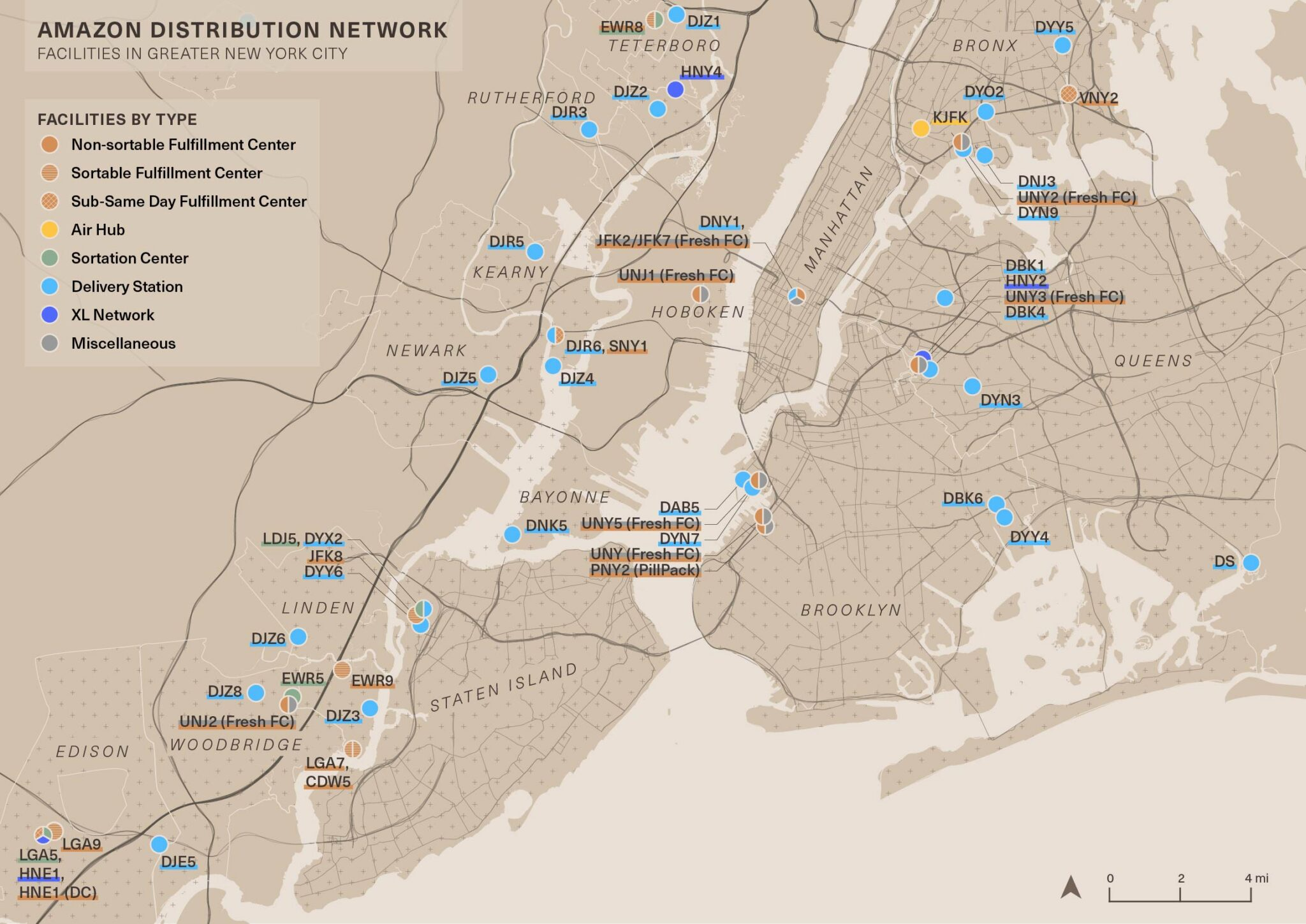
Occasional peeks inside Amazon’s massive warehouses notwithstanding, the company’s secrets of logistical domination are just as tightly controlled. But understanding the breadth, depth, and complexity of Amazon’s network in New York City is of utmost importance for city planners, antitrust regulators, and labor organizers alike. Benjamin Fong, building on his expertise as a chronicler of contemporary labor and logistics and a keen observer of Amazon’s activities across the country, undertook a citizen social science experiment with UO, seeking to dig deep into the company’s maneuvers in New York. Here, Fong uses the information hidden in plain sight — on the package labels themselves — to track the movements of this quintessentially contemporary behemoth.
