
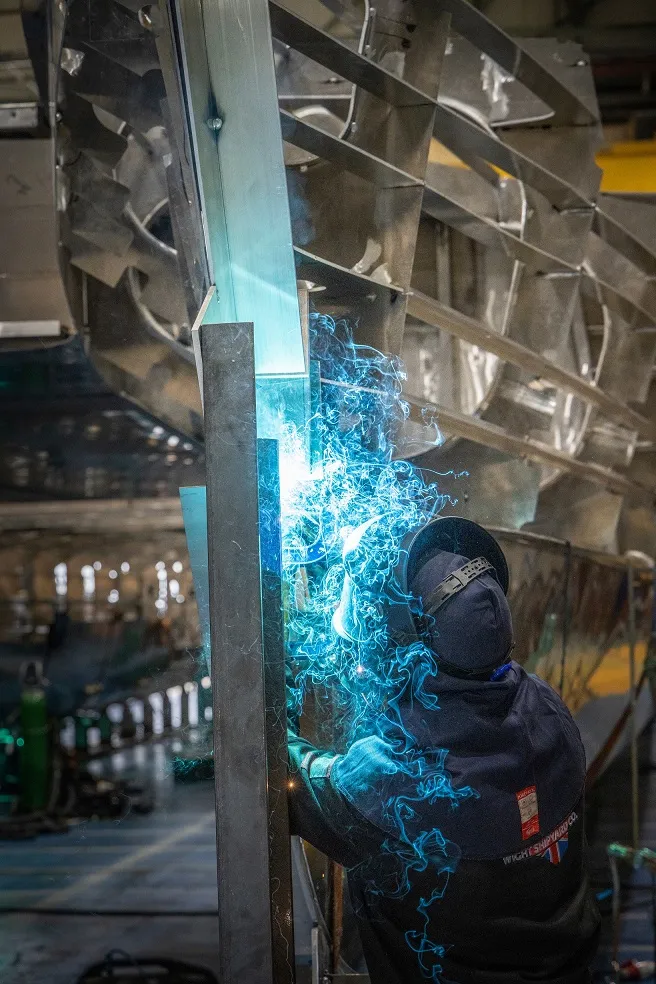
As passengers are returning to London's transport, with some overcrowding, it’s time once again to turn our attention to the Thames’ role in expanding the region’s transport. The River was the capital’s original highway, and can increasingly play a part in the city’s transport mix. In this installment, we look at developments of the expanding Thames Clippers fast catamaran fleet.
When we last looked at the River Bus fleet in 2017, Thames Clippers had ordered the improved Hunt Class Mk II Jupiter Clipper and Mercury Clipper from Wight Shipyard Co. These sisters feature a redesigned aft deck and different seating arrangements to enable them to carry 20 passengers more than the Hunt Class Mk 1 design. Nowadays, these catamarans usually sail on routes RB6 and RB2, carrying up to 170 passengers each, and added 14% more capacity to London’s River Bus service. This makes Thames Clippers now the largest commercial passenger fleet operating solely in English waters. They also allow the company to provide peak 15 minute frequencies on these busiest of River Bus routes.

Lighter by several tonnes, in part by using a vinyl finish instead of heavier paint, these catamarans save 15% of the fuel per passenger journey compared to the older fleet.
However, Jupiter Clipper and Mercury Clipper are not the largest boats in the fleet – that title goes to Venus Clipper, also constructed by Wight Shipyard and launched in 2019. She is a Hunt Class Mk III design, and carries the most passengers (220) thanks to her extended afterdeck. Accordingly, she is the flagship of the fleet, and wears emerald green as she is the greenest Clipper to date. It is not a coincidence that emerald is also the gemstone signifies a 20th anniversary, which Thames Clippers celebrated in 2019. Venus Clipper sails on routes RB1, RB2, and RB6.
Bringing back British boat building
Wight Shipyard Company, formerly Shemara Refit, based at East Cowes on the Isle of Wight, had previously refitted three Thames Clippers in 2016, which created 75 new UK jobs at over 100 businesses. There has been some reciprocal trade between London and the Isle of Wight, with the former having sent retired Tube trains to work the Island Line. The District line’s retired D78 stock trains had been refurbished by Vivarail for the Island Line's as-good-as-new D-Trains.
New hybrid Clippers under construction

Not intimidated by the pandemic, and bouyed by the potential of additional River Bus piers and services (which we will look at in a coming installment), Thames Clippers has ordered the UK’s first hybrid high speed passenger ferries. These are currently under construction at Wight Shipyard and are set to launch in autumn 2022 and spring 2023. They will run only on batteries whilst in the Clippers’ Central Zone between Battersea Power Station and Tower Piers (which is made easier by the lower speed limit in this zone - we cover speed limits a bit later in this piece). Outside of this zone, the boats will switch to hydrotreated vegetable oil (HVO) biofuel. Excess power from the biofuel engines will recharge the vessels’ batteries. The new boats will accordingly be ferry operator’s quietest vessels.

The ubiquitous Geoff Marshall recently visited Wight Shipyard to see these new hybrid Hunt Class catamarans now under construction, and of course, he made a video about it. Names for the first two boats have not yet been chosen, and Thames Clippers retains an option for a third boat depending on ridership growth.

An aerial diversion
The Wight Shipyard Co. building the boats are being built in was originally constructed to build flying boats, by Saunders-Roe. They designed and constructed many such aircraft - pre-war Empire flying boats and the fabulous post-war Princess jet powered flying boat airliner, among others. Although three of the latter were manufactured, British Overseas Airways Corporation (BOAC) had lost interest, given the ready availability of long runway airfields across the globe after the war. The RAF similarly declined. But that's a topic for another article.
The Thames Clippers fleet
Let us recap the River Bus fleet. Under its current corporate sponsor, Uber, each Clipper has their own colour stripe on each side of the bow to aid with identification. Note that some of the photos show the boats in a previous sponsorship livery, for variety:
Hydrocat Class
These catamarans each seat 62, have a maximum speed of 22 knots, and joined the fleet in 1999:
- Sky Clipper – Aqua
- Star Clipper – Lemon
- Storm Clipper – Wine Red

Class V
Seats 62, maximum speed 8 knots, joined the fleet in 2004. Before her life as a Clipper, she carried staff between Ford’s Dagenham plant and Belvedere. Now she is the only boat in the fleet that carries commuters, visitors, and hotel patrons between Rotherhithe and Canary Wharf on route RB4.
Twinstar Clipper – Brown

River Runner 150 Mk II Class
Seats 138, maximum speed 25 knots, joined the fleet in 2005:
- Moon Clipper – Violet
- Sun Clipper – Yellow
Operate on routes RB1, RB5, and RB6.

Typhoon Class River Runner 200 Mk IIB
Seats 220, maximum speed 29 knots, joined the fleet in 2007-08. Armament: None.
- Aurora Clipper – Powder Blue
- Cyclone Clipper – Orange
- Meteor Clipper – Spicy Red
- Monsoon Clipper – Pink
- Tornado Clipper – Mint
- Typhoon Clipper – Purple
- Hurricane Clipper - Seats 202, 4 wheelchairs (+1 mobility scooter), maximum speed 29 knots, joined the fleet in 2001.
Usually operate on route RB1.

Hunt Class Mk I
Seats 150, maximum speed 30 knots, joined the fleet in 2015:
- Galaxy Clipper – Yellow
- Neptune Clipper – Purple
Usually operate on RB6 or RB2 routes.

Hunt Class Mk II
Seats 172, maximum speed 30 knots, joined the fleet in 2017:
- Mercury Clipper – Silver
- Jupiter Clipper – Gold
Usually operate on RB6 or RB2 routes.

Executive Launch Class
- Comet Clipper - DHL orange
No passenger seating, maximum speed 26 knots, joined fleet in 2019. Not a catamaran.
This launch carries parcels instead of people,in a partnership between Thames Clippers Logistics and DHL. Parcels are loaded at Wandsworth Riverside Quarter Pier, then unloaded onto cargo bicycles at Bankside Pier.

- Orion Clipper - White
Seats 12, maximum speed 26 knots, joined fleet in 2016 and does private charters.
Hunt Class Mk III
Seats 220, maximum speed 30 knots, joined the fleet in 2019:
- Venus Clipper – Emerald Green
She has an extended aft compared to the Mk IIs.
Usually operates on routes RB1, RB2, or RB6.

Reducing maritime pollution
Having experienced drought, flooding, and record temperatures, it is increasingly dawning on society that much needs to be done urgently to reduce pollution. At the moment almost every commercial craft on the Thames uses diesel engines. But that is starting to change in more environmentally conscious cities. Ferries in Scandinavia are already starting to use liquid natural gas (LNG), hybrid engines, electric motors, and/or shore power in port to reduce emissions in urban areas. In addition, the coming Energy Efficiency Design Index international regulations will push the next generation of ships and ferries to more sustainable propulsion.
Thames Clippers had considered compressed natural gas (CNG) propulsion for new catamarans, but found that current CNG, and LNG, engines were of insufficient power and maturity. But they are investigating a number of other clean technologies.
All-electric propulsion may be practical
Increasingly strict regulatory and environmental requirements are some of the biggest challenges that Thames Clippers faces in the coming decade. All Clippers delivered 2015 and after have had to comply with the more stringent UK High Speed Craft Code, which stipulates double hull bottoms and 100 per cent life raft redundancy. This was a significant design challenge given the relatively small size of the boats, and to also keep the boats light to reduce power consumption and therefore emissions.
Furthermore, the company has committed to achieving Net Zero for all new builds by 2025, and Net Zero for its entire fleet, infrastructure, and environmental footprint by 2040.
Cleaner Clippers
Reading the tea leaves, Thames Clipper is developing a new 220 seat high-speed hybrid electric catamaran with 123 Naval Architects and Wight Shipyard, evaluating battery-only and hydrogen boats. This is part of the EU funded Horizons 2020 scheme to develop a 150+ passenger high speed electric ferry. The ferry company’s CEO Sean Collins believes that hydrogen fuel cells will be more likely to be used for electric ferries, due to the large weight of batteries on low waterline catamarans.
Thames Clippers has been participating in Europe’s TrAM H2020 project to evaluate electric operation for practical zero emission future transport. Such an initiative will also improve London’s poor air quality – a maritime equivalent of the Ultra-Low Emission Zone (ULEZ) for central London's road traffic.
Part of the TrAM project provides the opportunity to evaluate the current capability of electric batteries for a frequent stop service.
In 2019 the TrAM project conducted a research programme to develop the design of an electric high-speed passenger vessel for Norway. The current project is also conducting case studies for similar zero emission vessels in London, and Belgian inland waterways of. The London case is Thames Clippers’ main RB1 route between Westminster and North Greenwich, steaming 18 hours a day on a difficult duty cycle, with operational range requirements and short layovers between runs.
Thames Clippers believes that zero emission operations will be the norm in 10 years’ time, given the higher petrol prices and growing interest in electric vehicles - that it will be a customer expectation, more than just a competitive advantage. Furthermore, Thames Clippers has committed to having with all new boats be net zero by 2025, and for its entire fleet and infrastructure to meet this standard by 2040.
Maritime clean up hat trick
In September 2021, Thames Clippers also received funding from DfT’s Clean Maritime Development Competition to study three river sustainability research projects to develop greener, more sustainable passenger ferries:
1. Clipper 2.0: Studying decarbonising high-speed water transport
This study will evaluate the feasibility of integrating different fuel cell electric drive systems into new catamarans, as well as the potential for retrofitting the existing Clippers fleet. The project will also analyse three zero carbon fuel types – compressed hydrogen gas, liquid hydrogen, and methanol – to determine which is the best choice to power the fleet.
2. Cross River Zero Emissions Ferry
Thames Clippers will work with BAE Systems, Beckett Rankine, and Wight Shipyard Co to investigate the relationship between duty cycle and power demand for more efficient cross-river operation. The results are hoped to support the UK’s maritime industry meet the Government’s Net Zero 2050 initiative.
3. Project HOST (Hydrogen and Oxygen South Thames)
This project aims to transition Thames Clippers ferries from diesel to electric motors within 10 years using hydrogen fuel cells, supported by batteries. The project partners are Arup, National Grid, Wight Shipyard Co, and Shell.
However, it is noteworthy that Shell is a member of this partnership, as all oil companies are keen to sell hydrogen by-product from fossil fuel production, yet gain kudos from supporting ‘clean’ hydrogen power. We note the problem with grey (dirty) hydrogen generation in our article Hydrail breezes in the UK.
All electric Canary Wharf – Rotherhithe improved ferry proposed
A few years back in response to TfL’s request for concepts to improve the connection between Canary Wharf and Rotherhithe, Thames Clippers had proposed a fully electric pedestrian and cycle ferry. However, TfL at that chose a bridge option, although it was the much more expensive. The Covid pandemic and TfL’s resulting severe funding issues have put this fixed link on its deferred pile. In the meantime, TfL is looking at options for an enhanced, fast ferry service to enhance pedestrian and cycling in the area, and support new homes and jobs in the area:

Port of London Authority curbs speeds on the Thames
One drawback with the River's renaissance is that the Thames is seeing increasing numbers of fast catamarans, recreational vessels, mid-size cruise ships, as well as barges for major infrastructure projects such as the Thames Tideway tunnel. The Port of London Authority (PLA) had thus moved proactively to improve safety on and along the Thames. Much like the introduction of speed limits on motorways, speed limits also reduce fuel use and pollution.

The PLA had started public consultations in 2008 to improve maritime safety on the Thames. On their minds was the fatal collision near Cannon Street Railway Bridge on 20 August 1989 between the dredger Bowbelle and the pleasure boat Marchioness. The latter ship quickly sank after being pushed under by the dredger, drowning 51 people. The formal investigation calculated that the elapsed time from the collision to complete immersion of the Marchioness was only 30 seconds. Furthermore, it determined the cause to be poor lookouts on both vessels, and inadequate instruction of both crews.
Given the increasing numbers of River Buses and overall river traffic, the PLA determined that more stringent rules were needed. Surprisingly there had previously been no speed limits on most of the Thames, beyond the requirement that vessels travel at an appropriate speed for local conditions and nearby vessels.
From the consultation, the PLA revised its byelaws to include speed limits such that vessels proceed:
"at a speed so that its wash or draw-off does not compromise the safety of others using the River Thames, its foreshore, piers, moorings, berths, etc or damage the integrity of the foreshore itself.
"PLA intend the introduction of a speed limit to improve navigational safety on what can be a congested river with, in certain places, limited sight-lines and limited room for manoeuvre."
As for the effects of Thames Clippers' catamarans creating wash, the PLA had commissioned Dredging Research to investigate the claims, who determined that whilst Thames Clippers vessels do cause the most wash, it was caused by changes in speed, not the speed itself - “there is no clear guide to a relationship between wave wash and... the speed of the vessel".
PLA public consultation
In their submission to the consultation, the Marine Accident Investigation Board (MAIB) had recommended that the advisory speed limit of 12 knots be made mandatory up and down the River.
- West Of Wandsworth Bridge - 8 knots
- East of Wandsworth Bridge to Cherry Garden Pier* - 12 knots
- To Margaret Ness - 12 knots
- Below Margaret Ness - 30 knots
* This pier is just west of the East London Line (now Overground) tunnel in Rotherhithe, conveniently opposite the Met Police Marine HQ – an ideal observation location.
However the PLA also evaluated exemptions from such speed limits, namely for Thames Clippers, whose schedules are based on the company’s vessels' 28-30 knot maximum speeds. Vessels holding a PLA issued Certificate of Compliance (ie Thames Clippers catamarans, as well as emergency vessels) may travel faster on certain stretches of the River, but are required to have orange flashing lights visible:
- Wandsworth Bridge to Lambeth Bridge - 25 knots
- Thames Barrier area - 15 knots
- St Saviour’s Dock (east of Tower Bridge) to Margaret Ness - 30 knots
The PLA Byelaws also mandated the Automatic Identification System (AIS) Class Alpha on board all larger Thames vessels, which provides a screen that shows the location of all nearby equipped vessels. This system also assists controlling of all Thames traffic from the Vessel Traffic Service (VTS) Centres at Gravesend (the Port Control Centre) and Woolwich (the Thames Barrier Navigation Centre).
River Bus network reducing confusion
TfL's London River Services (LRS) has brought much needed simplicity and clarity to River Bus services, by adding River Bus RB route numbers in 2013, and fare zones (West, Central, East) in 2015. Despite this, public and private sponsors have wreaked their own havoc on the River Bus brand by changing the names of piers. The fact that River Tours (tourist boats) and River Bus icon signage are similar shades of blue which can easily be mistaken do not help either.

Yet another corporate sponsor rebrand
The ferry company’s corporate sponsor is currently Uber, which has insisted on renaming the fleet as “Uber Boats”. Sponsorship is a necessity to avoid TfL subsidy, and the sponsor calls the shots on the name and branding. Unfortunately, changing sponsors every few years really muddies the waters of brand recognition. Fortunately, however, the Thames Clippers brand itself is still strong.
We use only the company name, Thames Clippers, in this river transport series, as the corporate sponsor has already changed thrice. It could also change again by the time this article is read. We also note that the Thames Clippers website has always simply been ThamesClippers.com, although it has always contained a page about their sponsor du jour.
Those who argue for corporate naming of public transport services should take note of the effect it has on the River Bus service. The series of corporate sponsors have added their prefixes to the Thames Clipper brand, and festooned the boats with their marketing buzzwords, completely different livery and colour scheme. This degrades the River Bus brand as potential riders may not be sure it is a TfL service, a River Bus they had taken a couple years previously, or one of the many river tour operators with similar names and destinations (albeit much slower and at much higher prices).
This cacophony of names and brands makes the Thames Clippers brand even more important than it is for train operating companies, as the ferry company is still pushing to make its service known by Londoners, visitors, and tourists.
What doesn’t work, and what could be done better
To increase awareness of the maritime travel alternative, TfL could make the River Bus icons larger on the Tube Map. Or even better, depict a simple line showing the extent of River Bus services (but not individual lines). As we examined in our recent analysis of Thameslink being on, then off, then back on the Tube Map, the appearance of a service on the Great Bear of UK transport maps dramatically improves its visibility, and often its ridership. Countering this is the constant TfL concern of visual overload on the Map.
We will continue to investigate the plans to expand the River Bus network by adding new piers, potential new and expanded Thames Clippers services, and the various funding mechanisms for these, in the next part of this series.
Header image of new Thames Clippers construction by Christopher Ison © 07544044177. All his photos are courtesy of Thames Clippers.
Previously on Reconnections' modern river transport series:
Prequels
Part 1 - Soviet fleet on the Thames
Part 2 - Capitalist hydrofoils strike back!
London's First Highway
Part 1 – The Fall and Rise of London's River Buses
Part 2 – Surprising success of River Buses
Part 3 – The Evolution of London's River Passenger Transport Policy
Part 4 - We’re gonna need a bigger boat
Part 5 – Take me to the River - Pier Pressure and Speed Limits
Part 6 – River freight - Back to the Future of the Thames
