
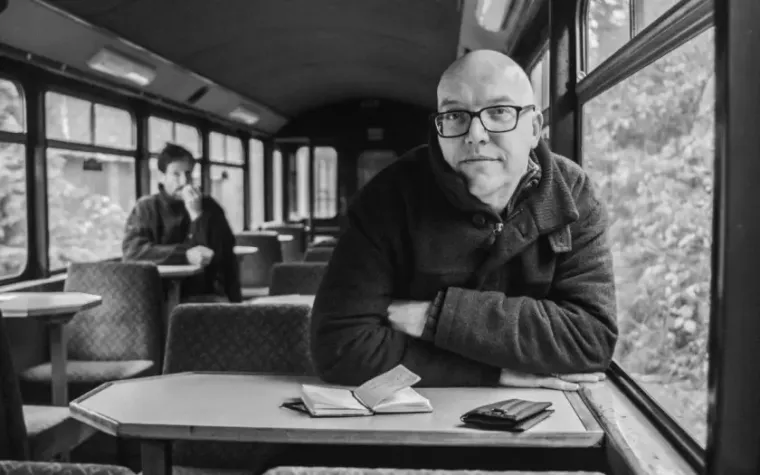
One of my colleagues at LR Towers lent me a book, saying it’s an interesting take on the trainspotter hobby that doesn’t fall into traditional genres. It’s part memoir, part travelogue, part punk music history, part railway history, part railway culture.
The book is Ian Marchant’s Parallel Lines, or Journeys on the Railway of Dreams (2003), sadly out of print. In particular I was intrigued in his classification of UK rail enthusiasts, and started writing about it. The same friend just told me that the author had passed away. So as a tribute to him and his writing, we offer this post.
Marchant wrote other books, on the longest pub crawl in the UK, night time, and other subjects, as well as two novels, several short stories, and newspaper articles. He made programmes for BBC Radio and for UK regional television, and was a Lecturer in Creative Writing in the School of English at Birmingham City University.
Here is an excerpt from his Parallel Lines, or Journeys on the Railway of Dreams (2003):
“In railway enthusiasm, as in everything else in human existence, there is a hierarchy, or a series of hierarchies. At the bottom you have ‘the rivet counters’. These gentlemen are the ones who are most likely to want all the numbers. They know every detail of their favourite engines down to the last nut and bolt. They konw, in short, just how many rivets there are in Mallard. ‘Rivet counter’ is a pejorative phrase in the world of the spotter, applied to anyone who is prone to be over-zealous on the technical details of any railway-related subject, whether they count or not. According to spotters, it is the rivet counters who have given them a bad name. Who do the rivet counters look down on? Bus enthusiasts.
“Next up on the heap you have your common-or-garden railway enthusiast. He likes watching the trains go by. He takes photos of the trains, and has a camcorder to film them too. He probably likes steam trains more than diesels, and diesels more than modern trains. He is most likely to be over forty. He goes on steam excursions at the weekend and may work as a volunteer on one of the restored lines. If he is dedicated, he might work his way up to become a drive of steam trains on his chosen line. Almost certainly, he is a modeller, or has at least had a go at one time or another. Although he will always note down the engine details of any train he is travelling on, he is unlikely to be slavish about the numbers thing.
“At the top of the tree, you have the bashers… They are secretive men, bashers, like Masons up to the thirty-third degree.
“But then you have the line basher, who is trying to travel over every inch of the system. You see him travelling around, incomprehensible railway atlas on his lap, crossing off all the lines he has covered in a particular day, or in a lifetime. Intimacy with the timetables is the line basher’s ruling vice. And then there are the stop-watch bashers. Armed with stop-watches, calculators and even, these days, satellite positioning equipment, the stop-watch basher leans eagerly from the window, counting wayside markers, working out how fast the train is going, where it is, and how much work it is doing. To them, what they do is serious research. They have a club, the Railway Performance Society, whose members sit on trains making the TOCs’ lives a misery by subjecting them to a permanent amateur time-and-motion study. If you called a stop-watch basher a trainspotter, he would be deeply offended. That is child’s play; this is the business of a man.”
Some parts of his observations are obviously dated – on age, gender, and technology. People under 40 are unlikely to have the space for a model train layout at all, so tend to buy and play computer train operating simulations, which offer a much wider variety of engineer experiences all over the world. Bashers now use SatNav equipped phones which provide instant speed and location measuring.
Here is another excerpt from his Parallel Lines:
“Trains are masculine; the engines are never referred to as ’she’.”
Marchant was also a BBC Radio show host, one of his railway theme shows being Ian Marchant Presents… ‘The Ghost Trains of Old England’ (Radio 4 – 27.10.2010).
The ubiquitous Geoff Marshall initiated his interview series of people covering the UK’s railways by interviewing Marchant in 2018. It was the interviewee who suggested Marshall call this series ‘Choo Choo Chat’, which he quickly did. Ian Marchant Railway Author – Interview Chat (No.1).
Marshall then featured Marchant again five years later as part of his ‘Choo Choo Chat’ series, except that Marchant this time suggested turning the tables and and he interview Marshall, in Geoff Marshall with Ian Marchant – Interview Chat (No.8).
Marchant’s writing is like a really interesting conversation, you’re not quite sure where it’s going, and it takes some tangents, but it’s fascinating journey. We are blessed to have been witness to a life well lived on the rails.
