
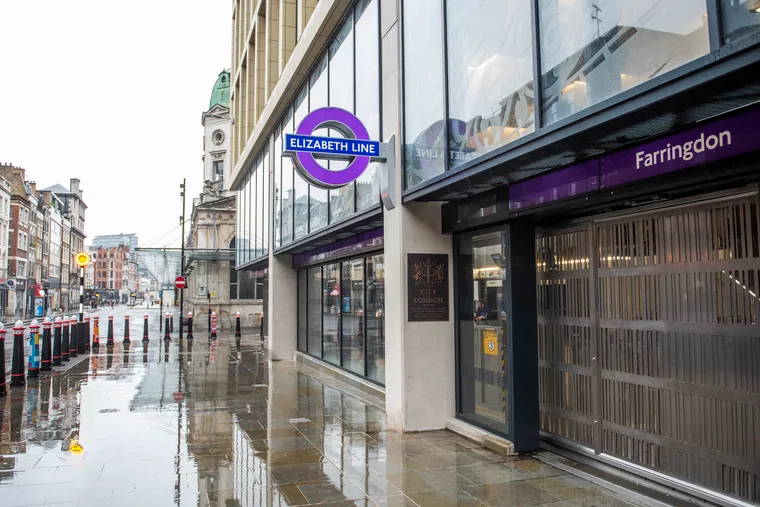
Unsurprisingly, the subject of Crossrail/Elizabeth line opening dates is a hot topic in the transport community at the moment. In this article, we address that big purple elephant in the room.
The truth is that Crossrail’s opening date (Or the Elizabeth line, as it is finally becoming) is currently a moveable feast.
This isn’t something for TfL or prospective passengers to panic about. We are long past the point where it became a question of when it would open, not if. It’s simply that opening an entire new railway, of Crossrail’s scale, is a complex series of interconnected events.
Before we explore how those events will play out, and outline the remaining challenges, it is only fair to readers who care mostly about the headline date to get that information out of the way first:
There are currently two target dates for the Elizabeth line’s possible opening, from TfL’s perspective. One is in May (and will be very obvious to anyone with a passing familiarity with how UK railway timetables and Network Rail work in the UK) and one is in June. Ignore anyone telling you that either of those dates is confirmed for opening (officially or internally). If it had been, we’d be printing it here.
That we’re not is precisely because TfL themselves have yet to decide when to open it. “It opens when it opens” may have been a frustrating message to hear from those of us keen to use it, but it’s also true. As both TfL and Crossrail have made repeatedly clear, the railway needs to be reliable before it can open.
This was something that Mark Wild, Crossrail’s CEO, emphasised in a personal LinkedIn update on 25th April:
“As we countdown to opening the new railway in the first half of this year we are diligently completing the complex safety approvals and also building reliability through continuous timetable running.”
The key phrase in the sentence above is continuous timetable running. It’s this that dictates just when a move to prepare for an opening date will begin (we’ll talk a little bit about what to watch for there in a bit).

The opening Elizabeth line operational timetable is somewhat TBA, but whatever level of service operates at launch will drastically exceed the 5tph service on the last full line that TfL opened (the East London Line on the Overground). Complexity in railway operation doesn’t scale linearly, it scales exponentially, and this means there remain challenges around working out what the best balance of stability vs launch service on the Elizabeth line.
Most of these relate to the two systems that have proven most problematic to Crossrail’s construction and fit-out since the start: Train software and signalling.
The line will have a solid claim to be the first “fully digital” railway, at least at its scale, in the world. And that’s meant Siemens and Bombardier (or rather Alstom now), as signalling and rolling stock manufacturers respectively, moving from worlds where they were dealing with mature, physical setups to a new way of working and testing. With hindsight, how these interface with each other on a digital level has proven considerably more complex than any of those involved in the project expected to be (although exactly as complex as the software industry would have told them to expect, but that’s a discussion for another day) and time consuming to get right.
The good news here is that both are now at a point where the remaining issues aren’t launch blockers. They’re things that impact reliability or operational style, and thus possible level of service at launch. On the train side, for example, 69 of 70 units have now been accepted by TfL. The remaining unit (018) is the telemetry train which will need refitting first. Of those 69, 68 have been used in passenger service so far. Unit swaps for servicing between the East and West sections of the line, via the core, have also been running without issue for some time.

All this means that, in terms of train reliability, things are near where TfL need them to be, with the latest train software update over the long Easter weekend hopefully improving reliability further (as previous updates have done) and pushing overall reliability above levels targeted for opening. They need to allow for ongoing refits (primarily from 7-9 car, four of which are currently underway), but on an engineering level the fleet seems to be performing how they need it to perform.
On a signalling side, however, some uncertainty still remains. Again, it’s important to stress that this is no longer a blocker to launch. It’s simply a limiter on initial service. And the longer TfL go without opening the railway, the more they can do to increase that limit quickly. This is because it’s obviously far easier to make improvements to a railway that isn’t in passenger operation than it is to an open one.
The signalling issues that remain are a mix of software, communication issues (spotty coverage and/or electrical interference from older systems), and interface issues with non-core infrastructure. A big software patch over Easter was aimed at ironing many of these out at a software level, following on from a similar big patching exercise earlier in the year that proved successful. The Easter push, however, was not expected to fix them all. The question is more, at this stage, whether it’s worth holding back for one major push on software before officially opening, or whether the gain from doing so would be less than simply opening and dealing with these issues through minor patches later.
Almost all of the remaining issues fall into this category: they’re about service level and reliability, not blockers to launch. LR understands, for example, that auto-turnback at Paddington remains off-the-table in the current software. This is a problem, as it’s not possible to run more than 22tph through the core without it. But at the same time, having the facility for this level of frequency wasn't expected until September, with the December 2022 timetable change planned for operation. Opening now may mean this doesn’t become possible until early 2023, as it’ll limit the ability to push and test changes, but at the same time there’s no guarantee that holding back on launch a bit longer would solve this problem any quicker. The only true blocker is a late-diagnosed issue with the emergency service radio systems, which needs to be fixed before the London Fire Brigade will accept the system into service, but this is seen as solvable.

Alongside all this, the stations that can open are now all ready to open. We always treated with suspicion suggestions that Bond Street (Which remains a thorn in the project’s side) could partially open at launch, and sources suggest that this has now been fully accepted by TfL and Crossrail themselves. Bond Street will be evacuation-only at launch, and open fully later. This will be true regardless of a May or June opening.


Hopefully, all the above has given you a good idea as to the current status of the Elizabeth-Line-To-Be. TfL and Crossrail are, mostly, at their “stick or twist?” moment. It’s about calculating whether the level of reliability and service they already think they can deliver (based on testing) is appropriate for launch, or whether there are tangible benefits to giving those involved a bit more time to work on software and signalling passenger-free.


We say mostly, of course, because there is one final thing - entirely outside TfL’s control - that plays a factor in the line’s opening: COVID rates.
Whilst the government seems to have largely decided that COVID is no longer a national issue, the data and reality is unfortunately the opposite. Current ONS case rates remain high, and this is having a visible impact on staff availability in businesses and organisations across the country. TfL is no different. One wildcard on the Elizabeth line’s opening thus remains staff availability. If there aren’t enough staff available, the line can’t open. There are no signs that currently TfL expects this to be an issue, but the situation may change with little warning.
So, if we accept that the line is almost ready to go, then what should people watch for in terms of signs that it’s about to happen?
Here, the important thing to remember is that opening is a series of interconnected events that, once started, can’t easily be stopped. Think of the Elizabeth line’s opening as more like a rocket launch than a ribbon cutting exercise.
Indeed one reason we know the opening is close at all is that many of the steps that, for purely logistical reasons, have to start about six weeks out have already begun. Signs are being unveiled in stations. Entrances and interchange passageways cleared and prepped. These are the things that are required for opening, but can (and should) be done as far in advance as possible.

Beyond that it’s probably best to think of the Crossrail (the project) to Elizabeth line (open railway) transition as being on a two-week timer. Once the decision is made, it’ll take two weeks to move through the various steps required to be ready to receive passengers, and leave sufficient time between that and the official end of testing, the last stable software patch and the rest. This also allows for finalising operational approval with the ORR. LR understands that neither the ORR or TfL anticipate any issues with this. Inspections that can be done already have been done, paperwork pre-submitted. It’s mostly a case of reviewing any iterations and getting the final stamp of approval.
It doesn’t take a lot of mathematical work, therefore, to work out when we should know something. So, putting our Gandalf hat and beards on, we will say this:
On the fifth day (of this week): look to the East. If the Elizabeth Line is opening in May, then the signs (in some cases, quite literally) will emerge then. If not, then you can apply the same logic to the available weekends in June.
Until then, treat any announcements of an opening date on social media or elsewhere with a pinch of salt.
London Reconnections is entirely supported by its community. If you like what we write and what we share, then please consider joining our Patreon. Every little helps!
