
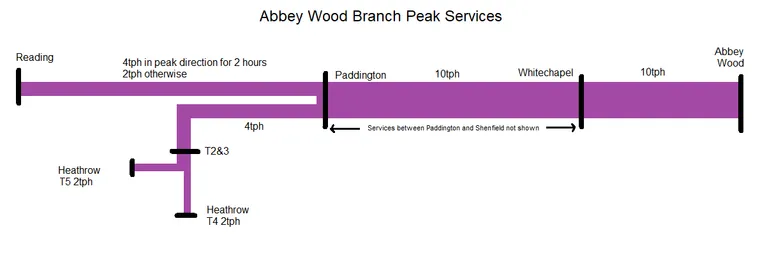
TfL fairly recently issued a press release announcing daily through running on the Elizabeth line from Sunday 6th November 2022. This was not a surprise as a combination of leaks and intelligent guesswork based on dates of planned engineering work means that it was expected - but perhaps no-one was expecting it to be announced so soon.
Even more surprising is that the new timetable for Elizabeth line trains from November 6th was already present on the National Rail website as well as, slightly less surprisingly, the Open Train Times website. Until now it had been impossible to predict with any certainty the service planned to be provided but we can now see what will be running in early November.
Whilst this next stage in opening is undoubtedly a good thing, the press release, inevitably, emphasises the positive and minimises the negative so there is more than initially meets the eye with the new service. So, without wishing to detract from this encouraging new phase of the Elizabeth line opening, we look at some of the rather messy aspects of the timetable and what has caused this.
This was never the plan – until recently
You may have lost track of the revised plans for Crossrail implementation that still keep coming. Certainly, nowhere in any public plan until this May was there any suggestion that Crossrail would initially only be running six days-a-week. And, until fairly recently, Crossrail (and its successors) were adamant that it needed to be opened in incremental stages. The next stage (Stage 4 on the original proposals) would have been through running between Shenfield and Paddington with services from west of Paddington continuing to terminate at Paddington. This was originally deemed as essential, as trying to do too much in one go would clearly lead to problems.
The National Timetable issue
A major potential problem dominating Crossrail’s planned sequence of opening was the perceived need to change timetables impacting on the National Rail network on one of the two dates in the year (one in May, the other in December) when the national timetable changed. Clearly, opening only between Paddington and Abbey Wood wasn’t an issue as that section of the railway was self-contained. However, it was originally claimed that it was not possible to implement though running on either the Shenfield branch or west of Paddington unless it coincided with a national timetable change.
A bit of extra thought should make it clear that requiring synchronisation with the National Timetable change is unduly restrictive. If the trains run in existing timings west of Paddington and east of Pudding Mill Lane portal (east of Liverpool St where trains enter the Crossrail tunnels) then, in principle, there should be no problem in choosing any date to implement Crossrail through running.
In fact, one could be more flexible – a lot more flexible – than that
On the eastern side, the twin tracks almost exclusively reserved for Crossrail (known as ‘the electric lines’ for historical reasons) were normally only additionally used by a limited number of freight trains. These freight trains operate outside peak hours. However, since the North London Line was electrified, it has been operationally more convenient and sensible to run most freight workings on the fast lines, which means that Crossrail is largely unaffected by freight considerations. Indeed, nowadays the only scheduled freight paths on the electric lines are between 2315 and 0545. And remember that a freight path doesn't mean that a freight train will actually run. It only means there is a 'slot' in the timetable in case one does run.
Despite the freedom from operational constrictions, the Crossrail timings in the November 6th off-peak timings east of Stratford are identical to those in the current (September 5th) timetable. Quite probably there was a desire not to needlessly alter these timings as existing passengers would be familiar with them.
West of Paddington, Crossrail uses the ‘relief lines’. Any other railway would call them the slow lines but the original Great Western Railway always had to be different in almost everything they did. Apart from Crossrail, the only other passenger trains that use these lines are the half-hourly GWR Didcot – Paddington semi-fast trains. Proposals to reinstate some peak-workings of these train have been put back because of post-Covid reduced demand.
There are also a number of off-peak freight trains west of Paddington on the relief lines. Typically, these originate at Mendip Quarry and terminate at Acton Yard before returning empty. Fortunately, the entrance to the yard is now grade separated as Acton Dive Under was constructed as part of the Crossrail project which eliminates conflicting flows. Unfortunately, the turnout at the junction is probably less than line speed for main route so this junction would still have some limited adverse effect on interworking with passenger trains.
Whilst freight trains do run to a nominal timetable, a few minutes adjustment here and there is generally not critical. In the up direction (towards Paddington) there is a freight loop between Iver and West Drayton which gives some additional flexibility.
Why introduce through running East and West at the same time?
What the above does not explain is why there is a need to commence through running on both the western and eastern sides at the same time. To understand why one must look at a little-publicised but fairly significant problem on the Elizabeth line and understand why it is such a big deal.
Modern Railways spills the beans
Concerns at LR Towers were first raised when reading an absolutely excellent one-off publication called Crossrail – London’s New Railway, published by the team that writes and publishes Modern Railways shortly before the railway opening date (and sadly seems no longer to be available). This has a considerable amount of insight and was clearly written with the co-operation of senior TfL staff who were interviewed. To a large extent, the publication seems to be toeing the TfL line, although we couldn’t help notice it used ‘Crossrail' in the title, not 'Elizabeth’!
It was in this publication that we first officially read that Auto-Reverse turn back functionality west of Paddington was not yet working sufficiently satisfactorily to be in implemented on the live railway. Not only that, it would not even be ready for the next stage of Crossrail as originally proposed. This was the original Stage 4, Stage 3 being the opening between Paddington and Abbey Wood. Stage 4 would implement Shenfield to Paddington (and nothing else). The problem was that this would require 24tph reversing at Paddington. This was supposed to be just not possible without an auto-reverse feature that would enable the trains to immediately reverse in the sidings whilst the driver walked down the train to take his or her position at the other end.
In the Modern Railways publication, the lack of Auto-Reverse was presented, rather emphatically, as no big deal even though it was admitted it would mean that an absolute maximum of 22tph could be achieved in the central section without it. More careful reading made it clear that even that 22tph depended on running all trains to the west of Paddington being through trains, to reduce the need to terminate trains at Paddington (Low Level).
In the article based on an interview with Howard Smith (Elizabeth line Chief Operating Officer) it is very tactfully suggested that running 22tph, rather than wait for full Auto-Reverse, was ‘an entirely sensible trade off’. We are not disputing this, but feel that it rather underplays the impact of not being able to run 24tph on the next phase of opening, and this does seem to be a major disappointment that has received very little publicity. Even the regular Modern Railways monthly publication seems not to think it worthy of pointing this out to their readers. Lack of Auto-Reverse also has another downside but it is not one visible to the public. The trains effectively have to queue up to reverse, and every now and again a through running train allows the queue to be cleared before another train arrives. Clearly running 22tph, of which 14tph terminate, is going to lead to a short queue at times, so an expensive train and driver is being unproductive.
The need to introduce through running in one go
If you don’t have Auto-Reverse in operation then a crucial question is ‘how many trains can you reverse in an hour at Paddington?’ This question is so critical that it is one of the reasons why Crossrail has still been closed on Sundays. One reason was that it was necessary to test out whether even a 22tph timetable could be run.
Obviously, we know that 12tph reversing at Paddington can be done because that is what happens now. It looks like 15tph was considered not possible, as the original plan was to have a 15tph Abbey Wood – Paddington service. However, this could have been because of problems terminating at 15tph at Abbey Wood and at present, with a 12tph service, trains can sometimes wait at Abbey Wood for a platform to be available, despite the simple and reliable train-every-5-minutes service.
Could 14tph terminating at Paddington (Low Level) be achieved?
The simple answer is ‘we don’t know’, although it could well be the case that this is known within Crossrail management. If you could terminate (and turn round) 14 trains per hour at Paddington and run 8tph through to destinations in the west (Heathrow and Reading) then you could run a true 22tph peak service on Crossrail. In practice, despite what is claimed by the Commissioner downwards (such as on this August video update) what is really being offered is a 20tph service with enhancements. We can be fairly sure that is possible because that is what they are confident they can introduce in November.
Is an alternative plan possible?
With no Auto-Reverse at Paddington, the original plan for Stage 4 to introduce through running from Shenfield to Paddington is just not possible - as you need to terminate 24tph at Paddington and only 12tph is possible – maybe slightly more but only slightly more.
One then wonders, why one does not introduce through running beyond Paddington westwards first? This would seem undesirable because you would be restricted to 12tph on the central section in London, because that is probably all you can terminate at Abbey Wood. At the same time, you would be increasing demand in the central section without providing more trains.
Introducing through running only west of Paddington would appear to have been possible and we do wonder to what extent that had been considered. This would certainly have been welcomed by some passengers such as those with large luggage travelling to or from Heathrow. It is unlikely that it could have been introduced without some timetable issues resulting in trains travelling west of Paddington having to wait either on approach to Paddington or after leaving Paddington - or both. This would disadvantage would seriously offset the benefit of providing a through service.
Just introducing through running beyond Paddington to the west surely could have been done, but it is arguable whether it really would have been beneficial if you still only run 12tph through central London. By way of contrast, introducing through running at both ends has real advantages – it enables a through service from Shenfield to Paddington to be introduced, and also enables at least 20tph in the peaks (and 16tph outside the peaks) in the central section.
Why not ‘Step Back’?
A puzzle with the consequences of the lack of Auto-Reverse is why not just have drivers ‘stepping back’ ie take the following train out so that trains can leave the sidings quicker. This is often implemented on the Underground (and some main line termini) in order to maintain a high frequency service. We don’t know the answer but we do know that stepping back introduces horrible complications and reliability issues, so it is avoided if possible. And, fairly obviously, it requires more drivers which is a problem either of expense or because you simply do not have the additional drivers.
No nice neat timetable
One thing that is so good about Crossrail at present is its absolutely regular 5 minute interval service. Except in cases of disruption (usually a train malfunctioning), it is a metronome regular service with a clearly defined interval between trains. The final timetable should be similarly regular, but this is next to impossible when you introduce 22tph and at the same time stick to existing frequencies on National Rail tracks.

It is only now becoming apparent how messy this would be. Whilst the majority of passengers won’t even notice, for some it will be extremely frustrating. In particular, it will cause two problems.
The Even Branches issue

The first and more obvious issue with running only 22tph in the peaks is that you have two eastern branches. You can’t run easily 11tph on each branch because you are trying to stick to even intervals as much as possible. Besides, passenger levels have generally recovered well on the Liverpool St – Shenfield line so you don’t want to reduce the level of service from 12tph in the evening peak and slightly more in the morning peak.
The actual solution
Despite what is publicly claimed, there will not be a proper 22tph service on Crossrail at the next timetable change. Basically, 22tph does not work well but 20tph does. So, quite cleverly, there is a 20tph peak service with some supplemental trains on the Shenfield branch. These exist in two forms:
- Supplemental peak trains to or from Liverpool St Main Line station.
- Extra trains squeezed into the timetable in one direction.
We shall look at these two options in detail.
Supplemental trains to Liverpool Street Main Line station
In the morning peak there will be two trains starting from Gidea Park (at 0743 and 0813) that will terminate at Liverpool Street platform 17. There is no return working. This is little different from today where there are two trains starting at Gidea Park at 0800 and 0827, whereas all the other peak hour trains start from Shenfield.

In the evening peak there will be also be two trains serving Liverpool Street main line station platform 17. These depart at 17.35 and 18.04.
Some readers may remember that, many years ago, the plan was to supplement the peak service on the Shenfield branch with 6tph in the peak direction only between Gidea Park and Liverpool Street main line. This then was reduced to 4tph. These extra trains were necessitated by the demand on the line to Shenfield, and an inability for Crossrail to cater for it once it was decided to build a branch to Abbey Wood (originally onward to Ebbsfleet). Covid and subsequent reduced demand has almost put an end to the need for these extra services which were never liked by the Crossrail team.
Longer term we suspect these supplementary trains will disappear. If demand does return on this branch, there will probably also be similar increased demand on the Abbey Wood branch. So any solution will be based on increasing the core frequency to both branches. It is possible that this could be achieved with fewer trains out of service for maintenance, but more likely that extra stock would have to be leased should this situation arise in the future.

It is worth noting that we could also see Crossrail trains serving Liverpool Street Main Line station at times of disruption. As well as that, some late evening services will continue to terminate at Liverpool Street Main Line station. In a similar way, some late evening services will terminate at Paddington Main Line station.
‘Push Through’ trains in the timetable
Crossrail has improved the 20tph service in the central section in the November timetable by introducing ‘push through’ trains. This is a concept often used on the Underground. The idea is you run the trains at the maximum sustainable frequency, then see if you can supplement the ‘peak of the peak’ by squeezing an extra train in. This involves adjusting timing of trains prior and after the ‘push through’ train before returning to regular timings.
Typical features of the ‘push through’ train are:
- It only makes one journey and only in one direction.
- It starts and ends at a depot or siding (so as not to block up terminal platform space).
- Often, but not always, it only operates in the more intensive morning peak.
A classic example is on the Northern line where to alleviate the busy section down to Morden, there is a morning-only extra train via Bank. This allows London Underground to claim that they run 31tph on the southern section in the peak – but it is only the morning peak and only in one direction.
The Crossrail November timetable appears to have two ‘push through’ trains in the morning from Shenfield to Paddington. These probably continue to the depot at Old Oak Common. In the evening there seems to be two ‘push throughs' in the reverse direction which probably continue to the Shenfield sidings.
These extra trains result in the claimed 22tph in the peaks but it is a matter of interpretation as to whether you consider this to really be 22tph. What, to us, is much more impressive is just how long Crossrail sustains 20tph in the peak in both directions.
Between 07.00 and 10.00 in the morning peak Abbey Wood has a train arriving and departing consistently every six minutes. Gidea Park has slightly more frequent but erratic service to London from roughly 06.30 to 09.30 with trains never more than six minutes apart. In the evening peak there is 10tph to Abbey Wood between 16.00 and 20.00 (arrival time at Abbey Wood), with just the occasional train arriving a minute earlier or a minute later than a regular six minute interval would provide. Again, Gidea Park has a slightly more frequent but erratic service from London between 16.00 and 19.45. So the evening peak is sustained for roughly four hours.
The ‘Wait Outside Paddington’ Issue
The press release ‘Notes for Editors’ for these improved Crossrail services rather disingenuously states that:
To regulate services coming into Paddington some trains may be held outside Paddington station for a few minutes before being routed into the tunnels. This is factored into timetables and will be announced to customers.
The ‘few minutes’ is not trivial. It might be true it is only three or four minutes but, if so, will be combined with trains travelling slower than necessary and seems to be typically more like 6 or 7 minutes. This seems excessive but the problem is that a train (on existing timings) has to wait until it can take the path of an Abbey Wood train. In the peaks, the worst case scenario is 5 minutes (12tph) but off-peak this could be up to 7½ minutes. Furthermore, one suspects the planners want to build in some contingency in any case because they don’t want a train that is a minute or two late messing up the service in the central London section.
No mention is made of any delay leaving Paddington, but there is an inconsistency in the time for Elizabeth trains not stopping at Acton Main Line to reach Ealing Broadway. So one suspects there may be some slowing down of trains to adhere to the timetable with the hope that passengers won’t notice too much.
Hopefully, there will be some limited ability in the national December timetable change to remove some of the dead time. National Rail timings could be tweaked and the contingency, which sometimes seems excessive, reduced to something less onerous. If the timetable is tweaked in December, then we will only have to live with the delays for 5 weeks which would seem quite sensible in ensuring a smooth introduction.
Off Peak Services
For completeness, we have added diagrams for off-peak services. From Monday 7th November these will be based on an 8tph pattern on the Abbey Wood and Shenfield branches but in May next year these will improve and be on a 10tph pattern as previously envisaged. However, Sunday is different with only 4tph on each branch before 10.00 and after 19.00. During these times of reduced frequency Elizabeth line trains to from Reading will terminate at and start from Paddington Main Line station (platform 12 or platform 14).
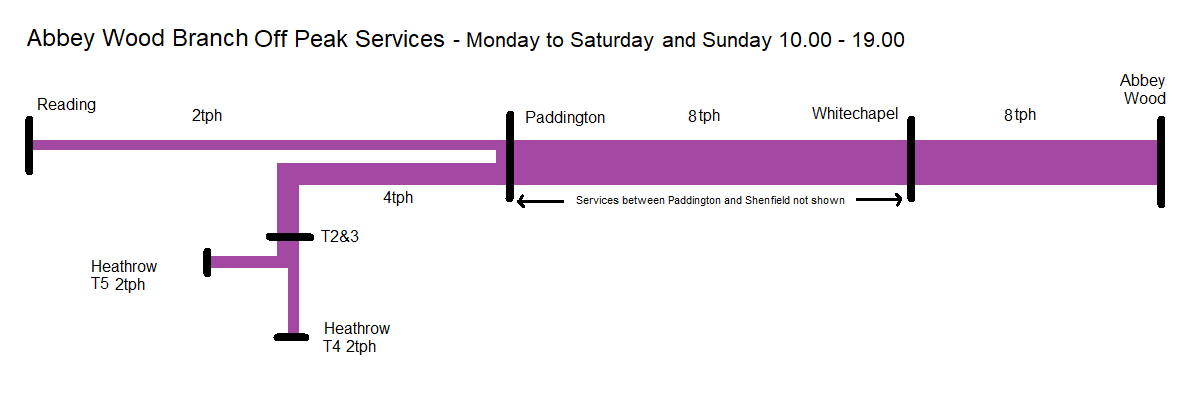
The Shenfield branch off-peak Mondays to Saturdays will have a simple regular interval timetable with identical timings as now.

On the Shenfield branch the Sunday service is reduced in the early morning and evenings in a similar way to the Abbey Wood branch. These frequencies on each branch have to tie with each other to give a consistent interval in the central section. Note that this means that on Sundays before 10.00 and after 19.00 there will be only 8tph (a train every 7½ minutes) in the central section between Paddington and Whitechapel.

Ongoing issues with no Auto-Reverse
Although the Modern Railways publication mentioned earlier suggested that the issue with the Auto-Reverse feature was down to more important signalling issues to resolve, anything that involves signalling that isn’t demonstrable as working is a concern. The extended saga of Crossrail signalling problems in the Heathrow Tunnels (now resolved by removing the old troublesome signalling) shows that one must never take unproven new signalling technology for granted.
Will this hinder plans for May 2023? Superficially, no because there is expected to be 4tph extra in the peaks west of Paddington, meaning the number of trains needing to terminate at Paddington will be the same (12tph) even though there will then be a 24tph service in the centre section. Off-peak there will be 20tph service, but with 10tph going west from Paddington there will be an easily manageable 10tph terminating at Paddington.
What may be a problem is recovering from service disruption if one can only terminate 14tph at Paddington. This alone should be of sufficient importance to ensure development of Auto-Reverse continues. In the very long term, the problem should disappear as normal reversing of trains at Paddington will be eliminated and the process transferred to the new interchange at Old Oak Common which is currently being built. If any plans develop in future to run more than 24tph on the Elizabeth line, Auto-Reverse will be essential.
Looking forward to May 2023
Whilst the Elizabeth line service from November 6th will be a considerable improvement, there are still further tweaks that need to be made. Service of 24tph needs to be properly implemented. Ideally, peak services into and out of Liverpool Street Main Line should be eliminated. Late night terminating into Paddington and Liverpool Street station needs to be at least reduced but preferably eliminated. Delays outside Paddington for trains to Heathrow and Reading need to be eliminated. This will probably involve some off-peak trains from the west terminating at Shenfield rather than Abbey Wood – which was the original plan.
The November 2022 timetable will bring considerable improvements but what could be regarded as the final phase of Crossrail implementation will not happen until May 2023. Even after that we expect to see some minor improvements. These will, perhaps, be discussed at another time. There is still scope for making things better still. In November 2022, Crossrail will seem almost complete and in May 2023 it will have the feeling of being fully implemented.
