
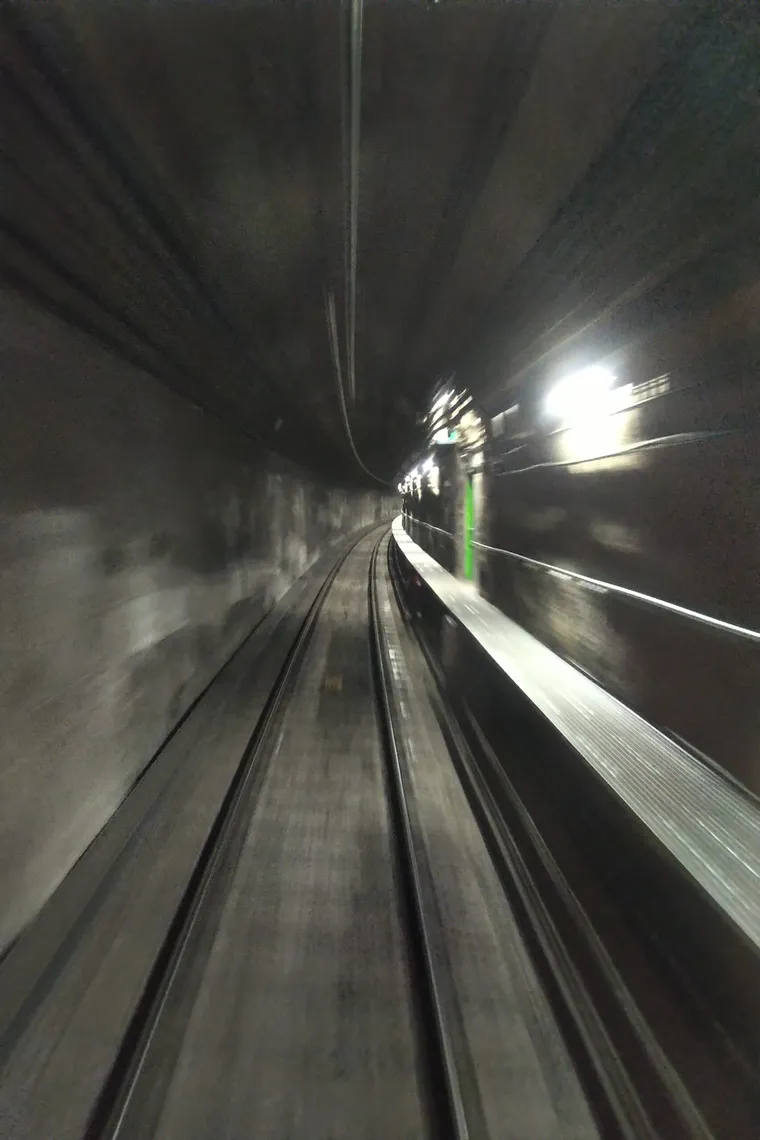
Montréal’s Réseau express métropolitain (REM) is becoming known for its automated metro operation, and its extensive reuse of existing railway and highway infrastructure. We look at how the opening of the next branch of this system completes part of the city’s original Métro network plans from 60 years before – as well as how the REM and Métro networks complement each other, and the commuter rail network.
Whilst Montréal and Québec City have distinct Francophone identities, they exist within the larger North American Anglosphere of public transport and civil engineering industry. We had already covered the Mont-Royal Tunnel repair and upgrading work in 2022, which was more extensive than initially scoped. The delays unfortunately continued, but the opening of initial A1 Brossard branch proved the REM automated metro concept.
We now cover the opening of the next branch to Deux-Montagnes, with 12 upgraded and two new stations. This is the largest increase in Montréal’s rapid transit network since the original Métro system opened three lines in 1968.
Métro Lines 1, 2, and 4 – what gives?
Montréal, and the province of Québec, had been profoundly Catholic since the French colony’s founding in 1608. This societal structure had by most accounts limited Québec’s commercial growth. By the 1960s, however, modernisation was coming to Montréal, notably in the form of a World’s Fair in 1967, on the centenary of Canada’s formation. This exhibition would expedite construction of the planned new Métro network to move millions of visitors around the city.
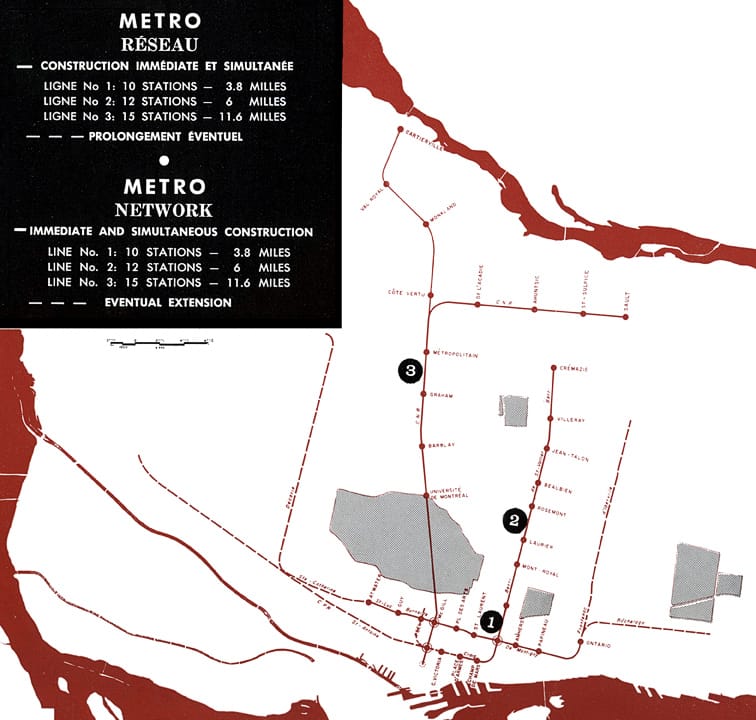
The original plan for the modern Métro network was presented to the public in October 1961, consisting of three lines: Line 1 (Green) running east-west, Line 2 (Orange) running north-south in a large U shape, and Line 3 (Red) running under Mont-Royal, taking over the Deux-Montagnes commuter railway tunnel and alignment.
In November 1962, however, Montréal won its bid to host the 1967 World’s Fair, with the theme Terre des Hommes (Man and his World). It was hosted on man-made islands in the St Laurence River, made of piled river dredged rocks and mud, plus spoil from Métro, highway tunnel, and skyscraper foundation excavation.
To accommodate the tens of thousands of daily visitors, it was wisely decided to have visitors be transported to the exhibition site, by a new Métro line 4 (Yellow), between the main island of Montréal and the south shore. As a result, Line 3 was shelved, and was in a few years removed entirely from the Métro network expansion plans.
However, Line 3 is now reappearing, under a different guise and on a different network.
By the time the World’s Fair opened, the Métro network consisted of three lines, 1, 2, and 4. A decade later this was still the case, and this non-consecutive numbering had many Anglo Montréalers recalling the following scene from the 1975 film Monty Python and the Holy Grail:
Arthur: Right! [removes the Holy Pin] One!... Two!... FIVE!
Galahad: Three, sir.
Arthur: THREE!”
This is a delicious irony, but the real story is not about upper class twits, but changing priorities in a modern metropolis.
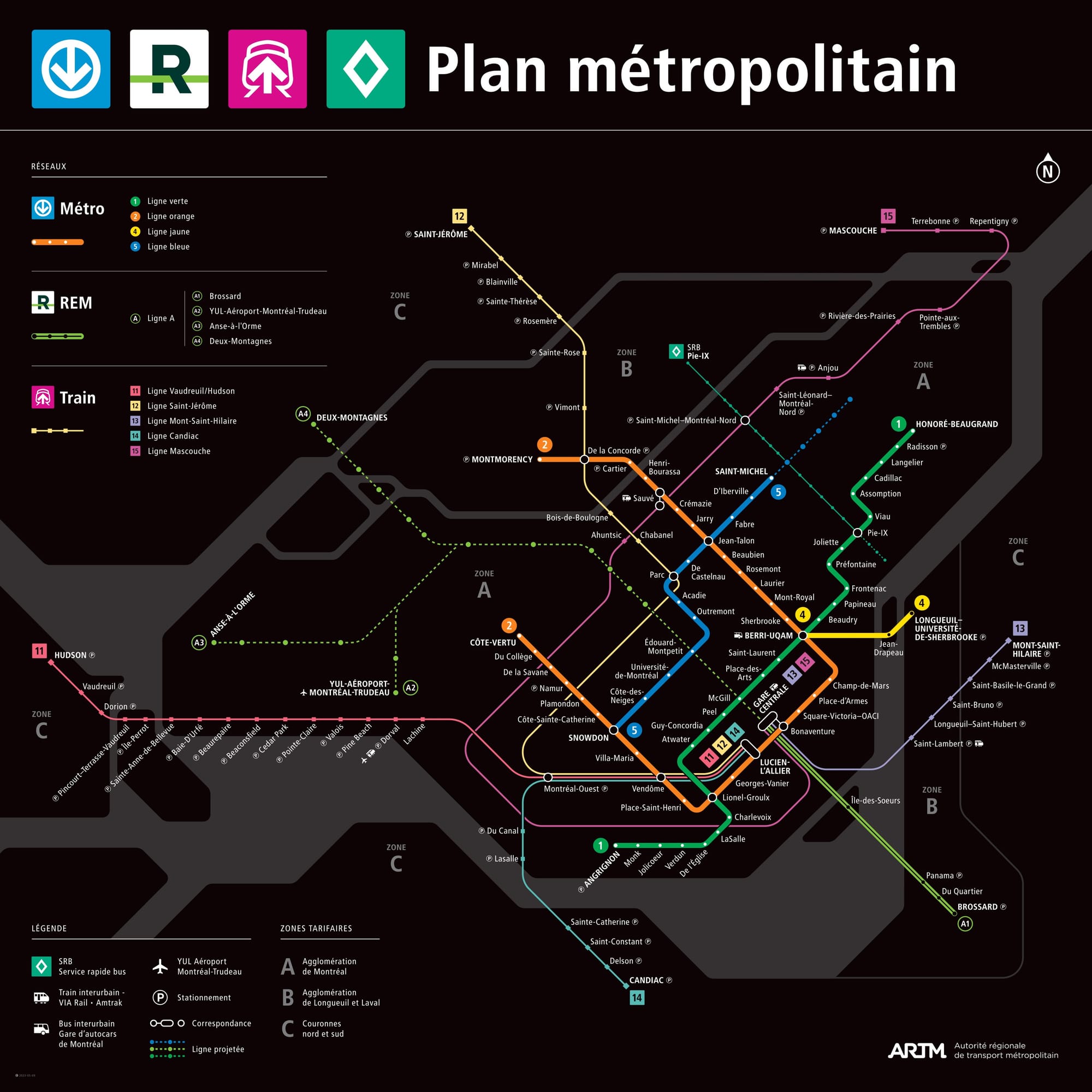
As of 2023, this is how the Montreal region's rapid transit lines had evolved to:
A4 Deux-Montagnes branch
The Deux Montagnes line was originally an electrified commuter rail line which opened in 1918, which was last operated by exo, the name of the region's commuter rail services (as well as buses in the southern and northern suburbs). By the 2010s, the line had hourly service for most of the day, but not quite on a clock face schedule. Along with occasional use of the Mont-Royal tunnel by exo Line 15 to and from Mascouche, and a few VIA Rail trains per week, this railway line and its tunnel were still under-utilised. It has now been converted to a modern metro line, operating unattended using GoA4 (grade of automation level 4) from REM (Réseau Express Métropolitain, the operators). In doing so, this new A4 branch has finally given Montréal its long-planned Line 3, the culmination of the original 1961 Métro plan a mere 64 years later.
North of the Ville-de-Mont-Royal station, the exo commuter rail stations had been basically halts, with occasional small bus shelters on downtown bound platforms. These stations have been rebuilt to the same large, glass-enclosed REM standard of the initial A1 Brossard branch, to protect waiting passengers from the elements. This is intended to encourage transit oriented development (TOD) around its stations, but that depends on zoning changes, and there are NIMBYs lurking in banlieux/suburbs everywhere.
However, the most difficult part of this railway upgrade was the conversion of the Mont-Royal tunnel from a century old blasted rock path that saw at most four trains an hour to a modern and safe urban railway corridor with trains up to every 90 seconds, carrying far more passengers.
It describes the salt damage on the original tunnel concrete walls and vaults, which rendered them much weaker than expected. This necessitated more extensive repair work than initially estimated to ensure structural stability. The existing concrete vault at the south end of the tunnel was in too poor a condition to be repaired. An umbrella arch was built to replace it, reinforced with galvanized steel.
Construction of the project is undertaken by NouvLR, the engineering and construction consortium composed of AtkinsRéalis, Dragados Canada, Group Aucon Québec, and EBC. They removed all the existing commuter and mainline train infrastructure in the tunnel, including the tracks, sleepers, and ballast, then started implementing the new plans.
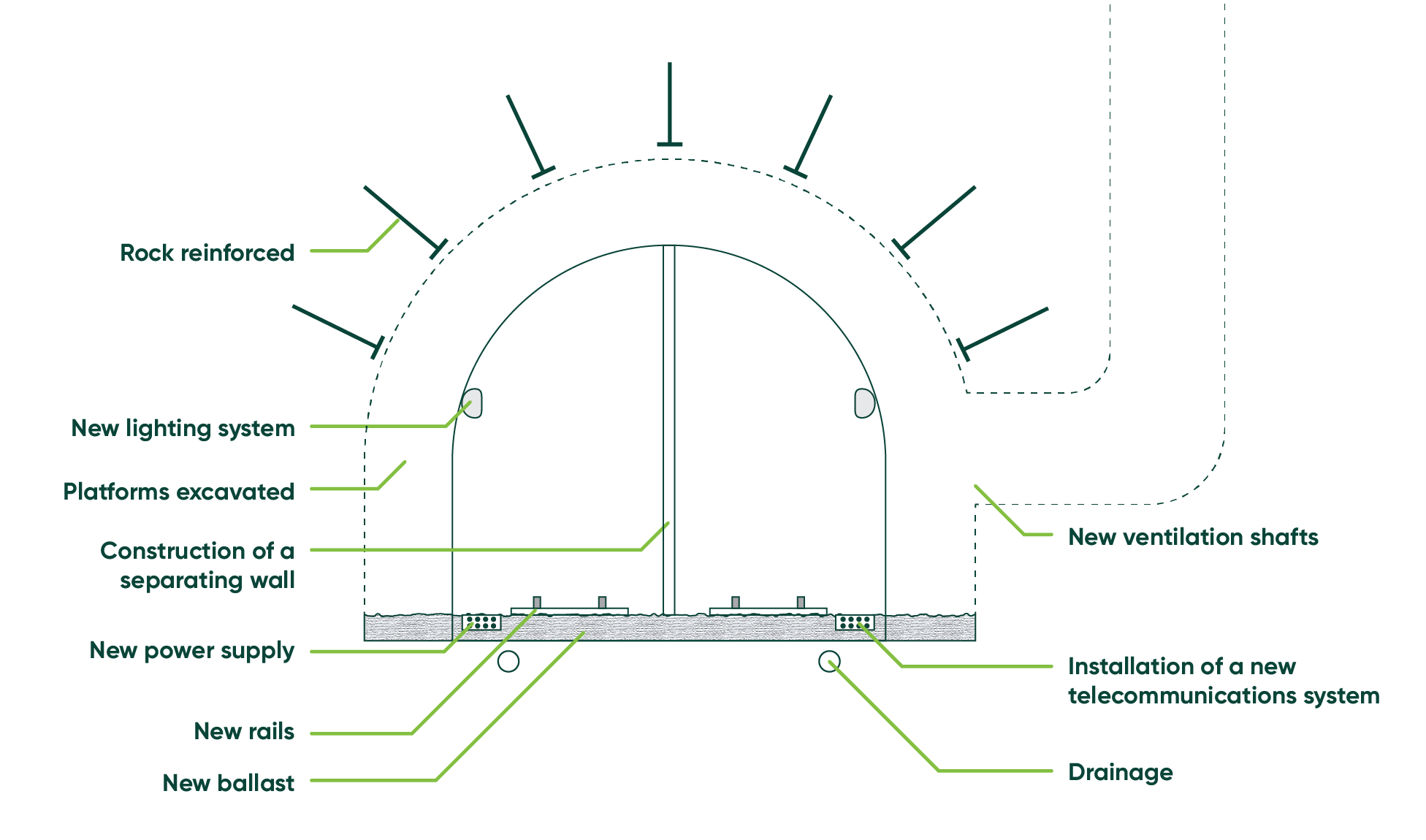
The century-old tunnel had minimal and outdated safety systems – minimal lighting and smoke detectors, and no cameras, evacuation paths, sprinklers, ventilation, or loudspeakers. If there were a fire in the 4.5 km tunnel, the casualties might have been horrific.
In 2021 excavation began along each tunnel track to create niches in which anchors were installed for the installation of the auxiliary systems and equipment. Simultaneously, installation began of the 1,300 prefabricated concrete barrier components to build the central fire wall down the length of the tunnel. This ensures that a fire in one tunnel or train does not affect the other tunnel.
Fire doors were installed every 250 m to allow emergency passenger evacuation from one track or platform to the other for safety. A modern fire suppression system was installed, as well as large fans to evacuate smoke in case of fire. Then fibre optic cables to communicate with the central control station were put in place, as well as an evacuation walkway at train floor level. Next came the installation of the rigid overhead contact line for train power, as well as cameras, lights and loudspeakers – necessary for potential evacuations and for monitoring within the tunnel.
NouvLR produced two videos showing the history of the tunnel upgrade works – the scenes are amazing, even if you don’t understand French (unfortunately there are no English subtitles). The second video shows the more recent works in preparing the tunnel for commercial operation.
The first REM train traversed the Mont-Royal Tunnel on March 1, 2025 to begin the dynamic testing phase. This was completed in October. The official opening of the trunk and branch occurred on November 14, 2025 and was attended by Prime Minister Mark Carney and the Québec Premier, signifying the importance of this network.
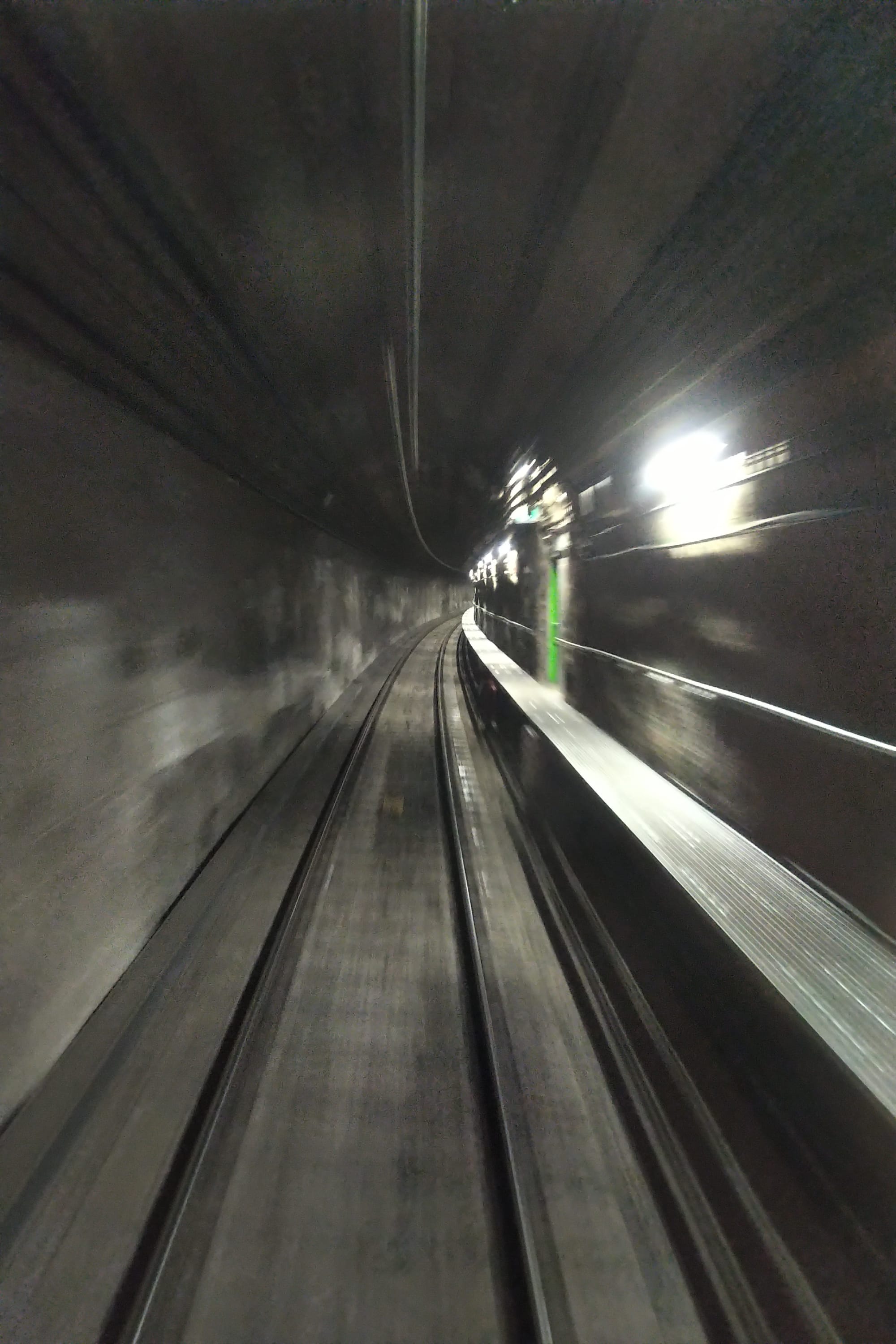
This modern infrastructure allows the trains to run at 100 km/h (62 mph) over the network’s longest stretch between stations, much faster than trains ran previously through the tunnel.
Édouard-Montpetit Station
Nestled in the north side of Mont-Royal is this existing station on the east-west Blue Line 5 Métro. Initially, the project owner and lead Caisse de dépôt et placement du Québec – Infrastructure division (CDPQI) had no plans for a REM station here, as the nearby Université de Montréal campus was already well served by the Métro. However, the City of Montréal wanted a more direct connection between the Blue Line and downtown.
The existing Métro network required taking the Blue Line east or west to either interchange with the Orange Line, then and back west or east to downtown. Basically, Métro passengers needed to go around Mont-Royal, instead of under it directly to and from downtown. Unfortunately, the Mont-Royal tunnel is 70 m under the surface, and about 60 m under the Blue Line. For comparison, London's Hampstead Tube station has the deepest lift shaft on the Underground, bored 55 metres (180 ft) down, operated by high-speed lifts.
There was a plan in the early 1980s to build a station on the Deux-Montagnes commuter rail line under Line 5’s Édouard-Montpetit Station. This plan was cut from the Blue Line designs early on because of its high cost, and presumably poor transfer numbers due to the then Deux-Montagnes commuter line only running off peak every 2-3 hours, and not on an evenly spaced schedule at that.
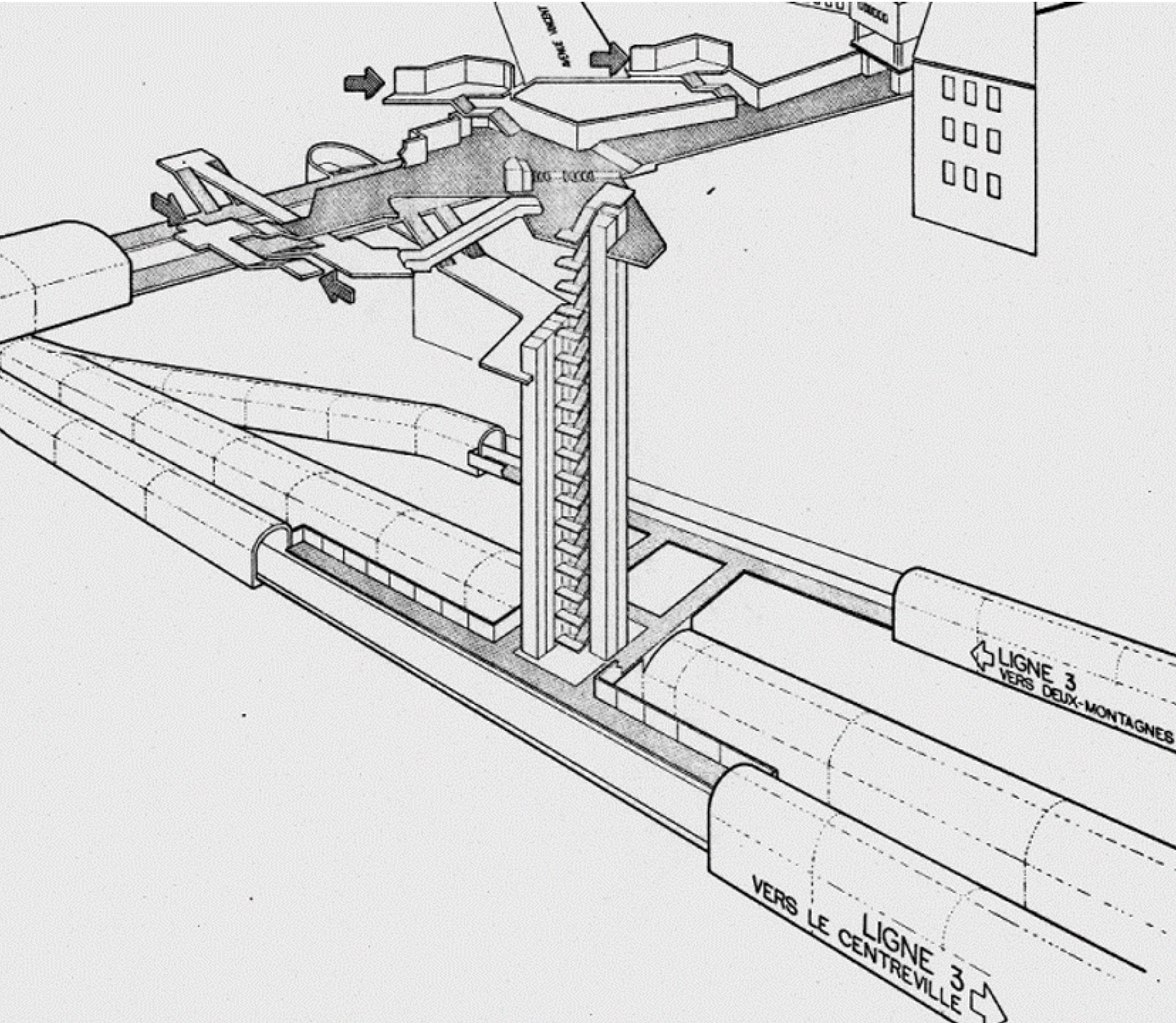
However, the city of Montréal pushed hard for CDPQI to build a REM station at Édouard-Montpetit station, as the much more frequent REM will lead to many more passengers using this transfer. This would also increase inter-connections with the Blue Line – which since its opening in 1986, has attracted less than anticipated ridership, and still operates short 6-car Métro trains (the other Métro lines operate 9-car trains).
CDPQI acquiesced, and designed and constructed the following REM – Métro interchange:
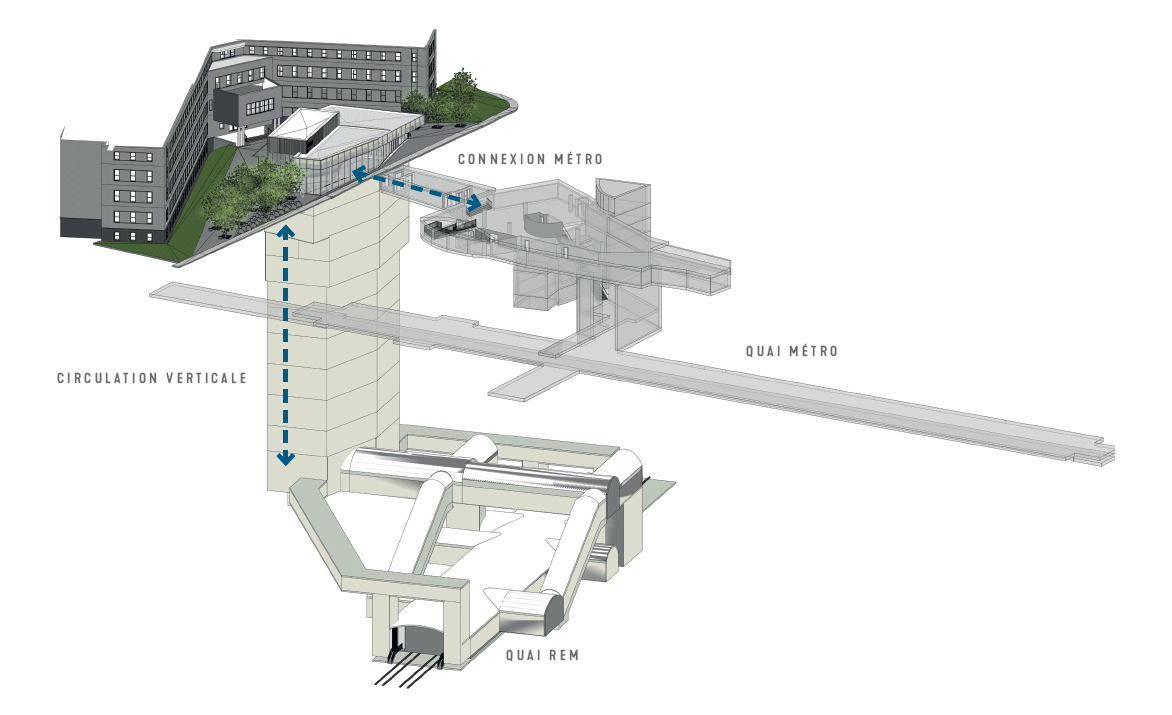
The REM station has four 60m tall high speed lifts to reach the new REM station, which traverse the depth in only 19 seconds from door closing to door opening. For comparison, the 55m lifts at Hampstead Tube station take 30 seconds. Acceleration and deceleration is so smooth that there is no sense of how far, or fast, the lifts travel. The lifts have vertical linear lights inside that rise and fall with the movement of the cabs.
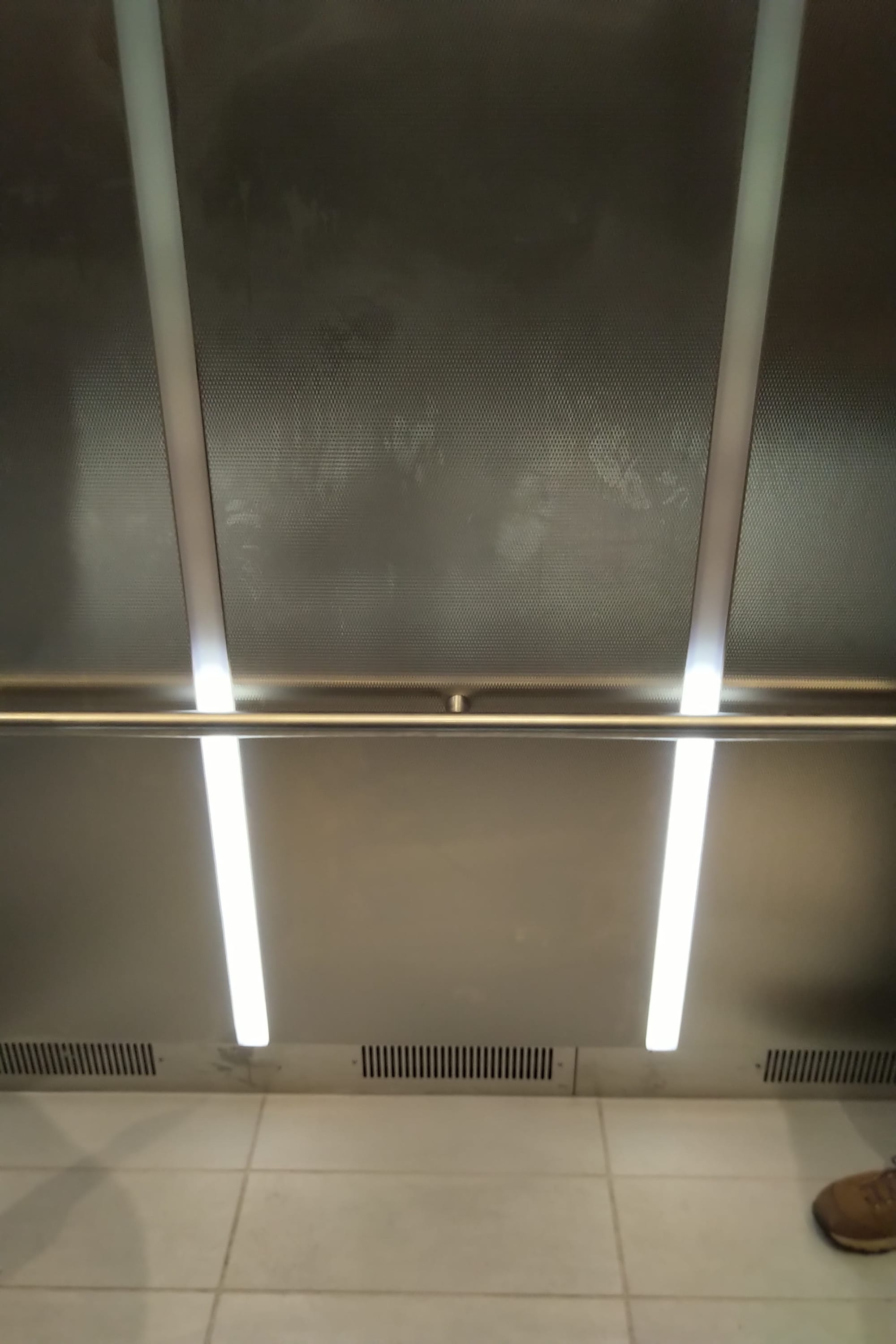
As elevators are the most failure prone device in stations, even two shut lifts out of service will leave two working lifts to move passengers rapidly up and down. Note that the mezzanine is about 10 m above the REM platforms, and there is are separate lifts to the two platforms, as well as stairs and escalators.
Côte-de-Liesse intermodal station
We waited on publishing this article to see how well the full Deux-Montagnes branch, with the interchange with Line 15 open, operates, what the initial ridership and passenger flows are like, and any bottlenecks in the connection. As we covered in https://londonreconnections.com/north-american-cities-join-the-fare-zone-club-finally-integrating-intermodal-fares/, transfers between Métro, REM, and exo are free within each of the region's fare zones.
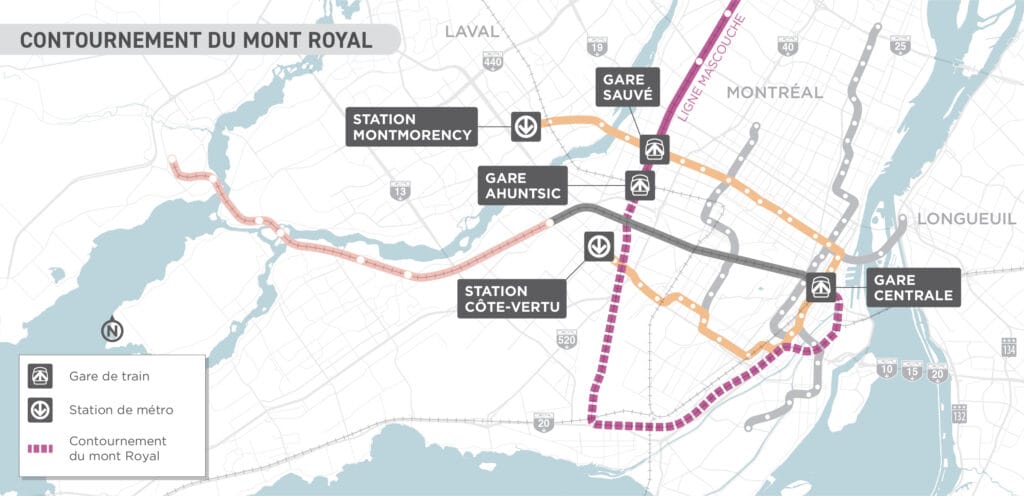
On January 12, 2026, Côte-de-Liesse REM station became the new terminus of exo Mascouche Line 15 (all exo commuter rail lines are given double digit line numbers). Due to lack of railway track directly downtown from the east of Montreal Island, this line's trains had been travelling to and from the eastern part of the island and Repentigny off the eastern tip, all the way around the west side of Mont-Royal, then back east to downtown at Lucien-L’Allier exo station. Ironically, before the conversion of the Deux-Montagnes branch to REM, the Mascouche trains all had used the Mont-Royal tunnel to quickly access downtown. The following 2023 map shows the detour dashed circumnavigation by Line 15, which added 45 minutes to traverse between the Deux-Montagnes line and Gare Centrale:
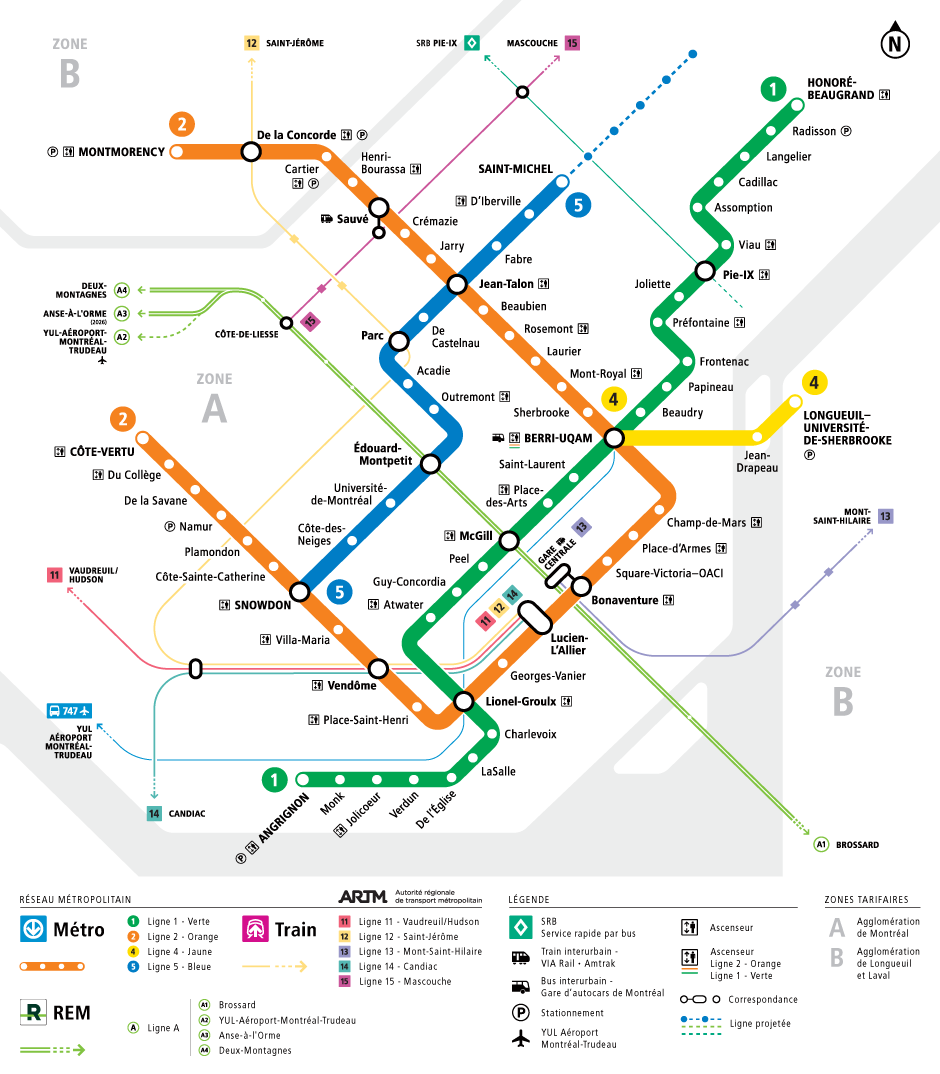
So in designing the REM network, CDPQI Infra realised that a REM station near the St-Laurent subdivision (Canadian name for railway sections) would restore the Mascouche Line's much shorter and quicker access downtown, as shewn in this 2025 STM map:
Whilst Côte-de-Liesse station is in the midst of a light industrial area, it's main raison d'être is to be an intermodal interchange. Unfortunately, the connecting exo Mascouche Line 15 currently has a meagre 5 peak tidal direction trains, and an off-peak service of 3 trains per weekday (to and from downtown), and no weekend service. In fact, when the current Québec government was looking to cut budget expenditures, this Line 15 was one of three that it proposed to remove funding for altogether. Fortunately, public and local politician pushed back strongly, which resulted in no cuts to any exo commuter rail lines.
CDPQI constructed a second southbound REM platform at Côte-de-Liesse station to take the passenger load of incoming Mascouche line trains, and to more easily turn back trains for more frequent service on the core of the network.
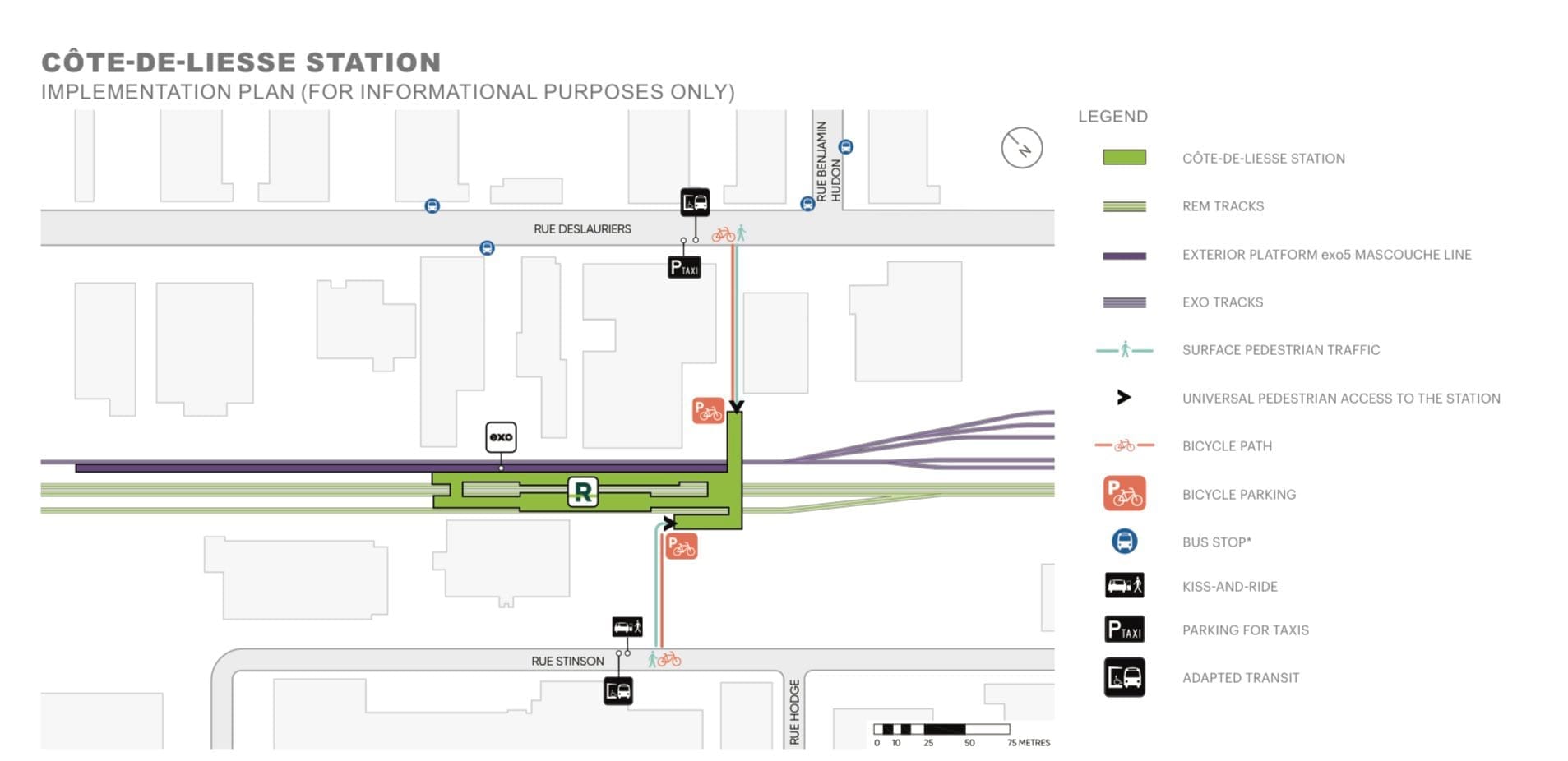
Just south of Côte-de-Liesse station is the exo commuter train storage yard with four tracks. The exo platform at the station itself extends north to allow full length 12 car trains to be accommodated.
There was word that Autorité régionale de transport métropolitain (ARTM) was intending to improve its exo service on the Mascouche commuter line to make better use of this new REM connection. It turns out, however, that ARTM is not actually adding more trains to Mascouche Line 15 once it starts terminating at Côte-de-Liesse – as they would have to negotiate with Canadian National Railway (CN) for additional paths. Unfortunately, negotiating with Canada's railways for commuter trains is never an easy, cheap, or quick endeavour.
So the Mascouche Line 15 will still operate five morning peak trains, one midday train, and two evening trains inbound, and a similar outbound schedule of one morning train from Côte-de-Liesse, one midday train, five evening peak trains, and one mid-evening train. But, the train lengths will be increased from 3 cars per train to anywhere from 4 to 7, depending on the past ridership of each departure, to handle additional riders transferring to and from the REM. Unfortunately, the ARTM agency operating exo lines has not learnt that train frequency is freedom.
So Côte-de-Liesse station may not be a key public transport interchange for years to come, and it is far too early to tell based on the Mascouche Line's first week of ridership, but it is a long term investment in public transport for the region. This is the right time to build this interchange, as retrofitting a transfer station onto a working, frequent trunk REM line would have been much more difficult and expensive. In addition, infrastructure and material costs have been increasing at a rate higher than inflation, and that will likely continue.
It is important to note that the Mascouche Line 15 stations were designed and constructed as modern and accessible, with lifts, pedestrian tunnels under the track instead of level crossings, and shelter from the often harsh weather. They are not the station halt design of the other exo lines. So ARTM had high hopes for the line when it was designed.
Also demonstrated on the above map are the isolated A4 REM stations in Laval at Sainte-Dorothée, and Île-Bigras on a small island, in Zone B, at its extreme western tip, not near the municipality’s commercial centre near the Métro Line 2 terminus at Montmorency.
Service on the Deux-Montagnes branch - What's the frequency Kenneth?
During rush hours, this branch will see trains in each direction every five minutes. Off peak, this reduces to every 15 minutes. The frequencies will be higher on the inner Montréal segments of the line, which makes a lot more sense.
The initial operating hours on the REM:
- Brossard to Côte-de-Liesse (the network core): 5:30 am to 1:00 am
- Côte-de-Liesse to Deux-Montagnes: 5:30 am to 9:30 pm
After 9:30 pm, bus services are provided between Côte-de-Liesse and Deux-Montagnes stations to allow testing and the integration to continue on the A3 Anse-à-l’Orme branch, which is scheduled to open in spring 2026. It is expected that full evening service on the A4 Deux-Montagnes will begin once the A3 branch opens.
Platform screen doors – not just for safety
As for the passengers, the platform screen doors keep the stations warm in the city’s winters, when temperatures often drop to -25°C or lower. Passenger comfort is further boosted with heated seats, akin to the seat warmers in most modern cars. In summer, the trains are air conditioned, important as temperatures can reach +40°C at times, with humidity. But only the three underground stations are air conditioned.
Passenger comfort is also greatly improved by having platform screen doors on the highway median stations on the A1 Brossard branch – highway noise and pollution being particularly unpleasant.
A3 Anse-à-l’Orme branch
We shall describe the other REM branches in reverse number order, as this is the order in which they are being opened.
Initially CDPQI planned to open the A3 and A4 branches together. However, with the testing finding numerous small bugs taking up more months than expected to resolve, they decided to open the A4 Deux-Montagnes branch first, to begin operations on the core Mont-Royal trunk section. Then any lessons learnt from A4 opening could be applied, under test conditions, to the A3 branch.
The A3 Anse-à-l’Orme branch will be an all new elevated segment to the West Island residential communities and light industrial parks, not based on an existing railway line. It will be elevated beside the Autoroute 40 highway, also known locally as La Métropolitaine, as well as serving the quarter’s shopping mall complex.
The previously announced frequencies of the A2 YUL-Aéroport, A3 Anse-à-l’Orme, and A4 Deux Montagnes branches were to be 1:1:2 respectively, so if followed, the opening of the A3 branch will add a third more trains to the core REM section between Bois-Franc and Gare Centrale (at least). REM will likely experiment with short turning some trains on the A1 Brossard branch, according to demand. This should reduce the crowding on the busiest section between Édouard-Montpetit and McGill (and to a lesser extent Gare Centrale).
The A3 branch will also parallel the Vaudreuil-Hudson exo Line 11 commuter rail running 2 to 4 km to the south. At REM’s western-most Anse-à-l’Orme station, which will be about two kilometres from the existing exo Baie-d’Urfé commuter stations. As the new REM terminus is in the middle of an industrial park, on the western, tapered tip of Montréal Island, with large parks and limited subdivisions, this station will also have considerable park and ride usage.
The head of exo predicted in 2024 that once the REM begins running on the Anse-à-l’Orme branch, the Vaudreuil-Hudson Line 11 will see a 15-20% decrease in ridership. From stations an equivalent distance from downtown, the REM will be 10-15 minutes faster to get to or from downtown than exo.
A2 YUL-Aéroport-Montréal-Trudeau branch
This short branch off the A3 branch has only two stations. After the first station, Marie-Curie (originally dubbed Technopark) in cut and cover, the line descends into a TBM bored tunnel, converging to one track to a station at YUL Montréal Trudeau Airport. A crossover just before the station results in only a 30% maximum train frequency reduction.
Whilst this branch will be the last to open, a test train proceeded for the first time on this branch in January 2026. This marks the beginning of track and communication system validation on the final section of the REM.
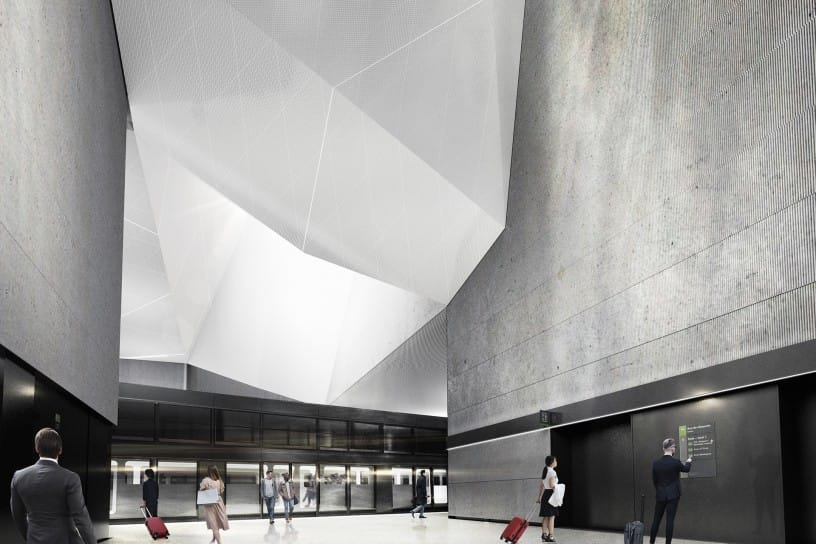
Aéroports de Montréal (ADM) wanted full design and construction control over the REM station at their airport – partly to provide design features different from the rather spartan aesthetic of the rest of the REM network. If constructed as rendered, this will be the only REM station to match the grandeur and architecture of the original Métro's stations. This also ensured that they had full control of construction so it would not disrupt airport operations.
The station is mere metres from the main airport terminal, which is exceptional passenger convenience. This did, however, create a major challenge for construction, excavating a 40 metre deep station pit right next to the busy terminal. To maintain control over construction to safeguard their terminal, ADM offered to build their own station at their own cost of $600 million Canadian (around £325 million).
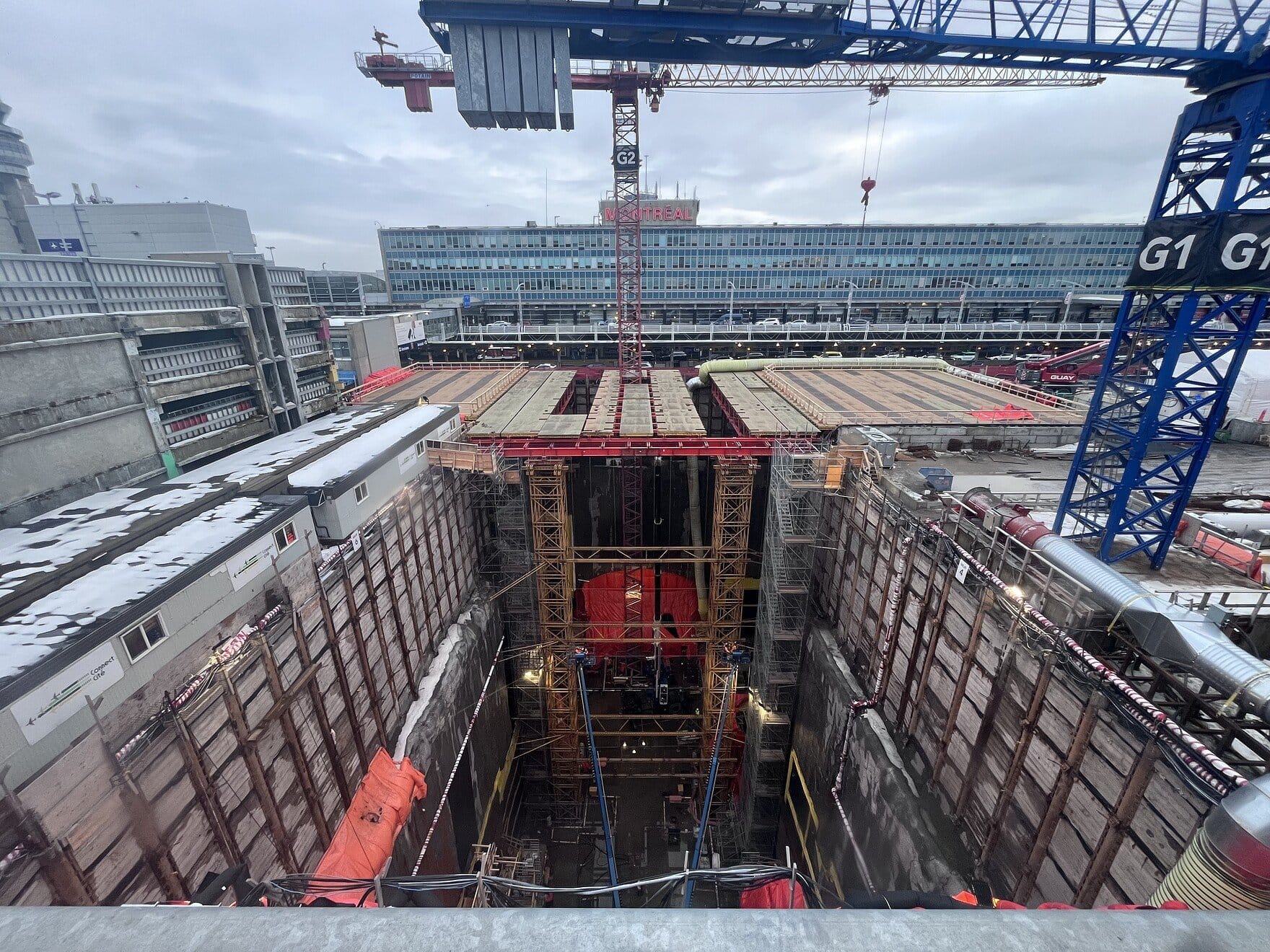
The route of the line takes it in tunnel under one of the runways, and to protect future development issues at the airport, it is being bored 50m below surface level. Even at this depth, NouvLR has been monitoring the runway level to an accuracy of 3 mm vertically, with satellite surveillance and piezo-electric sensors off taxiways. These can detect any sign of ground movement or settlement that could affect aircraft movements. Along the route of the TBM, satellites can observe to a resolution of approximately 10 million points.
Aéroports de Montréal and NouvLR are taking particular care, because there have been recent issues. During tunnelling of Ottawa's Confederation light rail Line 1 (a city two hours from Montréal with a similar winter climate), a sinkhole suddenly appeared on a busy downtown street. It took out three lanes, delayed station construction a year, and remediation cost the city $130M (CAD).
This REM branch will be last to open, which is now set for 2027. Frequency will be every 10 minutes in the peak and every 15 minutes otherwise, with the journey taking about 25 minutes between downtown and the airport.
Dorval VIA/exo station a missing link?
The new airport station has designed with provision for a future southern extension of this REM branch to the Dorval exo commuter rail and VIA Rail station approximately one kilometre south, then onward to residential areas, or even under the river to the Rive Sud (South Shore). However, the single track tunnel to the airport on this branch will limit frequencies and ridership of any such lengthy extension.
The suburban town of Dorval's mayor claims not extending the airport REM tunnel another 700 metres south to the Dorval exo/VIA Rail station and bus intermodal interchange was a mistake. It wouldn't have cost much to operate the TBMs another 700 m: excavating stations is the major cost centre for line construction. Dorval station connects travellers to commuter trains downtown and intercity passenger trains, as well buses to the Dorval residential area to the south.
It is possible to walk between the airport and Dorval – I have done it myself, with luggage – but it is not a particularly enjoyable experience walking along narrow sidewalks and flyovers.
However, cynical Montréal transit observers note that CDPQI may not be keen on having a second (slightly indirect) rail route to YUL-Aéroport-Montréal-Trudeau that would only require one station’s travel on their new REM line. This would yield them much less payment than passengers taking the REM nine stations to or from downtown, as CDPQI is paid by passenger-km. This is similar to the way that CDPQI had the municipality of Longueil remove the direct-to-downtown bus from the South Shore, replacing them with shorter routes connecting to the nearest A1 Branch REM station.
But this is standard – and good – transport planning practice, re-routing bus routes to funnel passengers to rapid transit lines as quickly as possible, taking advantage of faster travel on segregated rights of way. In addition, buses are labour intensive, so shorter routes save on labour costs, as well as optimising use of high capacity assets.
Furthermore, the new south shore Champlain bridge was designed with median tracks for the REM line, but it sacrificed the previous bus lanes. So south shore buses would slog along in the bridge traffic.
A1 Brossard branch’s winter operational issues
The initial A1 REM branch to Brossard has operated at 99% reliability – in non-winter months – since its opening in 2023. However, there have been some issues with trains stalling during the winter, with wind blowing snow, freezing rain, hail and ice pellets into train crevices to freeze components.
The REM train pantographs were reinforced to knock off any ice that has accumulated on the overhead wires. Trains are kept operating overnight whenever ice is likely to accumulate. To deal with snow, pick-up trucks on two sets of railway wheels traverse the track, equipped with a snow blower to clear the right of way and the emergency walkways.
REM trains are also operated slightly differently in winter compared to warmer months. When there’s a risk that ice or snow is accumulating on the brakes, trains apply brakes earlier on the approach to a station to melt any accumulation. Nonetheless, ice buildup on the catenary has stranded a few trains, with a rescue train not being able reach it.
In the past this has meant recovery from winter operational problems could be as long as an hour and a half. Lessons learned mean that the train and signalling systems can now be reset in as little as 20 minutes.
These challenges should be seen as initial teething problems. Notwithstanding these occasional disruptions, this branch has been moving a respectable 30,000 passengers per weekday, in line with pre-opening estimates. Weekend ridership has been lower, with two-car trains operated.
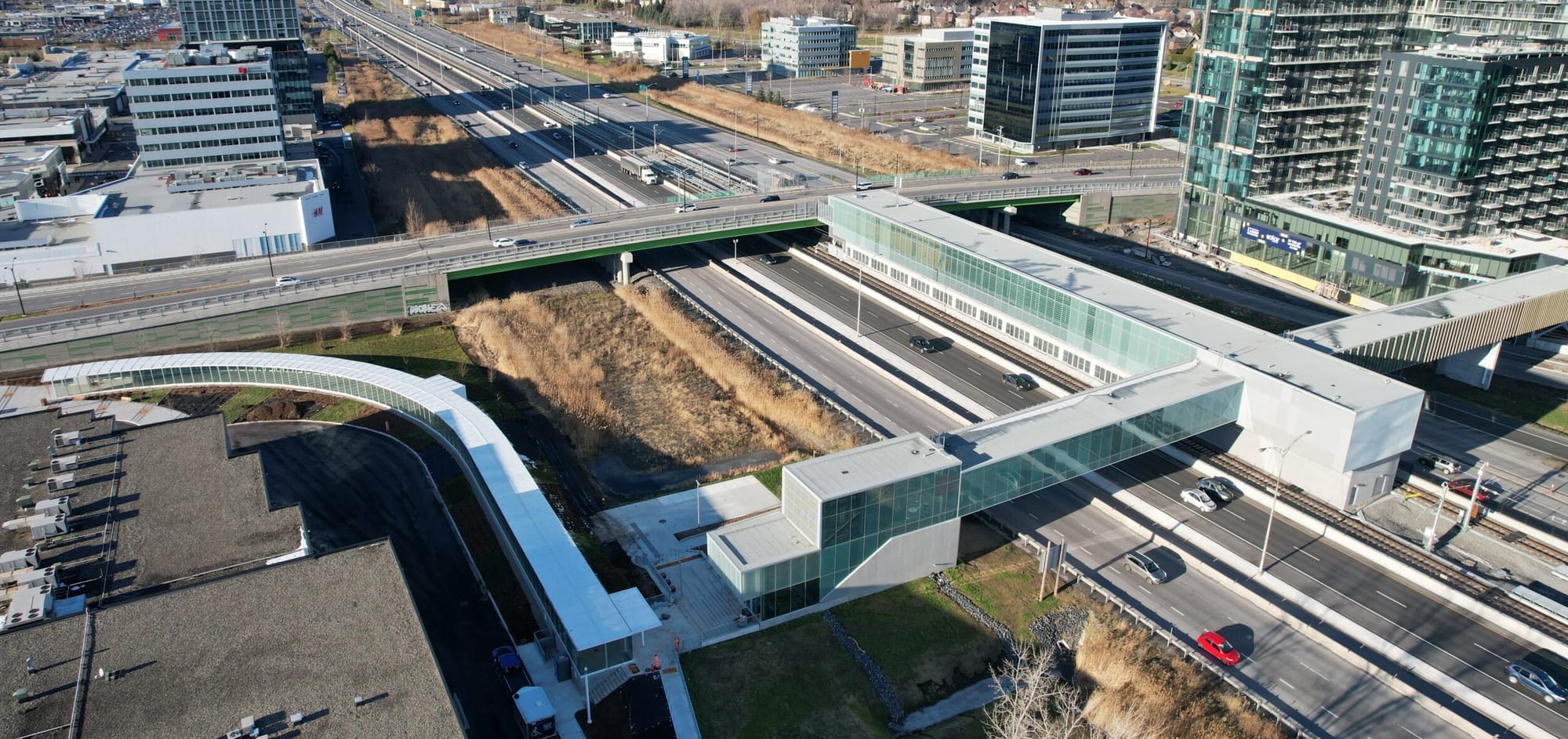
Office and high rise residential towers have sprung up around the Du Quartier station, which also has an outdoor shopping mall on one side. Covered walkways take passengers to and from the station over the highway in comfort, although there is a 6 m gap between the station walkway and the covered path to the mall.
Winter is the toughest challenge
REM selected the Alstom Metropolis train with appropriate modifications for winter operation. None of the other 30 or so cities operating this model of train experience the severe cold or winter precipitation experienced in Montréal, being European temperate, sub-tropical, tropical and desert climes.
Add in the long exposed and elevated track south from Gare Centrale above the St Lawrence River – basically a windswept winter tundra of water and ice – and the trains, switches and lineside equipment are exposed to constantly blowing cold and freezing precipitation.
Whatever initial modifications that Alstom made to the trains, and NouvLR made to the rail infrastructure, they may have underestimated the winter-proofing necessary to keep the system operating reliably in all conditions. The electric track switch heaters have been replaced with gas fired ones, which melt snow and ice much quicker.
This demonstrates the need to specify trains that are designed from the start for the climate they will be operated in. Canada has had some lessons in this regard, having purchased trains from the UK that were never designed or equipped for the Canadian environment. A great example was the Channel Tunnel Nightstar trains, sold to Canada and operated in a very different climate.
Fortunately, the A4 Deux-Montagnes branch through-running to the A1 Brossard branch has seen far fewer delays this winter, so it appears that the network has slid down the wall of the Bathtub Curve into the low breakdown part of the reliability graph.
Thinking ahead – or thinking big – doesn’t always pay off
At times, Montréal has planned big for its future. In the 1970s, the city was the largest city in the country and was the centre of Canada’s banking sector, and the federal government planned for a second airport north of the city. This was to be connected by a high speed rail line through the Mont-Royal tunnel to downtown. A spur would be built off the existing Saint-Jérôme rail line for this operation.
The airport was Mirabel, but it never reached its potential. It was sited 50 km from the city centre, the direct rail line to downtown was never put into operation, and by the 1990 the airport had few international flights, and no domestic service. It soon closed to passenger flights and its terminal demolished. Today it is largely a freight airport, with a few charter passenger flights.
Part of the problem was the 1970s Québec separatism movement, which after becoming the provincial party, most banks moved their headquarters to Toronto, as did many other companies. This and other factors led to the greater Toronto area experiencing rapid growth. By the mid-1980s it was the most populated city region in the country. Airlines follow the population, and central Canada’s airport hub shifted from Montréal Dorval (as was) to Toronto Pearson airport.
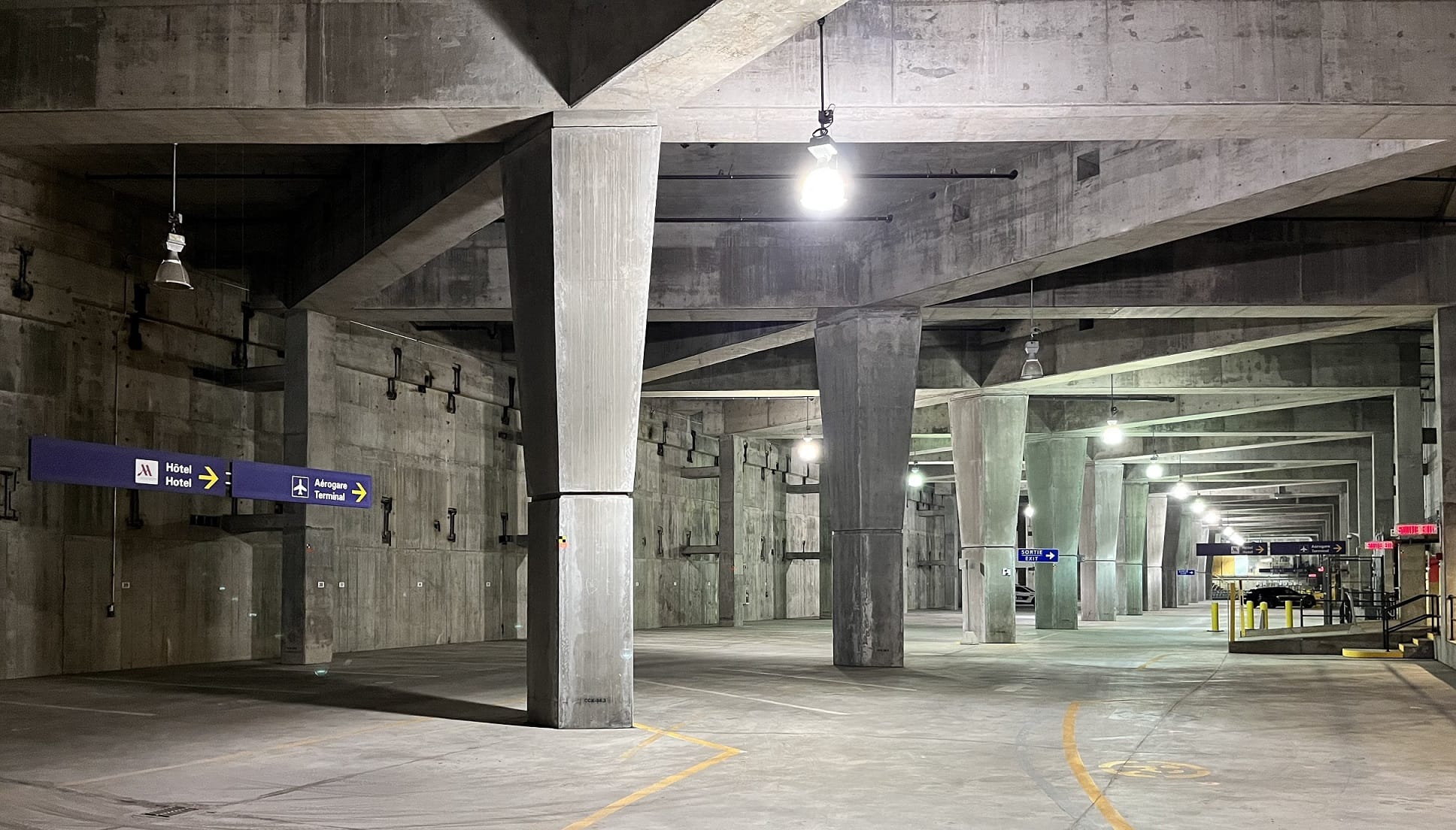
Nevertheless, in 2009, Aéroports de Montréal bet $25M on constructing a prospective airport rail station underneath Trudeau Airport, to help persuade the federal and provincial governments to finally approve the high-speed airport train they had been discussing for years. Much like the extra platforms for western connections from Heathrow (described as a ghost station in this rather over-dramatic video), Montréal-Trudeau Airport’s station cavern is also unused for its intended purpose. Today it is used as an underground parking garage, quite possibly the most beautiful brutalist parking outside of Paris.
Integrated public transit, cycling, and walking access
As is almost standard in Canadian rapid transit networks, bus terminals and bays were designed into REM stations, where neighbourhood space allowed. Large bus terminals have enclosed waiting areas, washrooms, and often a cafe for snacks and beverages. REM took pains to design good pedestrian and bike access to its stations, with paths, bike parking, and covered walkways. Such amenities are often considered unnecessary frills in many US transit systems.
Although the rest of the network was planned to open in 2024 (except for the A2 YUL-Aéroport-Montréal-Trudeau branch), delays in integrating various sub-systems together (as seen with London's Crossrail) as well as discovering more dynamite residue in drill holes in the Mont-Royal tunnel meant progress has been slower that expected.
So unfortunately airport travellers and workers will have to wait at least two years after the rest of the REM network starts operation to take the REM to the airport. And despite being numbered Branch A2, it will be the last REM branch to open.
REM station design
Bois-Franc REM will be the transfer station between the Deux-Montagnes A4, Anse-a-l’Orme A3, and YUL-Aéroport-Montréal-Trudeau A2 branches. As such, it was designed with wider platforms for space for passengers waiting to transfer trains.
Unfortunately, as is the trend with new North American railway and rapid transit stations, few if any benches are provided at REM stations for the elderly, injured, tired, weak, or those with heavy bags. Whilst accessibility is legally required in all new transit stations in Canada and the US, provision of basic resting places is not, and consequently is not provided in many stations.
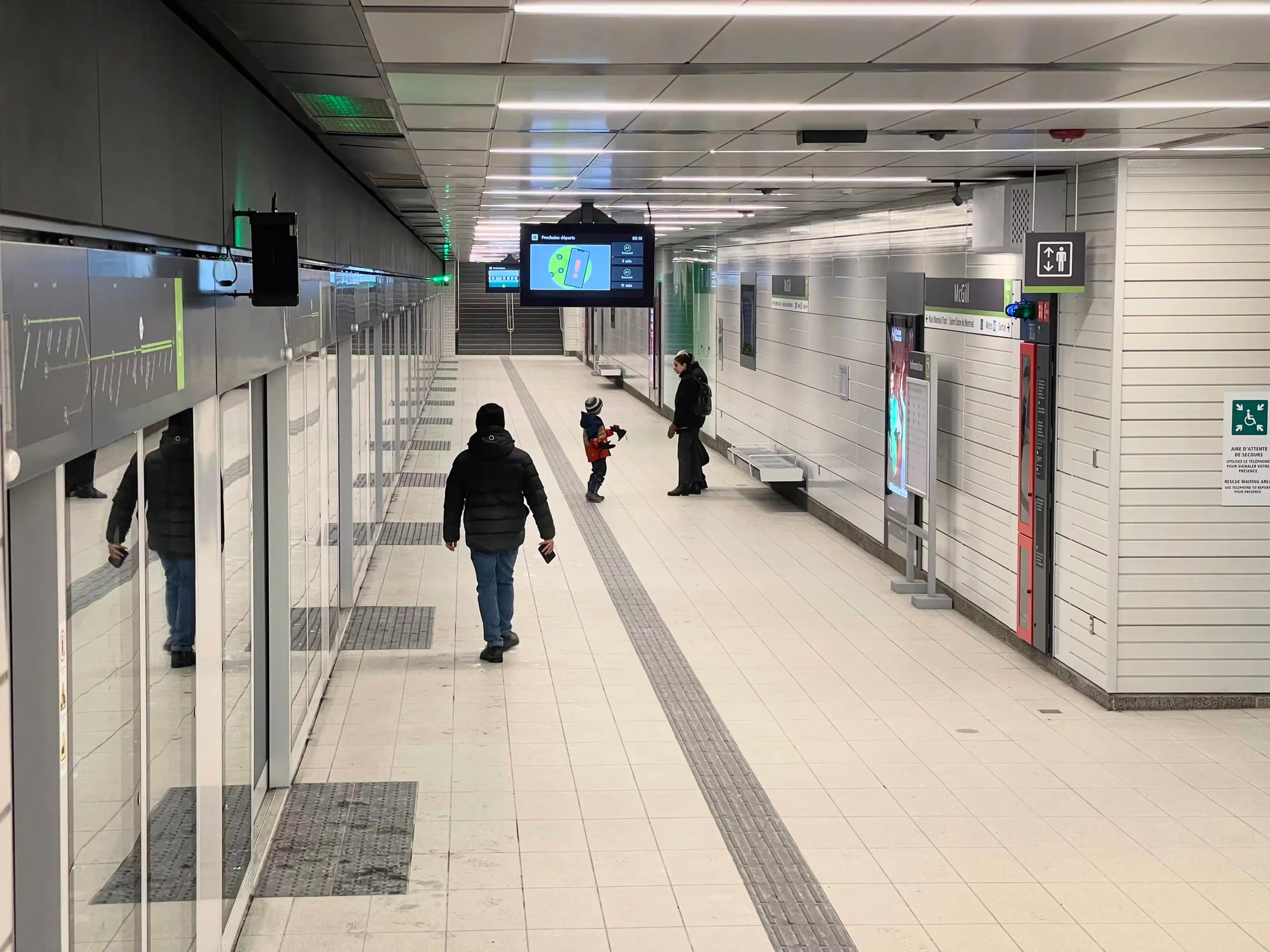
The subterranean Édouard-Montpetit and McGill station platform walls are plain – white ceilings, all white walls, light beige floors. The only accents are dark grey stripes, which aren't beating the boredom accusations. These platforms, with no adverts, have the feel of a hospital corridor. Fortunately, the rest of these two stations is more colourful, especially Édouard-Montpetit, which features several complex, layered artistic mosaics, and exposed natural rock wall segments.
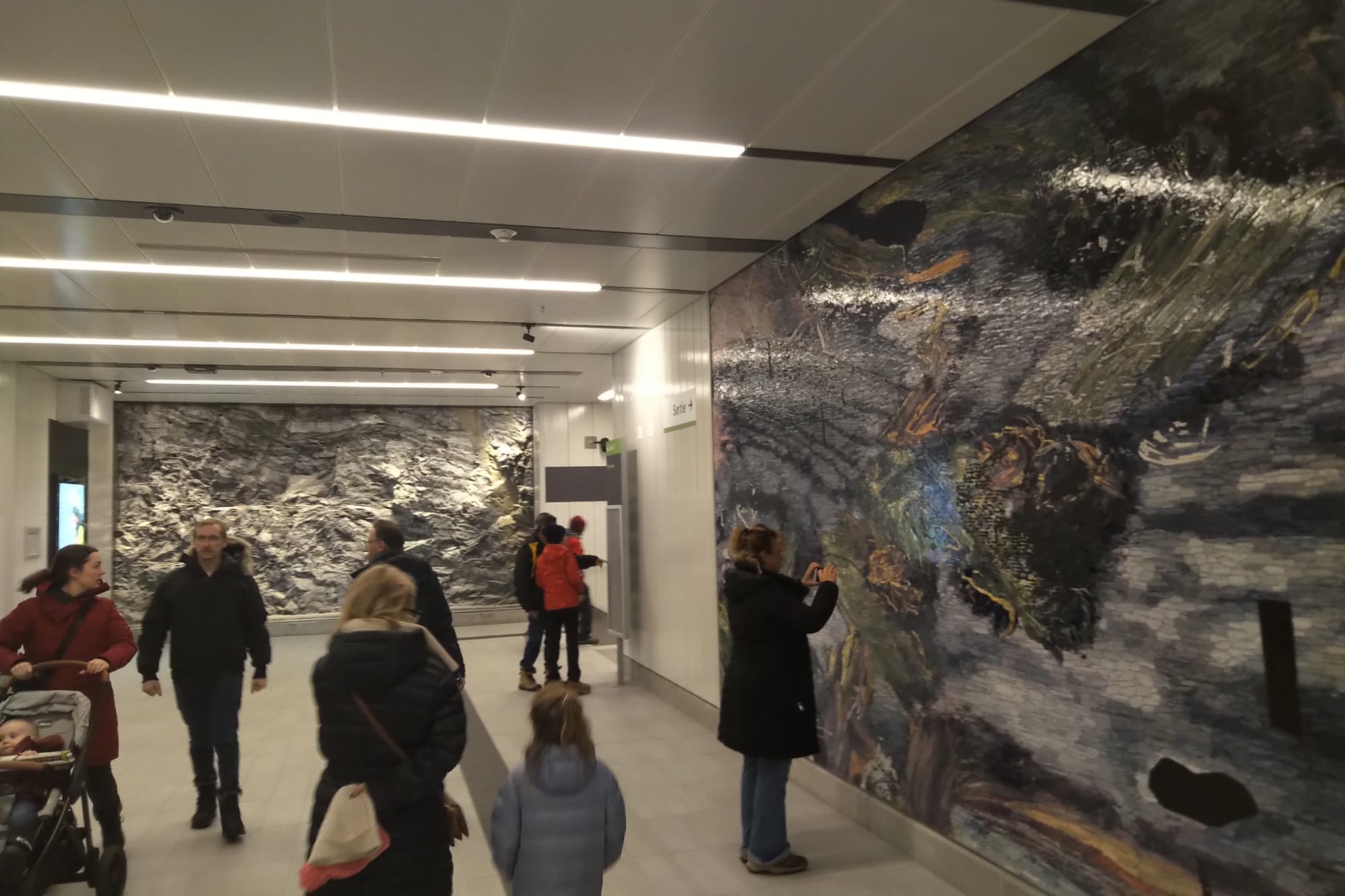
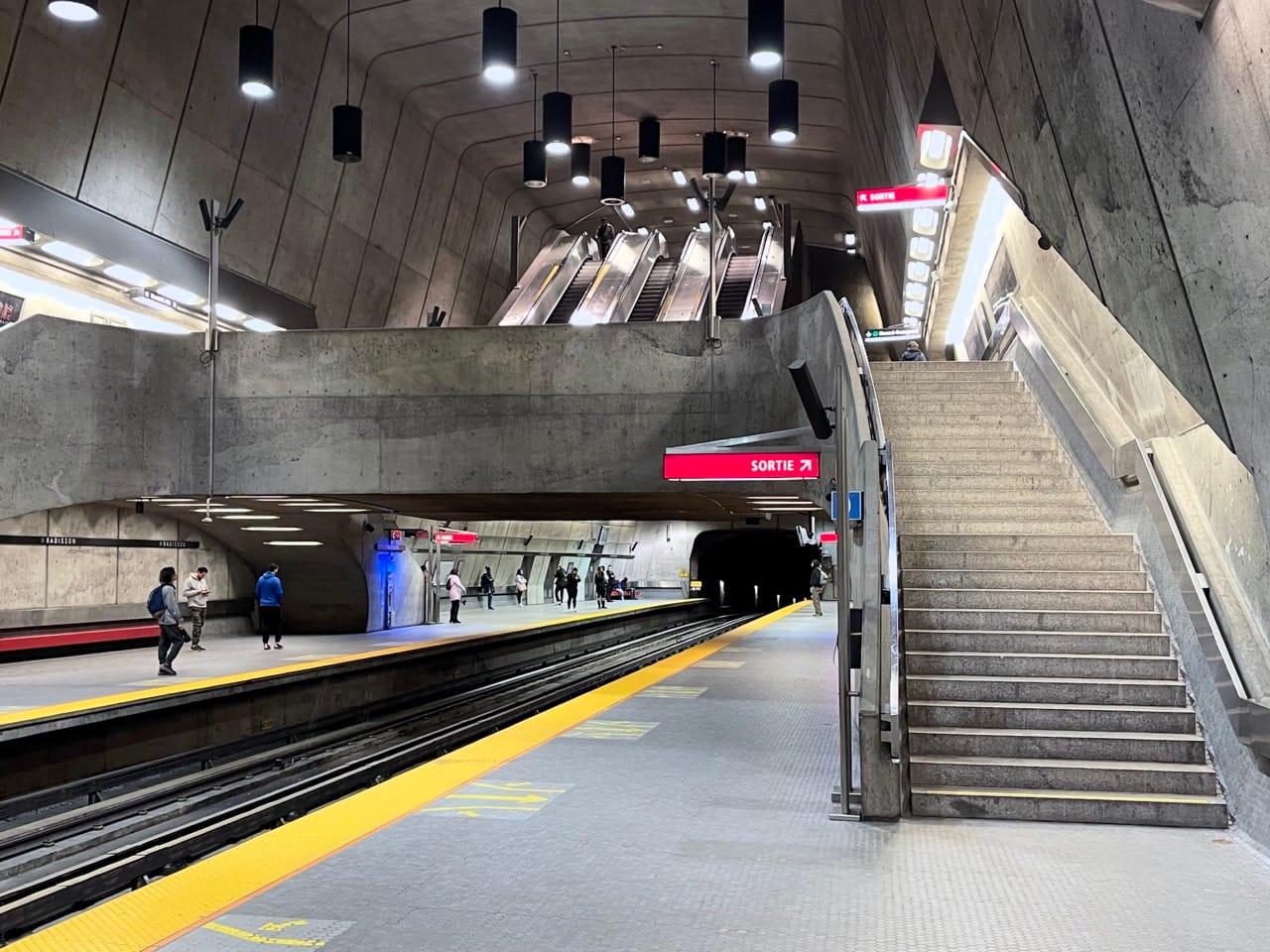
However, the white station walls in REMs underground stations do help make them universally bright. This contrasts with some Métro stations which are principally concret brut (raw concrete), giving the stations an atmospheric feel, quite different from most other underground stations around the world. Snowden Métro station is downright dark.
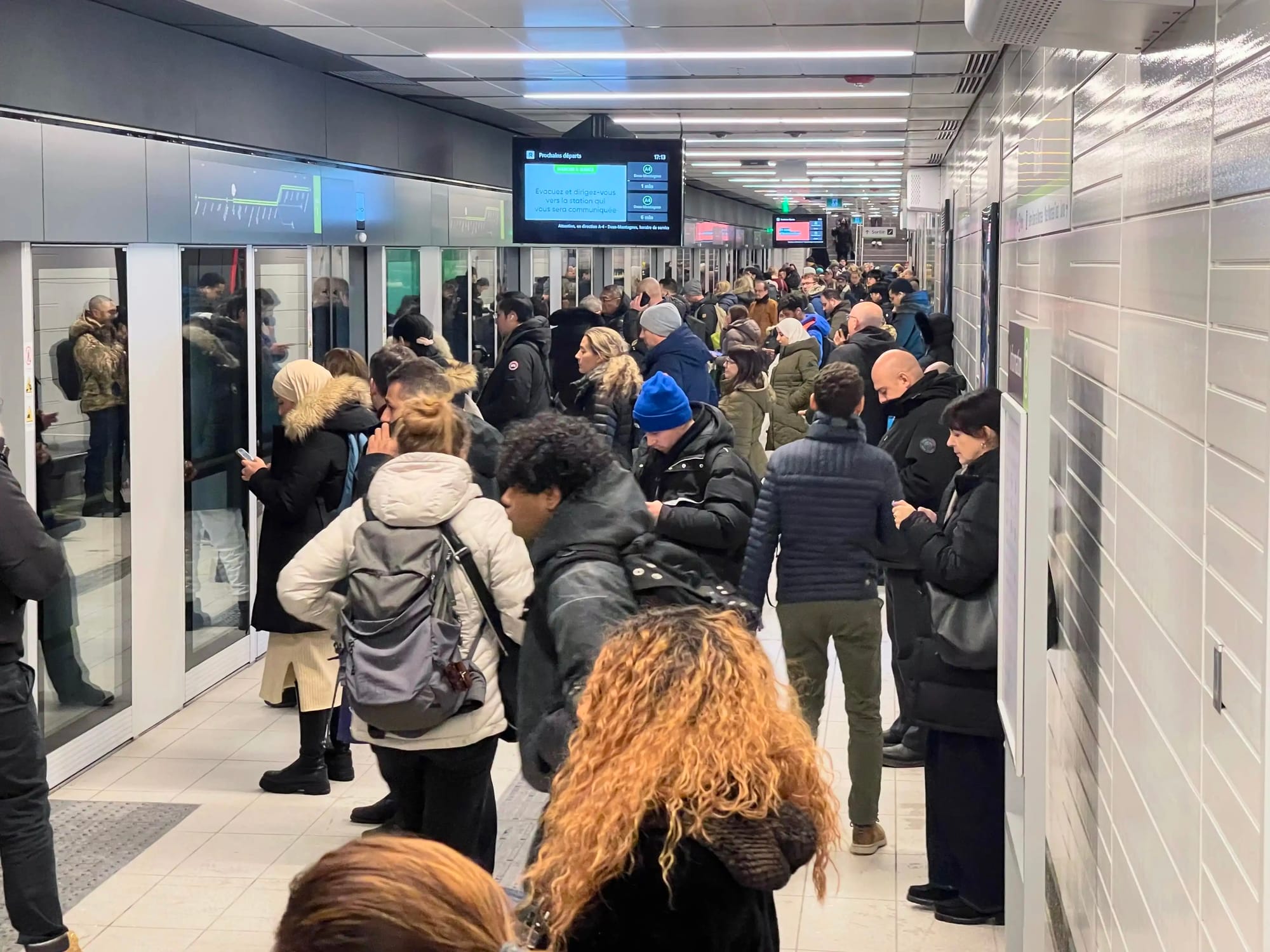
Having attended the opening weekend of the Deux-Montagnes branch, the busiest section is between Gare Centrale, McGill, and Édouard-Montpetit stations. There is often a crush of passengers boarding and alighting at McGill and Édouard-Montpetit. However these stations have the narrowest platforms, being constrained by the need to excavate hard rock. Unlike traditional metro and underground stations, the platform screen doors keep everyone safe. These platforms may become the pinch points of the entire network (although they are wider than those on most Underground stations in central London). Fortunately, REM can add frequency of its automated trains relatively easily to reduce crowding.
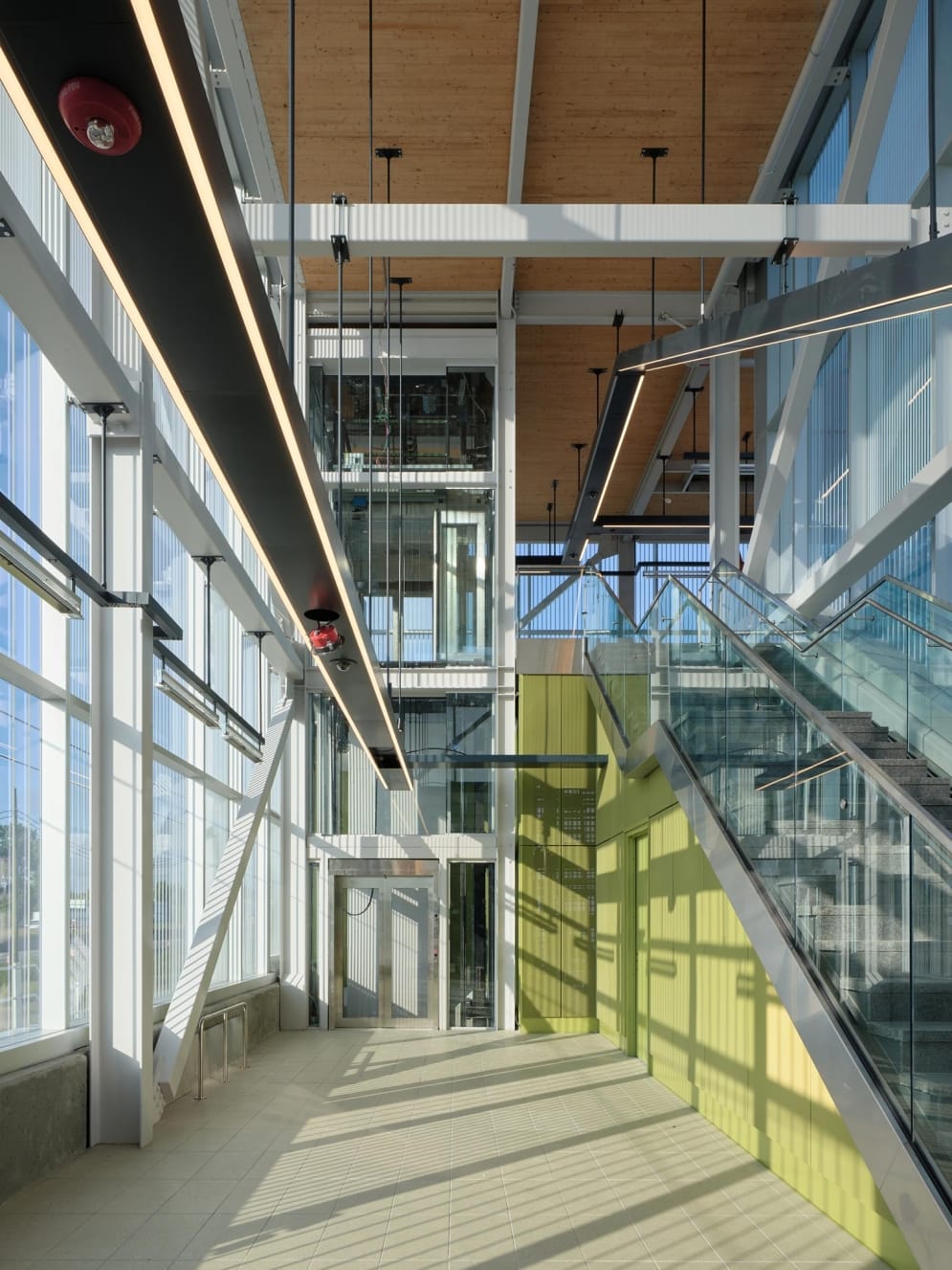
REM's surface and elevated stations have a much warmer feel fortunately, with wood ceilings and some coloured brick off platform, which avoid the white–grey–black monochrome of its underground stations. Although these stations have more of a Scandinavian minimalist feel than any on the legacy Métro network, REM station design represents Montréal’s Nordic nature.
To advertise, or not to advertise, that is the question
There are no poster adverts on REM platforms, in their stations, or on their trains. However there are advert screens. On the Métro, au contraire, there are really colourful, well-designed posters, as befitting French design culture. REM stations seem a bit sterile in comparison.
CDPQI may have chosen a flatter, neutral colour palette to minimise a dated look decades later. Avoiding station poster advertising seems an odd choice, however, given how the stations are minimalist.
Furthermore, there are integrated REM / Métro maps in REM stations, but they only show interchange stations with the Métro, not the rest of its stations. In addition, there are no Métro or exo lines shown on the REM trains, only their mode symbols and line number at interchange stations. Métro trains feature the Métro system map only, plus REM and exo interchanges. However, Métro stations do post the full integrated ARTM Plan Métropolitain rapid transit network maps – as reproduced above.
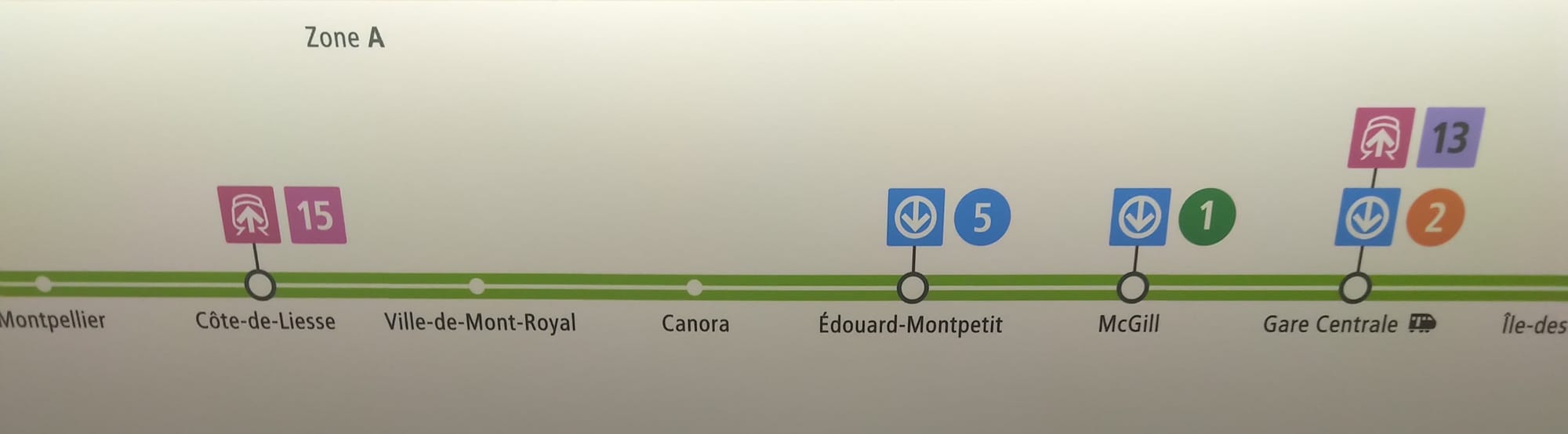
Rapid transit network gaps
It also remains to be seen if a business case for the southern extension of the A2 Airport branch can be made at some point in the future. Previously, CDPQI was not keen on adding interchange stations to its REM network. Their original plans didn't include connections to the Métro at McGill (Green Line 2) and Eduoard-Montpetit (Blue Line 5). They may have calculated that there would not be a return on investment to add these costly interchanges with other modes The city had to force them into building stations there. CDPQI wanted a self-contained network, possibly as it might provide a better return on their investment.
But that ignores the network effect. Reed's Law, a version of Metcalfe’s Law for telecommunications networks, states that the utility of large networks scales exponentially with the size of the network. A large metro or underground network is far more useful than a small one. And a network is almost always improved with additional interchanges, if they are constructed cost-effectively and service is provided regularly.
When the REM is fully opened, there will still be a few other small gaps between it and other modes, like the 2.7 km between Côte-Vertu Métro as the northwest terminus of the Orange Line and the Bois-Franc REM station. The area is older suburban, with strip malls, light industrial, and single family homes, with low- and mid-rise apartments going up near Bois-Franc. Furthermore, Bois-Franc is the interchange between the three north/west REM branches, so it would make some sense to extend the Métro there for better suburban connectivity.
Whether this is sufficient to require a link between the Métro and the REM is another matter. But given that the Métro is never constructed at grade or elevated, it would have to be tunnelled - unless the line were enclosed in a tube to protect the trains and track from the elements.
In 2022 a new, underground Métro train depot and storage yard opened a kilometre north of Côte-Vertu Métro station. It is also half the way to Bois-Franc REM station. However, it was not designed to have Métro trains operate through it, and would most likely require two running tunnels to be constructed alongside the depot. Once a solution was found to operate regular service through this depot it would reduce the distance to Bois-Franc REM to only 1.6 km.
Infill stations mooted
The burgeoning condominium quarter of Griffintown, a former industrial workshop area 700 m south of Gare Centrale and downtown, has long been slated to have a REM infill station constructed. But there has been no work apparent at the site for the last three years, and there's been no announcement as to when construction would start, nor when it would be projected to open.
In 2022, the previous Mayor Valérie Plante requested that another infill REM station, Bridge-Bonaventure, be constructed south of Lachine Canal. This would assist in the redevelopment of the port and industrial lands into a densely populated area with large residential towers. The REM station would be located off Bridge Street, south of the 'B' of 'Wellington Basin' in the map below:
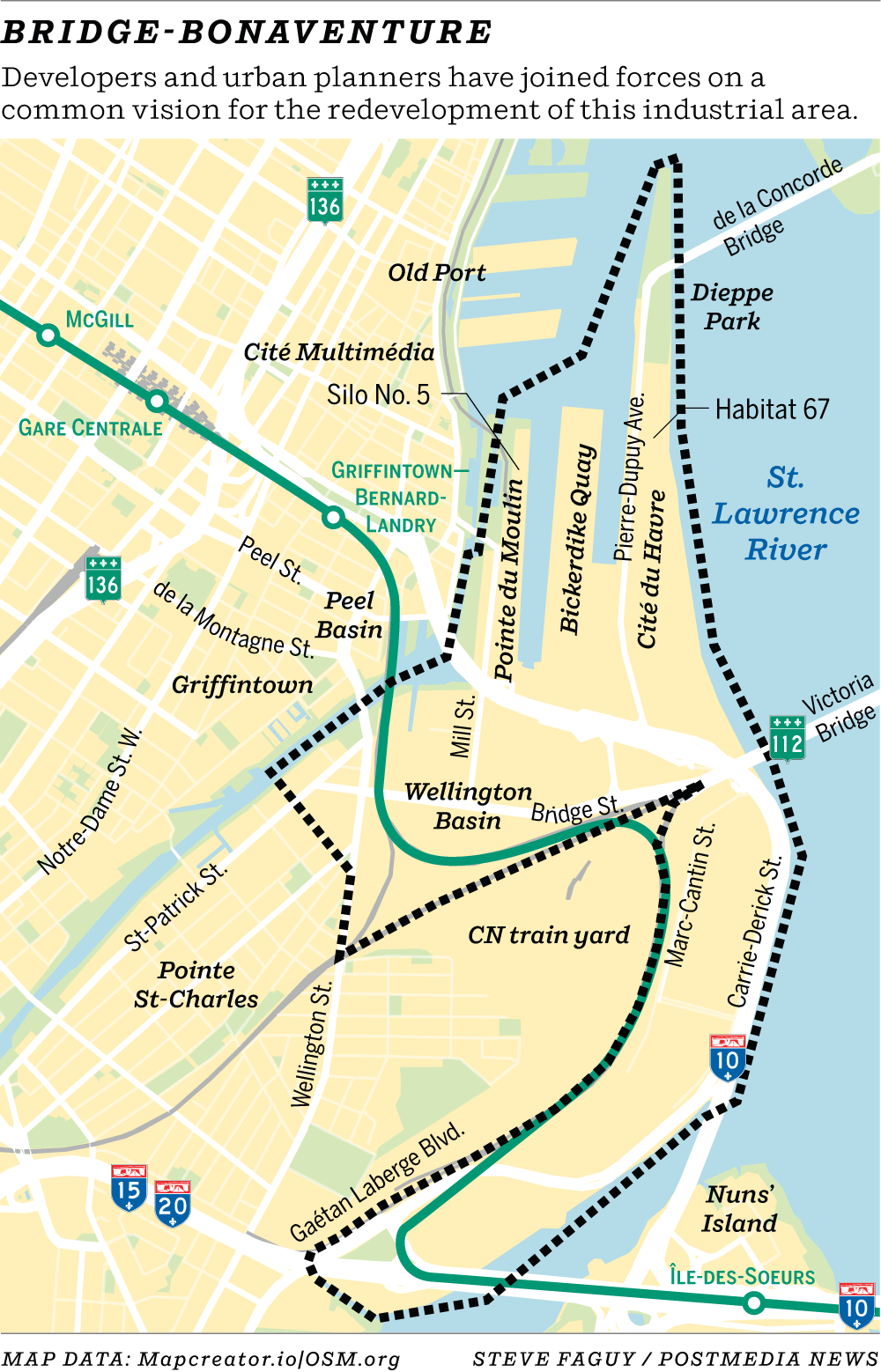
CDPQ Infra analysed the Griffintown-Bernard-Landry stations and Bridge-Bonaventure and determined that they were technically feasible. But to minimize impact and costs, it would be necessary to construct both of the stations simultaneously. Their construction will be disruptive as it would require weeks or months long shut downs of the Brossard A1 branch. It is quite possible that, like the automated Vancouver SkyTrain infill station build, that the REM trains could operate on only one of the two tracks, alternating between north and southbound trains to provide a reduced service, but avoiding closing the entire line. This infill stations project is currently in the sourcing the funding stage, likely from the three levels of government, and other property tools. The city is confident that both new stations will be well used and assist in neighborhood development and sustainability.
REM still has excess capacity
The REM network will have lots of spare capacity for its first decade, until the Deux-Montagnes and Anse-à-l’Orme branch stations develop significant transit-oriented development around them. The bottleneck would be the busy core section between Côte-de-Liesse and downtown.
There are commuter parking lots around Bois-Franc and the stations north-west of it. However, once in Laval and the north shore municipalities (Zones B & C), the houses are larger, apartments are far lower and fewer, streets are wider, and the parking lots are much smaller Hopefully in the future the park and ride lots can be converted to high rises for much needed residences, as there are housing shortages in the region.
Potential, unofficial, REM extension
Remember the original 1961 Métro network plan image near the beginning of this post? Line 3 included a spur east, running under or alongside the Canadian National Railway (CNR) a few kilometres. This is the same St-Laurent railway subdivision of the exo Mascouche Line 15.
There are now a number of big box store shopping areas close to a number of Line 15 stations, and the central section of this line serves residential areas. With all day service, this line could provide a cross-town alternative to the constantly congested Métropolitaine Autoroute 40 highway that runs through the middle of Montréal Island. In addition, there are the following connections to other rapid transit lines:
- Orange Line north-east arm, at Sauvé
- Pie-IX busway
- Saint-Jérôme Line 11 at Chabanel
- Côte-de-Liesse REM
However, Mascouche Line 15 ridership would have to increase greatly, and mid-day trains added, for any such conversion to be worthwhile.
Conceivably CDPQI could also take over the exo Line 11 Vaudreil-Dorion commuter rail line, which currently doesn't even have hourly off peak service. However, it does serve a string of older suburban villages and their shopping areas, in a way similar to the outer part of the Deux-Montagnes branch.
We have heard, unofficially, that due to the difficulties that CDPQI has experienced in building the REM network – technical, geological and political – they are not interested in expanding the system. In REM’s favour, its lines and branches can be at grade or elevated, hence constructed more cheaply than tunnelling. This is in contrast with the Métro, which is locked into underground only, as its rubber tyred and un-weatherised trains are not designed at all for the local harsh winters.
Should it expand the system, CDPQI may need to buy more trains and acquire more depot space, but the system currently has sufficient consists to run trains up to every 90 seconds (40 tph).
The cost benefit analysis of closing such gaps as between the Orange Line terminus of Côte-Vertu and the Bois-Franc REM station by Métro would determine if it were worth spending a billion dollars or more for it, given the likely relatively small number of transferring passengers. It depends also on land use around the interchange, its zoning, and the potential for future extensions of the lines.
Summary
The weak point in Montreal’s multi-modal transit network is its commuter rail system, mostly operated at rush hours, and sporadically outside of that. This A4 Deux-Montagnes REM branch is a massive upgrade of such an underused commuter line to a rapid, all day, and urban metro service. It also provides frequent mobility across the city between the northwest and southern edges of the conurbation through downtown. The A2 Anse-à-l'Orme branch will reach the western tip of the island in a few months. This should attract and concentrate high density development around the line's suburban stations.
The benefits of the REM network north of Gare Centrale are multiple. It upgrades a sporadic all-day commuter rail line to a very frequent, automated metro, maximising Mont-Royal tunnel's passenger capacity. In addition, the tunnel was significantly upgrade to modern safety standards. All level crossings were removed from the line, and platform screen doors for safety and comfort at all stations, a first for North American urban rail systems (not including airport trains or people movers). And building numerous elevated rail segments to another North American city has not caused the sky to fall down.
REM provides two new interchanges with the Métro network at the heart of the two metro networks, downtown. And it has also shortened the Mascouche Line 11 exo line trips to and from downtown by 30 minutes (including transfer time). These are major additions and improvements to the city's and region's public transport system.
In terms of infrastructure, CDPQI ensured that the new south shore Champlain bridge was designed and constructed with median tracks, and stations, for the REM. As well as running the alignment in hydroelectricity and highway rights of way where possible, to avoid the expense of tunnelling or constructing elevated sections. Furthermore, maintenance depots were established at the end of three of the four REM branches, where land is cheaper and much less likely to face urbanisation pressures.
Once fully open, CDPQI estimates that the REM network will have 150,000 weekday passengers. It's early days, and the start of the holiday season, but the footfall at the Centre Eaton multiple level shopping mall right next to McGill station has jumped up 60%.
Given its crosstown route, connecting the south shore, downtown, Mont-Royal, West Island, and northern suburbs, it should transform travel for residents, workers, students, and visitors It is already attracting high density development around many of its stations.
Like London's Elizabeth Line and the Grand Paris Express, the REM is a North American beachhead automated metro and platform screen doors are the future of urban rail lines.
Thanks to Jacobo Trigo for making time for my interview on the system's construction and engineering aspects.
