
It’s been a while since we looked in detail at London’s bus network and its related issues on LR, so it’s time for an update. We begin by looking at what has happened in recent years with regards to finances and emissions.
Looking back on the first term
The election of Sadiq Khan as Mayor of London in May 2016 had a significant impact on the bus network, and will continue to do so for years to come. This is despite the fact that his election manifesto didn’t have any big headlines about buses. The real transport issues in the manifesto were about the cost of using public transport in London, with proposals to freeze fares and introduce a one-hour bus ticket. The manifesto claimed TfL was “flabby and inefficient”, and that as the new Mayor he would make it more efficient in order to cover the cost of the fares freeze and to protect services. The manifesto specifically stated that services would not be reduced to cover the expected loss of income.
Alongside the desire to save Londoners money on their transport costs, the new Mayor also promised to improve bus drivers’ pay and remove the “race to the bottom” on driver salaries. He also pledged to make buses “cleaner and greener”, with new hybrid buses being bought, and newer, cleaner technologies like hydrogen and electric power being trialled and then introduced into fleet service. Most of these are planned for introduction from 2020 onwards.
Both of these commitments have had significant impacts on the cost of service provision. A 2016 commitment to pedestrianize Oxford Street would also have a considerable impact on the nature of the bus network in Central London, if implemented.
The above policies represented something of a shift from those in place during Boris Johnson’s tenure at City Hall. The former mayor only had one stated bus policy and that was the development and introduction of the New Routemaster bus. One thousand of these vehicles were eventually ordered and the final batch came into service in 2017, but with little fanfare, given that the new Mayor had already publicly repudiated this policy. We discussed the long term legacy of the New Routemaster more fully in our look at Wrightbus’ situation in Northern Ireland.
Bus subsidies: the elephant in the room
The other key impacts Johnson had, as Mayor of London, on the bus network were an ongoing downward pressure on “subsidy”, no overt policy of bus network expansion and a continued rise in bus fares and season ticket prices over 8 years, linked to RPI.
Only in late 2014 did we get a headline of “500 extra buses” promised for the network. This was a rather sudden change from the previous seven years, and represented TfL deciding it had to do something with growing congestion on some routes, and pressure to improve access to hospitals and create new links. The TfL business plan was duly updated with a new upward projection of annual scheduled kilometrage, with an increase from 493m kms in 2014/15 to 516m kms in 2020/21. The annual difference between revenue and costs was estimated at an average of £470m per annum despite the service expansion. Revenue and patronage were estimated to rise too.
Meanwhile two other of Mayor Johnson’s initiatives were in full swing that would come to have serious consequences for the bus network. These were the construction of segregated cycle superhighways and the “Road Modernisation Plan”.
The TfL Business Plan
We now move forward to December 2016 and the publication of a fully updated TfL Business Plan that reflected the new Mayor’s priorities. In respect of the bus network there were two significant elements in the plan. The first was the complete abandonment of the December 2014 plan to add “500 extra buses” and its replacement with a flat annual kilometrage of only 497m kms. The second element was a complete revision of forecast bus revenues and costs of operation. The annual subsidy was projected to rise to an annual average of £603m. Part of this was because the fares freeze naturally depressed the expected revenue. The need to fund newer, cleaner buses and cover the changes in bus driver salaries also impacted on the projected cost of bus contracts. These cost increases were offset to some extent by the scrapping of service volume expansion.
The absence of increasing passenger numbers
There is one other element of that 2016 Business Plan that now stands out. TfL, and we must assume the Mayor, were expecting to see a 11% increase in passenger journeys over the duration of the plan. This fundamentally underpinned assumptions for forecast revenues. This always seemed optimistic and would have required some impressive increases in usage, when you consider that fares were not going to increase and the Hopper ticket always had the potential to reduce revenue too. In reality, these increases have not come to pass. Bus mileage peaked at 507m kms in 2016/17, before dropping to 489m kms in 2018/19. Bus journeys, meanwhile, were 2.261bn in 2016/17 (already down on the 2015/16 total) and have remained largely static since (2.22bn in 2018/19).
The air quality issue
A fundamental element of the Khan’s programme for London was the improvement of London’s air quality. The Mayor’s control of most of London’s public transport network gives them the ability to use TfL as a delivery body for elements of that quality improvement programme and buses are a key part of that. We are not going to review the entire air quality programme, but will look at how the bus network and the vehicles that run it are affected.
Ultra Low Emission Zone (ULEZ)
There are three key elements in the strategy that affect buses. The first was the decision to implement an Ultra Low Emission Zone (ULEZ) in Greater London and to do so earlier than had been previously planned. The second was the decision to expand the area in which “clean” buses will be required to operate. The final element was a decision to create 12 “low emission bus zones” in Greater London.
Boris Johnson proposed to introduce an Ultra Low Emission Zone from 2020. The ULEZ is the same area as the congestion charge zone, which covers most of the West End and parts of the City of London. It does, however, exclude the Edgware Rd – Park Lane – Victoria – Vauxhall corridor, as well as the Marylebone Road linking Kings Cross to Paddington.
In terms of buses the proposal was that all double decker buses in the zone would be hybrid vehicles to Euro6 standard for vehicle emissions, except the Euro5 spec New Routemasters. Single decker buses would be zero emission. Khan later fine tuned that policy slightly by insisting all double deckers will be to Euro6 standard, this required something of a bus shuffle to ensure that only newer, Euro6 compliant New Routemasters served ULEZ routes.
Low emission bus zones
The second element in the Mayor’s strategy that affects buses is the plan to introduce up to 12 “low emission bus zones” (LEBZ). This involves the use of the least polluting buses on specific stretches of road across Greater London that have high levels of airborne pollutants.
The target of twelve zones remained in the latest TfL Business Plan, although only seven had been fully implemented by this point. The remainder were confirmed as implemented in September 2019. A full break down of these zones can be found here.
Implementing these zones has not been free of controversy or difficulty. Using Putney as an example, TfL re-let a large number of contracts for routes in this area and a lot of new hybrid double deckers were brought into service. Despite TfL’s best efforts, however, not every route had the desired low emission buses in place. Therefore some urgent shuffling of buses was undertaken, with route 63’s brand new buses being sent in a south westerly direction to take up duty on route 93 which serves Putney. The residents of Honor Oak and Peckham, who had just started to get used to newer buses on their route, suddenly found themselves on rather older, less emissions-friendly double deckers once again.
More bus juggling
The real controversy sprang from elsewhere in Wandsworth, however, where the Euro6 spec small buses from the G1 route were duly whisked away and replaced by older buses from the 424, a local Putney route. This swap did not go unnoticed either, with the G1’s users, and local residents in Clapham expressing their “outrage” at losing their new buses. Wandsworth Council duly joined in the debate despite having pressured TfL to improve Putney’s air quality changes for years. It said that other routes should not lose their vehicles in order to put low emission buses into Putney.
These issues nicely highlight the delicate position that TfL now finds itself in. Bus revenue is flat and the subsidy gone, yet implementing the much-needed emissions changes within the LEBZ (and beyond) means new buses. And TfL cannot fund new buses on every route whenever these zones are established. Other fleet shuffles have occured since 2016, and we can expect to see more fleet shuffles taking place as the remaining zones are implemented. It is notable that recent Business Plans have been more cautious in promising retrofitting ‘where possible’ on upcoming LEBZ routes. This suggests that some may launch with buses that don’t meet the new standards at all, at least until natural fleet turnover occurs.
The importance and success of these zones should not, however, be overlooked. A recent TfL report indicates that they have likely equated to a 29% reduction in NOx emissions across the entire TfL fleet.
Zero emissions and the ULEZ
All single decker buses operating in the ULEZ will be zero emission from September 2020. The latest Business Plan also commits to only purchasing Euro6 compliant double deckers from 2020 forwards, with the entire London bus fleet to be zero emission at tailpipe by 2037. The nuances in those commitments and the differences in implementation date demonstrates the scale of the task TfL has in updating the bus fleet. It is also worth noting that the 2020 double decker commitment itself represented a slight slip. The 2016 plan had originally promised this would be the case from 2018 onwards.
Overall, Mayor Khan was an early beneficiary of the zero emission single decker policy as he could claim (somewhat dubiously) that he had introduced 50 all electric buses on routes 507 and 521. This was technically true, but also the case of benefitting from the actions of his predecessor (something Johnson had been all to happy to do as well). The reality is that these buses had been ordered under the previous Mayoralty in response to the policy established then. Routes 507 and 521 had been test bed routes for the first all electric single decker bus trials using two Chinese and two Spanish single deck vehicles.
ULEZ and route conversions
In reality, there are not many single deck routes that run into the ULEZ, but the four routes that do (routes 46, 153, 214 and 274) had their contract re-tendering dates brought forward to create a longer time period than usual between contract award and the new contract start date. This was to allow operators and TfL time to equip garages with electric charging or hydrogen fuelling facilities and procure new zero emission vehicles as required. TfL themselves tendered for a new Hydrogen fueling station at Metroline’s Perivale garage in 2018. Despite some delays, this is due to open shortly and will serve not only hydrogen single deckers, but 20 ‘world-first’ hydrogen double deckers. These will serve routes 245, 7 and N7.
Although they do not enter the ULEZ, two other single decker routes receive all electric buses in 2017 – these were route 70 (South Kensington – Chiswick Business Park) and C1 (Victoria – White City), operated by RATP London United and London Central. These routes benefited from some government funding for low emission vehicles and also from RATP itself. RATP are embarking on a conversion of their entire Paris bus fleet to low emission vehicles over the next few years, and wish to showcase their policy in London as well.
Green bus initiatives
It is worth summarising what other development work has gone on with low emission technologies in recent years and what else is planned. TfL has actively participated in several groups and EU initiatives on low carbon, zero emission and hydrogen vehicle technologies. It has also received a share of government funding in several rounds of “green bus” initiatives. All-electric single deckers currently operate on routes 312 in Croydon, the H98 in Hounslow, the cross river 108 route plus the aforementioned 507 and 521 as well as others. The first two routes use Optare Metrocity EV buses with the 312 having a full allocation, the 108 has the two Spanish Irizar buses made surplus from trials from the 507/521, whilst the largest fleet so far has been made up of Alexander Dennis bodied BYD single deckers. The chassis are made in China but the vehicles are bodied in Scotland. Alexander Dennis have formed a partnership with BYD with a clear eye to winning substantial orders in the UK for zero emission single deckers.
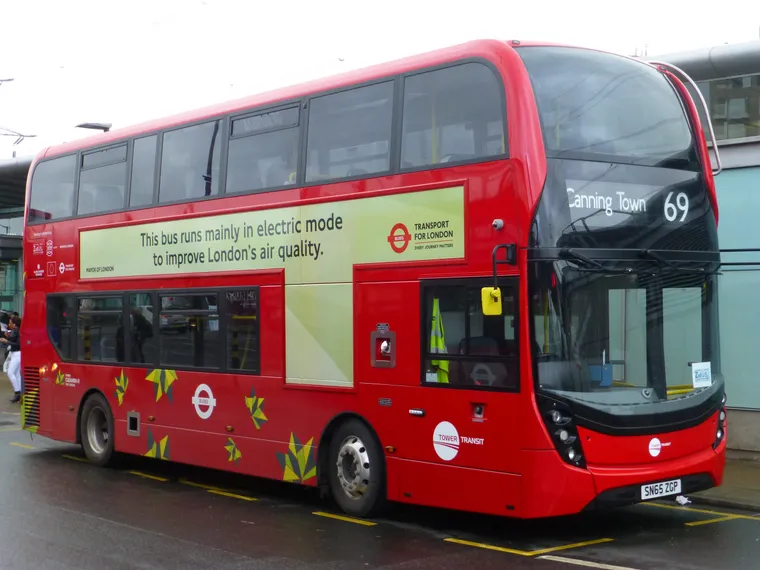
TfL have also run two trials of virtual and all-electric double deck buses in London. The virtual electric trial used specially adapted Alexander Dennis Enviro 400 buses on route 69. There were three buses in the trial and these used inductive recharging facilities at Canning Town and Walthamstow bus stations. Buses can recharge their batteries without being plugged in to an electricity supply. If required, the buses can use the small diesel engine they are equipped with if the battery charge falls below a minimum level. This is part of the ZEUS (Zero Emissions Urban Bus System) initiative organised by the UITP (L’Union Internationale des Transports Publics).
The second trial worth noting involved five all-electric double deckers produced by BYD. These were the first all electric, non-trolleybus, double decker buses in the world. These were being trialled on route 98 (Willesden Garage – Holborn) which is operated by Metroline with the buses based at their Willesden Garage. Since then, we’ve seen all-electrics introduced on routes 43 and 134. These use Optare Metrodecker EVs and Alexander Dennis Enviro 400s, respectively.
Ruling out other options
TfL have separately ruled out the use of gas as a fuel for the London bus fleet, even though Reading Buses have converted a large part of their single deck fleet to gas power.
Existing bus upgrades
In the meantime, TfL has also been out to tender for a fleet wide programme of engine and exhaust system upgrades. This covers all single and double deck diesel buses used on TfL services and is part of the commitment to make the full fleet Euro6 compliant.
Alongside the diesel upgrade programme, there is has been a small trial conversion of six older diesel buses to hybrid technology. The conversion technology was developed by Vantage Power and was deployed on 2 Volvo buses run by Go Ahead London. These were trialled on route 87 (Aldwych – Wandsworth) in 2017. It is understood that four further buses were also converted - two from RATP London United and two from Arriva, are also being converted. How successful these conversions were is as yet unknown.
Time to Hop
Moving away from emissions, an early delivery milestone for the new Mayor was the introduction of the so called “Hopper ticket” on the bus and tram network on 12 September 2016. This allows users to make multiple bus journeys for a single price, as long as they are completed within a set period of time. We have covered the technology behind the ticket before.
The ticket itself has proven a success. In September 2019 TfL reported that over 380m ‘hops’ had already been made. That success however, comes at a cost - further pressure on bus revenue. The original estimate from TfL was £30m per annum. What isn’t clear is how much of this was meant to be offset by a perceived increase in bus usage which, as we saw earlier, hasn’t happened. Indeed it is noticeable that since 2016 TfL (and the Mayor) have shifted public relations gears, with the Hopper now pushed as something that has limited the fall in bus passenger journeys, rather than something that will help foster an increase.
Whether that’s true or not remains tricky to ascertain. The dynamics of how people use the ticket is complex. Not every use of the Hopper ticket will necessarily result in revenue loss compared to the situation before introduction and there may be some truth in TfL’s claim that it has had a generative effect that is offsetting wider issues. Either way it has almost certainly cost TfL more, in raw revenue terms, than they originally planed.
The one thing TfL has released is a list of the routes most regularly “hopped” onto by users of the ticket. Indeed a Mayor’s Answer provided a list of these top 200 routes back in 2017. No one will be hugely surprised to see that the most “hopped” routes closely aligns to those routes which are busiest on the network. The long trunk route 18 (Sudbury – Euston) is the most hopped route with just over 74,000 uses in that dataset. Given the 18 interacts with a vast number of other bus services and provides a key radial link in north-west London, logic tells you that a route of this nature would feature highly. Its East London equivalent, route 25, is the third most popular “hopped” route.
The remainder of the list is a mix of routes that run radially into or across Central London, plus the busiest routes in Outer London that either provide “orbital” links between district centres (for example route 83 Alperton – Golders Green or route 41 Tottenham – Archway), plus those which run radially but don’t reach Central London ( for example route 263 Highbury – Barnet Hospital or route 81 Hounslow – Slough).
Finally, it is worth noting that phase 2 of the Hopper ticket came into use in 2018 when the Oyster system was upgraded. This allows unlimited bus and tram journeys within one hour. The upgrade also grants the discount to allow riders to make two bus rides within an hour but separated by a Tube or rail journey (for example Blackhorse Lane in E17 to Camden Town using the Vic Line from Blackhorse Rd to Finsbury Park with a connecting bus at each end). It will be genuinely fascinating what that does to ridership and revenue, and whether TfL has assumed it will be generative or not.
Facing the future
As can be seen from all the above, despite a general lack of publicity (and initial, direct manifesto commitments) there has been considerable activity on the bus front during the current mayoral term. A lot of this is positive, not least the enormous steps forward taken to ensure that London’s bus fleet plays its part in improving air quality. This is important due to the size of the impact such improvements can have.
What is also clear, however, is that this work - as well as changes such as the Hopper - have placed further pressure on TfL’s bus budget. Combined with the fact that bus journeys have remained at best static, this leaves TfL in a tricky situation indeed. Good things come at a price, and that price is becoming much harder for TfL’s wider finances to bear.
Nor is the path to better bus services wrinkle free. Later in this series we will explore some of the changes Khan and TfL have overseen in terms of bus driver employment experience, many positive, but here serious issues remain around bus driver fatigue and the way it is managed. Nor have we yet looked at the impact of increasing road congestion on bus services and more.
There is no doubt that the bus network remains a critical part of both TfL’s past and its future, but navigating the financial constraints and required improvements will be tricky in the years to come.
This article, and other elements of this series, were written by Walthamstow Writer (Paul Corfield). Paul lost his battle with cancer at the end of 2019. We publish them here in memoriam to a valued friend and colleague.
During his battle, MacMillan Cancer Support were invaluable. If you enjoyed Paul’s writing, you can make a donation on Paul’s tribute page.
Cover photo by Spsmiler