
Lots of good quality entries were received to the Christmas Quiz. Many were quite informative and in one or two cases an answer was not the intended answer but it was the or a correct answer.
The layout of the answers isn't quite as polished as we would like but we are all very new to the edit facilities that we are now using a different web hosting service and it will take time to establish what features are available. Please be patient with us whilst we discover the features available and the best way to present articles.
Question 1
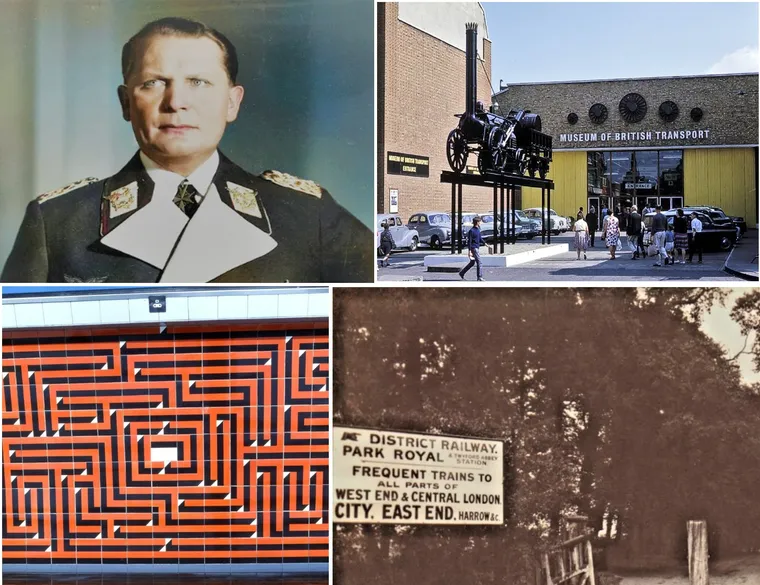
i) We asked where you could have once found a rocket in Clapham. The answer was at the former Museum of British Transport. Details can be found here. Any answer mentioning the transport museum was good enough to get the point.
ii) It seems that The Rocket in question could, until earlier this year when the question was originally set, be found at the Locomotion Museum at Shildon. However, it has now returned to the National Railway Museum at York.
iii) A quarter-scale replica could have been seen at Feltham Station in 2025. IanVisits reported on it.
Many of you pointed out that The Rocket is in fact a replica of the original although it is often referred to as if it were the original. Thanks to the person who referenced this useful and informative link on the subject.
Question 2
The question involved references to 'Bridge Cars'. This is term used to describe the carriages ('cars' in London Underground parlance) on the new Piccadilly line stock that don't have wheels or bogies and are suspended between the adjoining cars.
i) To ride one in central London in 2026 you would need to travel on the Piccadilly line.
ii) To ride a bridge car in London today you need to go to the Croydon-based tram network and travel on the one of the Stadler trams which also has the same arrangement. A couple of people gave the answer as the Cable Car (which crosses the Thames) which was clever but not really strictly bridging the Thames.
Completely coincidentally, long after the quiz was conceived, on the day before it was published, Diamond Geezer's post had a diagram showing a Piccadilly line bridge car. The diagram was taken from the PDF of a presentation about the Piccadilly line stock with numerous references to bridge cars.
Question 3
You had to identify temporarily closed major traffic intersection which was the location of many past fatalities. This was a somewhat cryptic reference to Gallows Corner. You can read all about it on the TfL website or on many of the local news websites which seem to regularly report on the troubles at this site and the apparent lack of progress.
Question 4
This was a question referring to a MyLondon article on London train station that's probably the most useless with another one 200 metres away. You were asked to state what MyLondon had overlooked. Any reasonable plausible answer will be accepted but the obvious one was that there was a stretch of water between the stations (North Dock). Nearly 3.1 million journeys a year start or end at West India Quay so the station clearly is not useless as far as a great many people are concerned.
Quite a few of you pointed out that it was easier to change to the Elizabeth line station from West India Quay which is another good reason for the DLR station's existence.
Question 5
We asked what ‘5’ went from singles to doubles, from oldest (probably) to newest and connects ‘3’ and ‘7’? The answer was Superloop 5 or SL5 which gained new electric double-deckers in 2025. Slightly perversely it connects with SL3 and SL7 which also form part of the loop in question.
Question 6
This asked what Bakerloo Railway (or Bakerloo Tube) had in common with ‘Big Bang’, ‘Crystal Palace’ and ‘Americano Coffee’. We were concerned that we would get answers that were on the right lines but not quite what we really wanted so were prepared to allow some leeway here. This turned out in most cases not to be necessary as those who answered this question recognised these terms as ones that were originally used in a derogatory manner.
The Baker Street and Waterloo Railway tried to discourage reference to 'Bakerloo' thinking it wasn't fitting but apparently the term which first appeared in the Evening Standard was used as a scathing or sarcastic reference to the line.
Similarly 'big bang' was a derogatory term used by physicists who favoured the 'steady state' theory led by Fred Hoyle as opposed to the alternative hypothesis which was originally termed the 'expanding universe' theory - but 'big bang' was catchier.
'Crystal Palace' is fairly well-known as a derogatory term coined by Punch Magazine to describe the building housing the Great Exhibition of 1851.
The story goes that American soldiers in Italy (in WW1 or WW2 depending on who you believe) wanted coffee but the local espresso coffee was too strong for them so they asked for it to be watered down leading to the Italians referring to the product as Americano Coffee in a derisory way. It was originally taken without milk but that was supposedly only because milk wasn't available.
'Lizzie line' anybody?
Question 7
i) We asked what form of transport, apart from the obvious ones, could be found at Tottenham Hale, Woolwich, Westminster and Canary Wharf. The answer we wanted was ferry. Tottenham Hale once had a ferry across the River Lea and the road outside the station is Ferry Lane. Woolwich needs no further explanation. The ferry at Westminster is why we have Horseferry Road. Just to be clear, the ferry was for horses - not it was pulled by horses. More recently, there is currently a ferry (TfL route RB4) between Rotherhithe and Canary Wharf. Sadiq Khan, rather prematurely, attended a press conference to highlight the provision of additional cycling space on the latest craft - which hasn't come into service yet.
ii) We asked what specifically was the purpose of this form of transport at these locations. The intended answer was to cross a river. This is as opposed to to travel up or downstream.
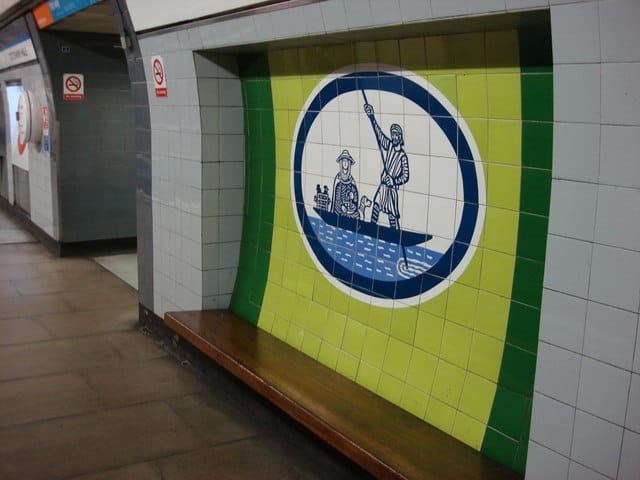
One answer suggested that the ferries involved more than transporting foot passengers which in three cases is true but, as far as we are aware, the Tottenham Hale ferry was just for people.
We recognise the question wasn't entirely clear to many of you so as long as you realise is was water-based transport and, in either part of the question, you refer to crossing the river or imply it then the points will be given.
Question 8
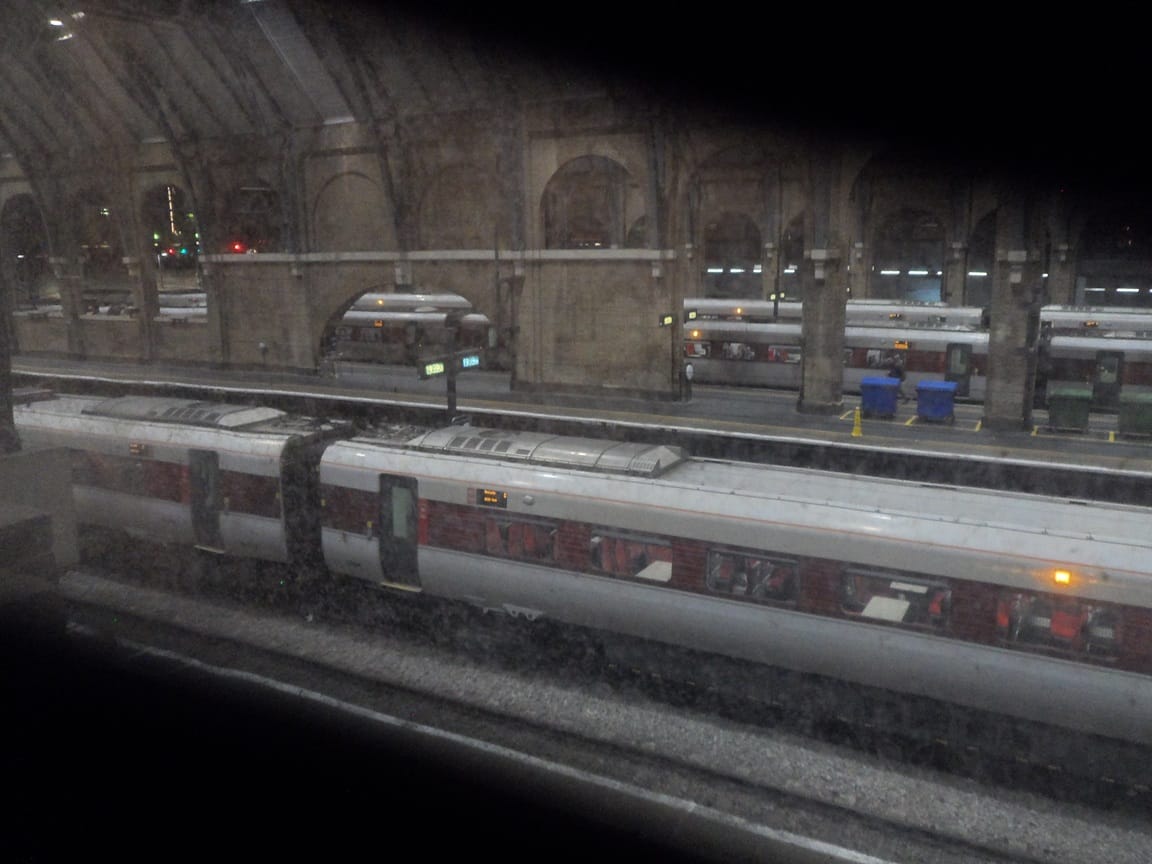
i) We asked from what building was this picture taken from. The answer is the Parcel Yard which nowadays is a rather nice pub and place to eat. Famously, the parcel yard, as a parcel yard, appeared in the film The Ladykillers and featured a critical part of the story.
ii) We asked the room within the building where this photo was taken from and mentioned this room is not accessible to everyone and probably not to most readers. Many people were completely misled by this clue which wasn't our intention and thought it was taken from the first class lounge which does seem very plausible given it is located in the mezzanine area. It was in fact taken from the ladies toilet and thank you to Martha for taking the photo. We can't believe one person actually searched the London Borough of Camden past planning applications just to check their hunch was correct - which it was.
Question 9
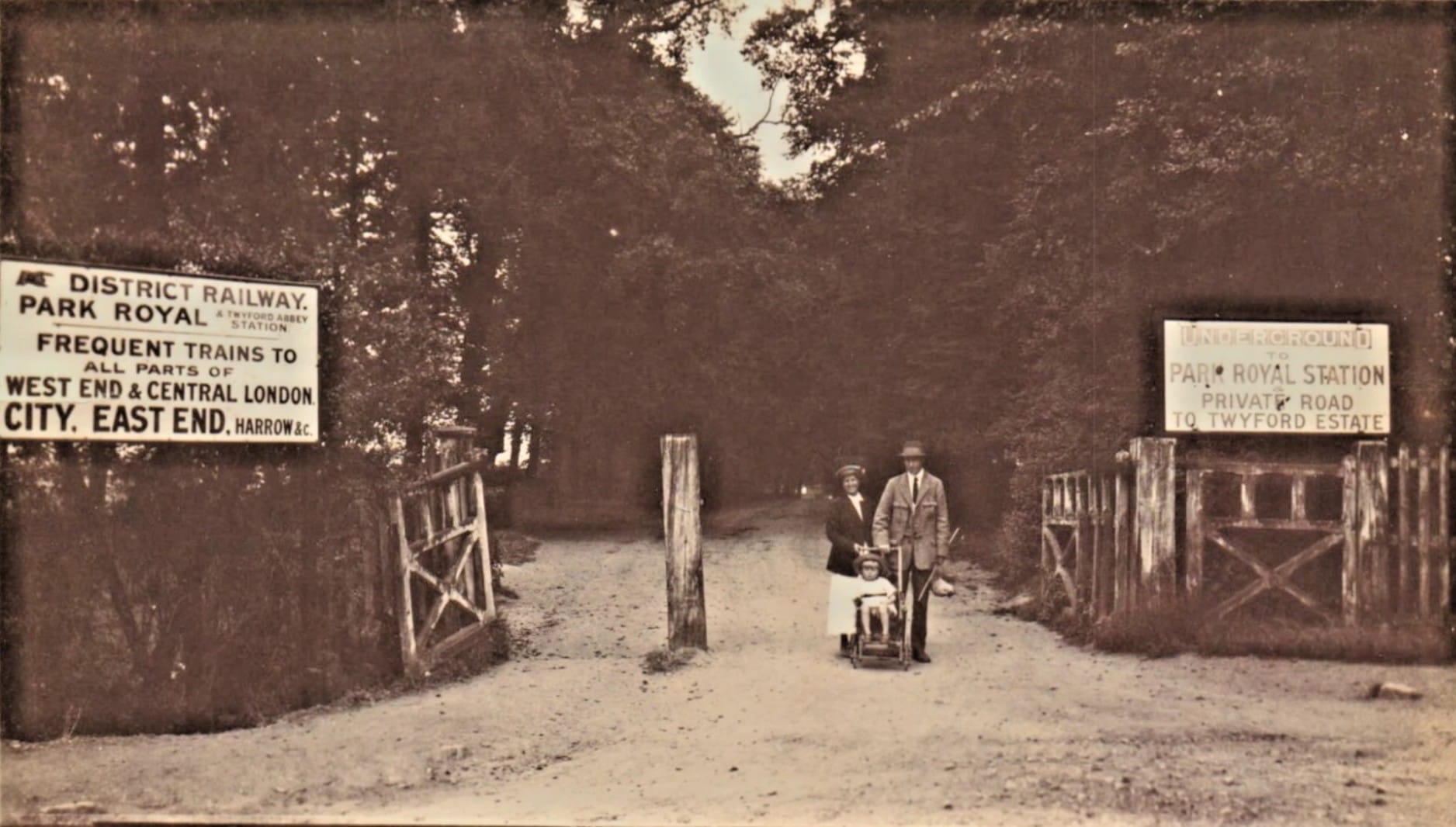
The station was Park Royal. We hoped, by reference to last year's similar question, you realised the station probably wasn't on the District line any more. This limited the number of possibilities. The further hope was that you would conclude this was a park and suggest Park Royal or that the lack of a built-up area eliminated almost all the other possibilities or simply that you would make a lucky guess.
At least one person managed to use Google's image search to find the original on eBay and a few others mentioned the postcard on eBay so in future we will have to be smarter at preventing successful images searches. We also should try and avoid published photographs where possible but that is becoming extremely difficult for historical ones.
Thanks to Jonathan Roberts, current owner of the picture, for providing this question.
Question 10
Hopefully an easy question regarding making two phrases from part of the name of two Victoria line stations and a town served by former Underground trains. If you realised we were talking about the Isle of Wight then your choice of towns was limited with Ryde the obvious one. So the answers were Hail and Ride (Hale and Ryde) and Park and Ride.
Question 11
This was a six part question based on Croydon Airport.
i) The famous field marshal who arrived at Croydon Airport in 1937 in order to attend King George VI’s coronation was none other than Herman[n] Göring. Not surprisingly, he wasn't welcome and didn't attend the coronation.
You can read about this here or here. Alternatively, the passage quoted in the article can originally found on page 182 of Croydon Airport 1928-1939.
Quite a few people gave the answer as Field Marshal Werner von Blomberg on the basis he attended the coronation. It is unlikely people would have generally heard of him and there is no actual evidence, as far as we are aware, that he flew into Croydon Airport - though he might well have done.
We concede that we were slightly misleading in not stating that Göring wasn't a field marshal in 1937 but didn't feel the need to point this out as we didn't actually state he was.
ii) The international call used in voice-procedure radio communications is correctly Mayday, Mayday, Mayday. Despite being famous it is rarely used with pilots normally formally declaring an emergency as most emergencies don't require an immediate alert. Note also it can be used to alert the controller to any emergency such as seeing an aircraft about to take off when the runway is blocked by another aircraft or other obstruction.
The Wikipedia article, as do many other people, points out the use of bad French which it tactfully describes as "sacrific[ing] grammatical accuracy in favor of communicability and recognition".
iii) The related international call for urgency but not immediate distress is also based on French. This time it is French for breakdown which is panne. Because it is a single syllable it is repeated and then the whole phrase is repeated three times so the answer is panne panne, panne panne, panne panne with spelling variations so often written pan-pan, pan-pan, pan-pan.
iv) The celebratory who visited the airport who was the first person to fly non-stop solo from New York to Paris was Charles Lindbergh. Many of you pointed out the dance named after him was the Lindy Hop although you didn't need to tell us that to get the point.
v) The airline that flew to Croydon Airport in the early days which is the longest continuously operating airline was KLM. The clue about containing letters of the alphabet should have made it obvious that you had the right answer when considering this airline.
vi) It seems, incredibly, only two people spotted the intended connection between the previous five answers. Some convoluted connections were clever but you could probably connect any five answers if you convoluted enough. All this just shows how setting a question could go wrong. We weren't looking for anything profound -all we were after was that there was a foreign element to each of the answers.
The idea was this was intended to be helpful. If you got some of the answers then this would have given you a clue to find the others. We hoped this would particularly apply if you answered parts ii to v and were stuck on the first part not realising we weren't talking about a British field marshal. This last part is probably the least successful question we have ever set.
Question 12
The fourth fixed-wing airfield in south-west London present around the middle of the 20th Century that began with the letter ‘H' was Hanworth Air Park.
Question 13
There were two questions about Epping Forest.
i) The station with the name that suggests it is the nearest station to Epping Forest was Forest Gate.
ii) The station actually closest to Epping Forest is Manor Park and the closest part of Epping Forest to the station is in an area that has the alternative name of Manor Park Flats. The sign pictured in the question can be identified in Google Streetview with the damage at the bottom of the sign clearly visible.
Chingford Plain looks like a plausible answer but on a map it can clearly be seen that Manor Park Flats is closer. Also, Chingford Plain isn't related to part iv of the following question and we stated (in the following question) that the two were related.
Question 14
i) The diagram consisting only of a black line and the picture can both be described by the words 'Bank branch'.
ii) This was a bit sneakier. The picture didn't really help but the caption did. This could be described as a test tube and a test tube is something found in a chemistry laboratory.
iii) The multiple unit shown in each of the pictures was a British Rail Class 411. Before being given a British Rail Class number they were designated 4-CEP which stood for 4-coach Corridor EPB, EPB in turn meaning electro-pneumatic brake.
Since there were two of them they were 4-CEPS and forceps are something you would find in an operating theatre.
Thanks to Southern Railway E-mail Group for allow us to reproduce their photos.
iv) The last part of the question showed three photos: a bus stop, a non-descript area of open level land and Wanstead station with an arrow pointing to a tall building behind it. The two words connecting the pictures were Wanstead Flats. The bus stop is Wanstead Flats bus stop, you will have to take it from us that the flat ground was in fact Wanstead Flats and ... - well you get the idea.
Question 15
i) Chesham is 1, Chalfont & Latimer is 2, Amersham is 3 and Heathrow Terminal 5 is 270. What are they?
The are the numbers on the labyrinth art-work which can be found at every Underground station and they are all unique and numbered. Identifying labyrinth is enough to get the point.
ii) The numbers are the stations in order visited to secure the world record time for visiting all London Underground stations. This record was made some years ago and is unlikely ever to be beaten as the Guinness Book of World Records has set an unrealistic maximum time for any subsequent attempt that must now include Battersea Power Station and Nine Elms. Those two station were not on the winning route so they can't simply be numbered 271 and 272.
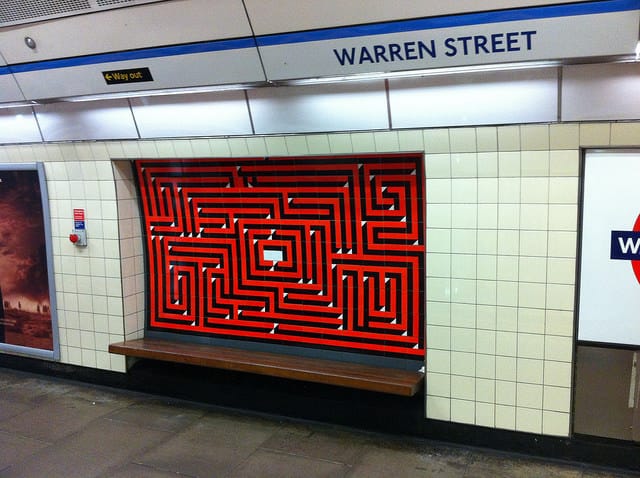
iii) Warren Street station not only contains a labyrinth but also a number of mazes as tiled murals behind the seating. Technically, labyrinthes and mazes are different.
Question 16
i) Newbury Park and Earl's Court (and previously Hillingdon) are appear on the National Rail live trains website as they are/were used as termini for rail-replacement buses. Newbury Park is a regular destination for when the Great Eastern Main Line closes - typically to run to and from Ingatestone. We don't know what Earl's Court is used for but presumably the West London (Mildmay) line. Hillingdon has been used in the past for major Chiltern Railways closures.
ii) Most London Underground stations have a three letter National Rail code starting with 'Z' - as does 'zebra' e.g. Whitechapel (ZLW), Farringdon (ZFD. Rare exceptions include Bond Street (BDS) and Tottenham Court Road (TCR).
Question 17
What connects the Cabinet War Rooms, the original name of the village that is one of the termini of the 146 bus and railway lines leaving London?
A set of cabinet war rooms was located at the former Down Street Underground station. The 146 bus terminates at Downe which was renamed from Down after the General Post Office required it to be renamed due to being confused with County Down in Northern Ireland (hence Down House, home of Charles Darwin, located in Downe). Railway tracks towards London are known as Up lines and those away from London known as Down lines.
Question 18
This contains a series of questions about TfL services and rivers.
i) The Jubilee line was originally going to be named after a river. Possibly more accurately, it was going to be named after a street which was named after a river.
ii) The river in question was the Fleet.
iii) We asked you to name five two-word Underground stations that have the name of a river as one of the words. There are many possibilities but some more obvious ones are: Roding (Valley), Westbourne (Park), Stamford (Brook - assuming a brook is a type of river), Brent (Cross), Dollis (Hill - also a brook). Other answers acceptable. Basically if Wikipedia says it is a river we will allow it.
iv) Fairly Famously, the Westbourne is encased in a metal pipe which itself is enclosed in a conduit above the platforms at Sloane Square station. This was excellently described in an episode of Secrets of the London Underground (about 3:30 minutes in from the start).
v) Much less well known is that the Fleet is below the platforms at Blackfriars Underground station. Apparently it was visible (as an enclosed sewer) to passengers before platform extensions were made in 1961-62.
vi) If things proceed as recently announced (in the budget), Thamesmead station will be added to the DLR.
vii) The other possible future DLR station with a river name in it is Thames Wharf.
viii) In 2025 the River Wandle was polluted by a diesel fuel leak as reported by the BBC and subsequently confirmed as coming from Thornton Heath bus garage.
Question 19
This question was about National Rail services and rivers.
i) Govia Thameslink Railway operates the Thameslink service (either answer acceptable. Merseyrail was not the intended answer but we will treat it as valid as we never put a London restriction on the answer.
ii) The 4-platform National Rail station within zones 1-6 which has a river name within the station name and is notable for platforms 3 and 4 being a considerable distance from platforms 1 and 2 is Peckham Rye - the river (or 'small stream') being the Peck. It is the probably only station with these platforms so far apart so it was just a matter of establish that there is a river name with the station name.
iii) Thames Ditton is in Zone 6 but not in Greater London.
iv) Lewisham has a confluence of two rivers between platforms 2 and 3 but the confluence itself is not within the station. The Ravensbourne and the Quaggy merge in the appropriately-named Confluence Park to continue towards the Thames and, once merged, the resulting river is generally known as Deptford Creek.
v) The Ravensbourne is one of the rivers that confluence at Lewisham and it is also the name of a station.
Question 20
i) This part of the question asks you to identify a bus shelter sporting a floral arrangement. Most people worked out that this was located opposite Betchworth Post Office.
ii) We asked what was unusual about buses stopping in the opposite direction. Most people realised there was no bus stop there and some provided the additional information that the bus flag indicated that buses stop in both directions.
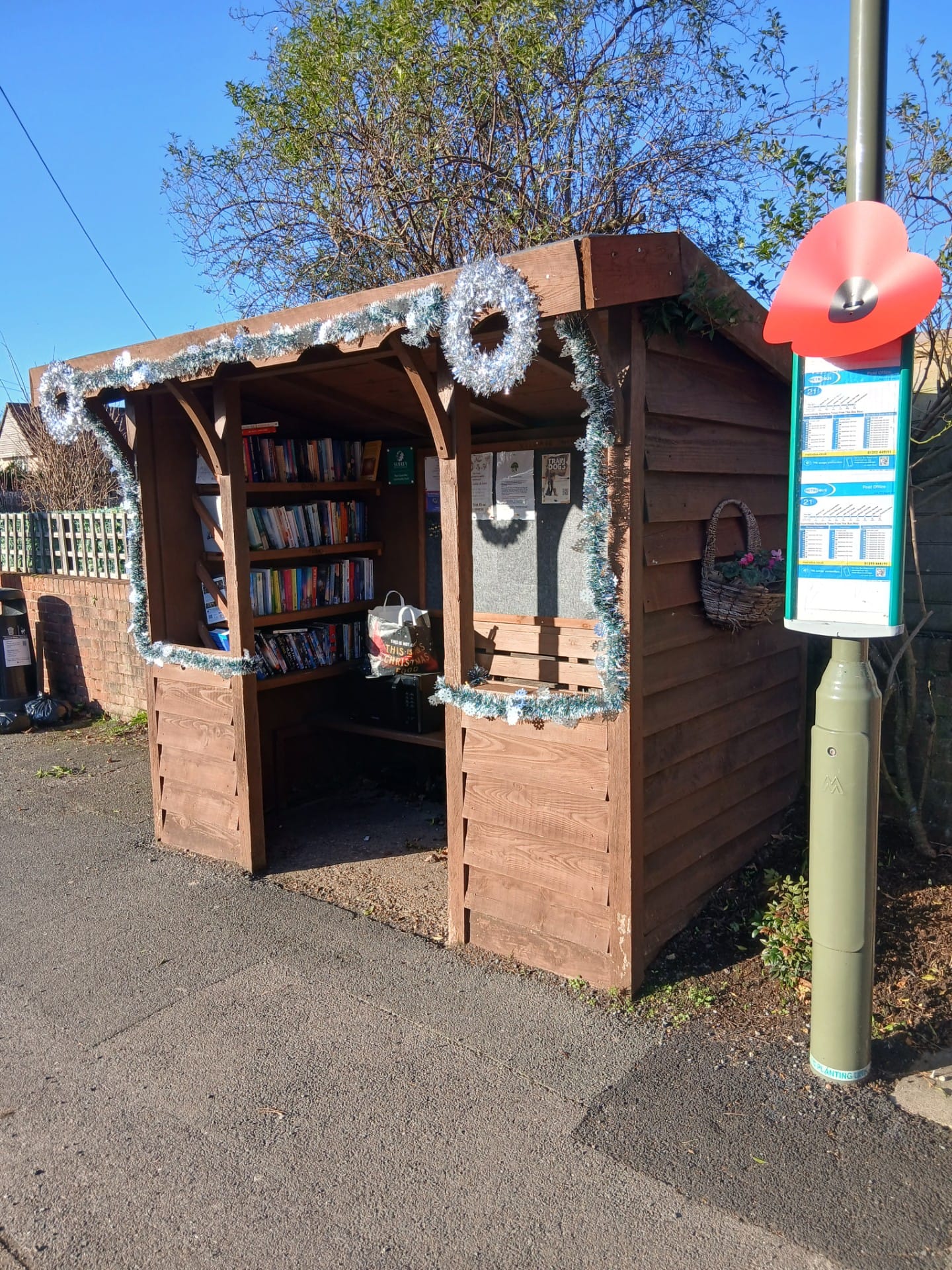
Of no relevance whatsoever is a picture of a (fairly) nearby bus stop.
We will publish the initials or pseudonyms of winners as soon as possible but this might be delayed due to ongoing winter cold/flu/covid. A tentative start has already been made on the 2026 quiz.
