
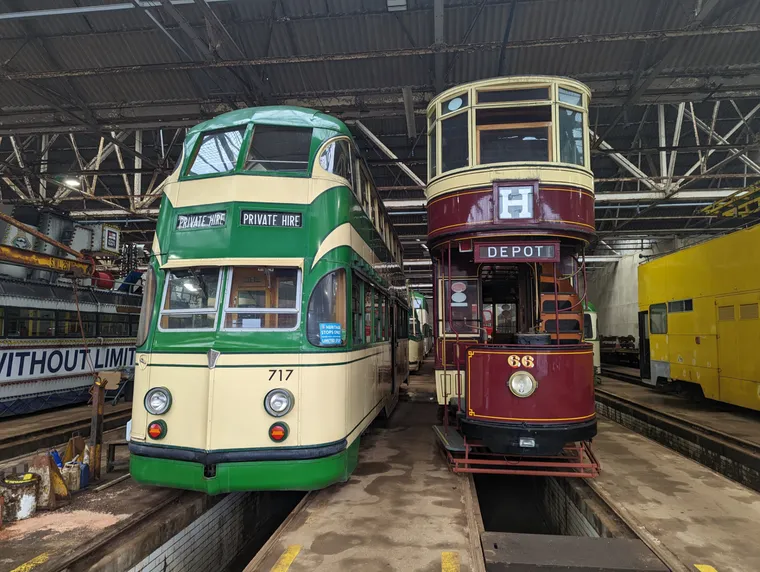
As our reading lists show, in LR Towers we firmly believe it's important to look outside London to understand the city, and its past, better. Much of London's own tram history is lost to it, but for Blackpool the story is very different. If you know where to look.
Blackpool currently has a tram network, running primarily along its seafront but with an extension to the station underway and stretches much further out. This is the modern child of what was once an even more extensive system, and thus Blackpool is arguably one of the most-overlooked components in the long history of trams in the UK. Too often it becomes bracketed in the 'seaside attraction' category in the public imagination, when the reality was - and is - so much more. Blackpool was the home of the first electrical streetway system in the world back in 1884 and has seen some form of tram network in operation ever since.
One of the contributing reasons to this has perhaps been the lack of dedicated museum space related to Blackpool's light rail history. Something that, tragically, in the past has often led to many historically important tram units or architecture at best falling into private hands - whether for display or secondary use - or worse, simply being scraped.
For those rightfully lamenting this situation, however, there is also an element of hope. Blackpool Transport (the current operator) and its various predecessors have always had a strong sense of history, and although preservation has never taken a front seat, elements within it - from senior management, to workshop, to operator level have always quietly worked behind the scenes to preserve as many of its historic fleet vehicles as possible in the spaces available to them, and with the limited funding allocated. This has, as is common at operators throughout the world, occasionally led to trams "falling off" inventory lists, but the net result has been that a number of historic units still exist within Blackpool Transport's control.
More importantly, as the value of heritage transport has become increasingly recognised, those units are no longer simply being preserved but playing an active role as heritage units in service. That leads to restoration budgets and, increasingly, to talk of permanent display.
With all the above in mind, we thought it might be of interest to LR readers for us to give a glimpse of what can be found behind-the-scenes up at Blackpool, both to give an idea of the collection and support spaces and to highlight that as volunteer days are now a semi-regular occasion at the Blackpool depot, timing a trip to coincide with one may be worthwhile. So we were delighted when we requested, and Blackpool Transport agreed to give us, access and a full tour of their current collection on a recent expedition outside the M25.
The photos below represent only a percentage of their collection, but give you an idea of the work underway as they try and balance running the new fleet of trams against their history, and establish - in these restricted financial times - whether a more permanent display of these vehicles would be of interest not just within Blackpool, but draw visitors as well.
For now, you can find out more about Blackpool tram heritage tours on the dedicated website. Our thanks to Blackpool Transport and their heritage department for being so accommodating to our visit.


