
We last looked at London’s hydrogen bus experiments, and this part of the series analyses current hydrail development. Regular operation of the world’s first hydrogen train started in September 2018 with two Alstom Coradia iLints on the somewhat isolated Cuxhaven-Bremerhaven-Buxtehude line in northwest Germany. Powered by eight 30kW hydrogen fuel cells (HFC) per car, they are replacing diesel trains on the line, with more iLints coming into service as they are completed. Hydrail, the portmanteau of hydrogen and rail transport, is the more common term for this new type of train.

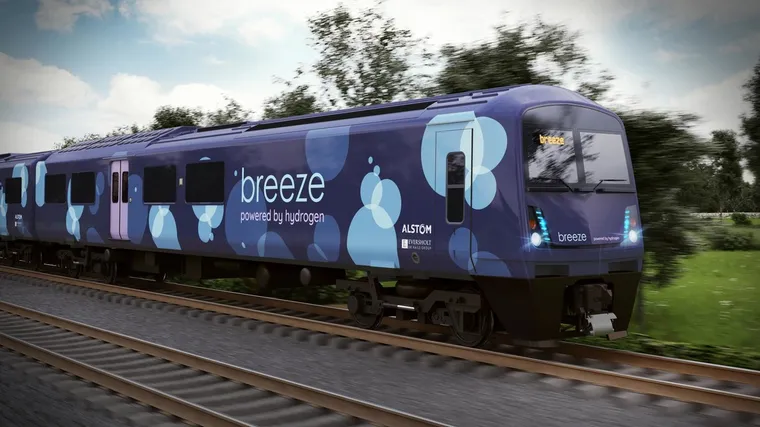
UK hydrail conversion will be a Breeze
Unfortunately, the more limited British loading gauge precludes the use of such roof tanks on imported iLints. So Alstom and leasing company Eversholt Rail are converting some of the latter's surplus Class 321 trains for hydrogen operation, called ‘Breeze’ trains. These are the Renatus units from Greater Anglia that have been retractioned with 3 phase motors and electrics by Kiepe. After scrapping the middle trailer cars, the iLint hydrogen fuel cell system will be installed in the end cars of the three car units at Alstom's Widnes Transport Technology Centre. This will become Alstom's hydrogen conversion centre of excellence once the trains are in production. Once they receive an order, Breeze trains could be operational within three years.

However, these trains will be space inefficient, as the three-car trains would provide the same passenger capacity as a two-car DMU - the area behind the drivers cab and the first set of passengers doors is lost to hydrogen storage. This means the trains will no longer be able to double up on short platform routes, which will limit the lines they can operate on.
Alstom/Eversholt are targeting Breeze units to replace diesel trains on regional lines. Breeze trains will have a range of 1,000 km and reach a maximum speed of 140km/h. In particular, the companies have been working with Northern to develop options for a fleet of Breeze units in the Tees Valley, from Middlesbrough to Nunthorpe, Bishop Auckland, and Saltburn.
These upgraded trains were given the acronym HMU (hydrogen multiple unit) and an entirely new TOPS class. As the Class 6xx series has been reserved for alternative traction like hydrogen, and Breeze trains are the first of this type, they were bestowed the first number, Class 600.
Alstom's goal is to develop a motive technology with much cleaner operation. Due to much less vibration and a 7db noise reduction compared to diesel, fuel cells provide a more comfortable ride. And with higher energy density compared to batteries, hydrogen fuel cells seem to be a good solution. Alstom also wanted HFCs with the same performance as diesel in these application, for interoperability and scalability to retrofit this technology across many different train types. This meant using industry standard components as much as possible, and familiar cab equipment for the driver.
Hydrogen for these trains is produced by two wind turbines powering a 5MW electrolyser. Whilst pricey to operate, this method is much more environmentally friendly than the fossil fuel method, and it provides the purest hydrogen. Alstom built a mobile refuelling station, which has proven useful for demo trips to other lines and countries. Alstom has been looking for more customers, and signed a deal in Germany for 22 Coradia iLint hydrogen multiple unit (HMU) trains, for a 2022 delivery. Anonymous Widower provided his observations of his ride on the German iLint in 2019.

Flexing the hydrogen muscles
There is a homegrown hydrail solution in the offing as well - Porterbrook and the University of Birmingham’s Centre for Railway Research and Education (BCRRE) have fitted Ballard HFCs to an existing Class 319 electric multiple four-car unit, called HydroFLEX. The next step of main line testing has recently received approval, as HydroFLEX successfully completed its proof of concept.

The goal of HydroFLEX is to develop an electrically powered train that can operate cleanly on all of Britain’s rail network, as part of the effort to decarbonise Britain’s railway. DfT recently set the goal of eliminating the country's 3,900 diesel-only locomotives from service by 2040, and is supplying some funding for HydroFLEX. UK Research and Innovation’s Innovate UK unit also provided £400,000 under its First of a Kind (FOAK) Programme, which will enable the HydroFLEX development team to develop the detailed final production design and testing of the train. Initially referred to as Class 319 Flex, they are now allocated the Class 799 TOPS designation.

HydroFLEX is a hybrid design, drawing most of its power from overhead lines or third rails, with the fuel cell kicking in where neither option exists. One of the four cars on the converted Class 319 unit holds the 100kW proton-exchange membrane (PEM) fuel cell and 20kg of hydrogen stored in four high-pressure tanks. The HydroFLEX train also carries 200kW of lithium-ion batteries to store the hydrogen fuel cell and braking regeneration electricity.
Hydrogen hybrid power
Almost all current hydrogen-powered trains are really battery-powered, with the hydrogen fuel cells used to recharge the batteries. Fuel cells on trains are still too weak to provide sufficient electricity to power trains directly. For example, the fuel cell power of a Coradia iLint is well below that needed by a Pacer to crawl away from a station. Hydrogen-powered trains also need a large tank for the hydrogen, which as we have seen can limit passenger capacity. Unless it is creatively stored in the roof, shewn here with each car of Alstom’s German iLint storing 98kg of hydrogen:

In Europe, 60% of track-miles are already electrified. But electrifying existing tracks can be prohibitively expensive, particularly for low volume lines. Japan and South Korea are planning hydrogen trains, and California and North Carolina are evaluating converting passenger trains to hydrogen power in the US.
Advantages of Hydrogen Fuel Cell Powered Trains
1. Flexible levels of hybridization
A modular HFC design allows different hybrid configurations of batteries and fuel cells, by adjusting the ratio of fuel cells to batteries, to satisfy different performance and range requirements.
Hybridized fuel cell trains can:
- handle loads of up to 5,000 tonnes
- travel at speeds up to 180 km/h
- achieve long distance range of up to 700 km
2. None of the operational constraints of an all battery configuration
Battery powered trains have significant drawbacks, including heavier weight, shorter range, and increased downtime to recharge. This limits such trains to only certain routes.
Fuel cell powered trains can operate on a wider range of routes and environmental conditions, however, with much less downtime. HFC trains are most economical for routes of over 100 km.
3. Potential lower total cost of operation
Not only is catenary infrastructure for fully electric trains expensive to install ($1-2 million per kilometer), it can also be costly to maintain.
Ballard’s total cost of operation (TCO) analysis shows that hydrogen-powered trains become the least costly alternative compared to both diesel and catenary electrification when:
- the cost of diesel reaches EUR 1.35 per litre
- the electricity price is less than EUR 50 per MWh
4. Little compromise in performance
Hydrogen-powered trains are just as flexible and versatile as diesel-powered trains with a similar range. They can cope with the requirements of rail transport just as well as diesel trains can, and will likely be part of the replacement technology when diesel is phased out.
Best use profiles for hydrogen
Fuel cell systems on trains can vary depending on the power demand profile. Long-distance and freight trains make fewer stops, so a larger fuel cell and smaller battery system are recommended. But as light rail and commuter trains start and stop more frequently, so it makes sense to have a relatively larger battery and a smaller fuel cell to optimise the regenerative braking energy storage.
Fuel cell modules are combined in different combinations for trains, buses, ferries, and heavy-duty trucks, with different supporting components and structures accordingly.
The UK HydroFLEX prototype demonstrated that hydrogen fuel cells can be incorporated effectively within existing trains, without requiring modification of the drivers’ controls. What the pilot didn't study was whether it would be cost effective, or environmentally prudent, to develop a hydrogen propelled railway and logistics chain.
UK view on hydrogen
Unofficially, DfT are fervently hoping that hydrogen fuel cells can help it avoid costly further rail line electrification, despite hydrogen energy efficiency being less than half of an overhead line power supply. This strategy has resulted in push back from much of the rail industry, with Transport Select Committee support, who want the more efficient electricity regenerating overhead electrification. Whilst the goal is 90mph/145km/h operation, DfT analysis is now saying that hydrogen is only worthwhile up to 75mph. This is due to the energy intensity required at higher speeds, which requires a greater quantity of battery and fuel cells, as well as hydrogen storage – so, fewer passengers.
For rail freight applications, hydrogen power would require four hydrogen fuel tank wagons to match the Class 66 diesel's range, which would remove freight capacity that eliminates the gross margin on even the longest UK freight trains. On the passenger rail side, the Institution of Mechanical Engineers (IMechE) recommendation is to run hydrail trains on rural branch lines only (max 75mph) with few stops, as only a third of the kinetic energy in a stop is recoverable with regenerative braking.
The trial area is Northern services centred on Middlesborough in 5 directions e.g. Saltburn / Whitby / Northallerton / Darlington / Hartlepool + Sunderland, as as this area typically has long platforms. Hence the loss of usable train length isn't a significant issue as it is elsewhere on the Northern network.
Scotland’s Class 314 hydrogen conversion
The devolved Scottish government is also investigating the costs and benefits of hydrogen fuel cells. Preliminary work started in September 2020, leading the University of St Andrews, Scottish Enterprise, and Transport Scotland to identify a suitable hydrogen train demonstrator. The goal of the £2.74 million contract is to develop a hydrogen demonstration train to be operational in time for the COP26 world environmental summit in Glasgow in November 2021. It will run on the Bo’ness and Kinneil heritage railway, off Network Rail’s metals to streamline the development process. Other objectives of this initiative are to determine whether such technology will be beneficial in addressing Scotland’s passenger rail services decarbonisation target of 2035.
In December 2020, the contract to convert a surplus Class 314 EMU was awarded to a consortium led by Arcola Energy, working with Arup, Abbott Risk Consulting, and Aegis. The 3-car Class 314 demonstrator hydrogen train will store 80kg of hydrogen. For actual passenger use however, an operational train would require double the amount of hydrogen, which would have to be stored within the coaches, in ventilated spaces. The 314s’ DC motors were replaced by AC motors for easier integration with Arcola’s powertrain. As the 314s were withdrawn from service due non-accessibility for persons of reduced mobility, they cannot re-enter service (without major alteration), and no new TOPS number was assigned.
Government support is still crucial however
Alstom's Coradia iLint Germany trial came to fruition due to a large demonstrator trial grant. Currently no other proposed hydrail line makes sense economically without a large subsidy, as the mobile refuelling rigs are expensive and slow to refuel, to the extent that they actually increase the rolling stock requirement.
The DfT hydrogen train trial forced on Northern for the Windermere Line couldn't pass the appraisal, as battery train was determined to be is a better choice for the line’s profile. Instead, the trial will be on Durham Coast line, using hydrogen generated from the planned Billingham Biomass Power Station (on the site of the former coal-fired North Tees Power Station), and the Wilton coal, oil, gas and biomass generation station.
The French Government has just entered the hydrogen realm, covering €47m of development costs for an order of twelve Alstom Coradia Polyvalent dual mode electric-hydrogen trains, with an option on two more. SNCF Voyages cites the €190m order as a significant step in reducing rail transport CO2 emissions, and to develop a hydrogen ecosystem. These four-car, 72m-long trains have 218 seats and the same performance as the dual mode electric-diesel version, and a 600km range. The Polyvalent is the latest variant in the Coradia family, with a maximum speed of 160 km/h (99 mph) in electric or bi-mode at voltages of 25 kV (AC) and 1.5 kV (DC). These trains will be operated in the Auvergne-Rhône-Alpes, Bourgogne-Franche-Comté, Grand Est, and Occitanie regions.
So where do we stand then on hydrail?
Hydrail is still in the learning to walk with supports phase - economic self-sufficiency is still years or even decades away. Notwithstanding this fact, politicians have been quick to plan commercial operations on this still developing technology. Hydrogen fuel cell technology is about where battery electric vehicles (BEV) were in the 1990s - there were a few on the road, and even fewer in commercial operation. But it's only in the late 2010s that BEVs are being mass produced. Applying a similar timescale to HFCs, 20 years from pilots to production, places hydrogen vehicles as somewhat commercially viable in the 2030s. Obviously the timescale depends greatly on how much research and development progress is made. As hydrogen fuel cells are increasingly used in more trials, applications, and modes, including ships, and clean hydrogen production comes down in price, the hydrogen landscape could slowly grow and mature into a useful technology.
Nevertheless, it will require quite a technical breakthrough to overcome hydrogen fuel cells’ 35% efficiency:

At best, hydrogen is only likely to be a novelty rail transport technology for niche and demonstrator applications.
Thanks to NGH and the LR Towers Brain Trust for the assistance in writing this article.
This is the second of a three part series investigating the practicality and potential of hydrogen as motive source. Part 1 analysed London’s hydrogen bus experiments, and Part 3 will look at current hydrail developments; clean, cleanish, and downright dirty sources of hydrogen; and numerous other factors.
