
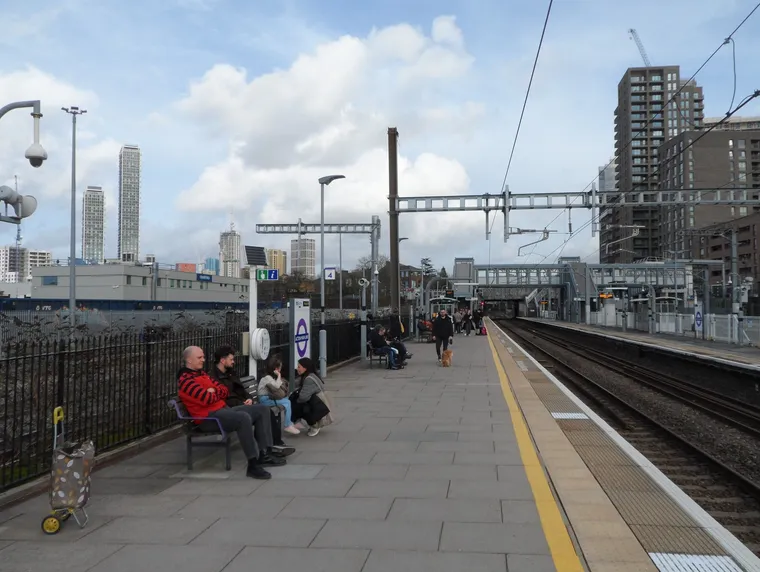
There has been no specific exciting news recently about the Elizabeth line, but there are various snippets of updates which, put together, are worthy of a report.
Improved frequency on Saturdays
This has been largely unreported. In fact, it seems that only Murky Depths had spotted this. Confirmation can be now made because TfL have, surprisingly early, published the December 2025 timetable (PDF).
From the December timetable this year, on Saturdays from roughly 11:00 to 21:00 hours the Elizabeth line will have 10tph on both the Abbey Wood and Shenfield branches. This means that there will be 20tph between Paddington and Whitechapel – something that will be welcomed by many central London users.
Whilst this might not seem a big deal, it is long overdue and it means the ceiling of 8tph/16tph (eastern branches/central section) off-peak service will have finally been breached. This is particularly good news as it may pave the way for the same frequency between the peaks during the Monday to Friday service which would also be very welcome especially as rail passenger numbers in general are almost back to their pre-Covid level. It should be remembered that the intention before Covid came was that the 10tph off-peak service would be introduced on opening.
The Gidea Park anomaly

Two of the 10 trains per hour towards Shenfield on Saturdays will terminate at Gidea Park. This seems very strange. Whilst the running time between Gidea Park and Shenfield is not trivial (13 minutes), the benefit of terminating 2tph short seems very limited – all the more so when one considers it takes two minutes to continue to the reversing siding at Gidea Park. The benefit in terms of stock utilisation amounts to one fewer train in service at most. The disadvantage is the loss of an even interval timetable between Gidea Park and Shenfield.
In the westbound direction (towards London) there are two 12 minute gaps between trains per hour on a service that otherwise runs at six minute intervals. One can argue this is not not especially inconvenient as people often leave home aiming to catch a particular train. It does rather diminished the 'turn up and go' concept though.
In the eastbound direction (towards Shenfield) an attempt has been made to mitigate the effects of this 12 minute gap by delaying the previous train by two minutes which creates an eight minute gap followed by a four minute gap at stations as far east as Gidea Park and an eight minute gap followed by a ten minute gap for Harold Wood and Brentwood. Given that most passengers do not travel further east than Romford, it does seem questionable if this retarding the timings of a particular train by two minutes is generally of overall benefit given that only passengers alighting at Harold Wood and Brentwood would benefit from this arrangement - assuming the majority of Shenfield passengers would probably take a fast Greater Anglia service instead.

It is hard to find a logical explanation for this. If you are going to do this why not do it consistently and reduced the service to 5tph between Gidea Park and Shenfield? This would not be unduly inconvenient for the relatively few passengers between Gidea Park and Shenfield. A possible reason for the 2tph terminators is something to do with Gidea Park having a crew depot. It is also just possible that maintaining 10tph on the Gidea Park – Shenfield section for long periods is unsustainable for the power supply transformers as it won’t give the transformers a chance to cool down – but that seems unlikely.
A difficulty at platforms 5 and 8 at Stratford?
A further issue may occur with the ‘Crossrail’ platforms at Stratford which also serve 2tph c2c trains from Shoeburyness to Liverpool Street at weekends. The importance of c2c trains calling at Stratford at weekends has risen in recent years with the opening of Westfield at Stratford. A further benefit is that Liverpool Street is more inviting as a station than Fenchurch Street and has better connections with other services. c2c trains cannot terminate at Liverpool Street Mondays-Fridays due to lack of peak period platform capacity at Liverpool Street and, in any case, could not be platformed at Stratford during peak hours.
With a 10tph service, one would have to either ‘flex’ the Elizabeth line timetable to fit in the c2c services (which has not been done) or somehow fit a c2c train in between two Elizabeth line trains six minutes apart. Given the actual dwell time at these platforms can be one minute or longer, this would seem to be a tall order.
Whilst this could have easily been resolved by c2c trains using platforms 9 and 10 at Stratford, it would have meant a loss of convenient same-platform interchange with the Elizabeth line and cross-platform interchange with the Central line, and so this has not been done. It will be interesting to see if problems arise at platforms 5 and 8. During the working week in the peaks, these platforms handle 14tph but this is for a relatively short period and the users are seasoned commuters who generally travel light. Furthermore, trains are never scheduled at less than four minutes apart. It might be only 12tph on Saturdays (10tph Elizabeth line plus 2tph c2c) but many of the passengers will be less sure of what they are doing and are more likely to be wheeling along buggies or heavy suitcases. Not only that, there are two consecutive gaps between trains of only three minutes occurring twice per hour.
Stabling for the extra 10 trains
One of the issues we have commented on before is the lack of stabling space for the 10 extra Elizabeth line trains on order and now being built. A helpful article in Modern Railways August issue (TfL at 25) confirms there is space available for five trains at Old Oak Common Depot. To quote the article:
Options to the east of London have been looked at, but the most likely outcome is that agreement will be reached with the Great Western Railway on stabling Class 345s at Reading depot.
The comment about options east of London is interesting because it shows where TfL would like to put the extra stabling sidings if a suitable site were available. It also probably suggests that this would be the preferred option in future if ever there were a requirement for more or replacement stabling sidings.
Given the stated desire to have the new trains in service as soon as possible, TfL’s options for new stabling sidings were looking limited so perhaps we should not be surprised at the use of Reading. One advantage of using GWR’s Reading depot is that, should a suitable location subsequently be found at a more convenient location, it should be possible to terminate their agreement with GWR – especially once GWR becomes government owned (as is the plan for all train operating companies).
The fact that there is spare stabling space at Reading is down to the GWR Class 769s never entering service and returning to the lessor. It is quite likely that GWR will want the stabling space in future and it would be interesting to know the details of any agreement that is reached and any termination clauses present.
Stabling trains at Reading does raise the interesting possibility of improved services prior to the morning peak and late in the evening peak as trains come into service or go out of service. There is also the possibility of taking over the anomalous GWR night service on the relief lines between Reading and Paddington serving seven stations normally served by Elizabeth line trains.
Old Oak Common
HS2 serving Old Oak Common between 2029 and 2033 has been deemed “not achievable” by Mark Wild, Crossrail saviour, in a report endorsed by Lord Hendy, rail transport minister. As has been pointed out, most notably by our contributor Jonathan Roberts, the Elizabeth line is far more important for the development of the Old Oak Common area than HS2, so the delay to HS2 running doesn’t really impact much on the local area but not opening the station at all most certainly does. To what extent this matters is hard to determine with a lot of the current activity in the general area unlikely to lead to a substantial number of jobs e.g. data centres.
It seems that the opening of the station will be delayed but by how much has not yet been determined. This delay might be helpful in resolving the question of level boarding at Old Oak Common. This issue is reportedly “close to being resolved” but one suspects the solution will be a fudge solution and maybe the extra time will enable a better outcome be pursued.
What to do with the 10 extra trains?
The delay to Old Oak Common gives rise to a new issue. Five of the 10 trains on order were allocated to extending services from Paddington to Old Oak Common (four to operate the service, one as a maintenance spare) but TfL have also said they want all the trains to be used productively as soon as they are ready for service. It is not clear if having extra maintenance spares beyond the one already catered for in the new tranche of 10 trains counts as productive use.
We are getting to the point where it is becoming hard to see how all the 10 extra trains can be usefully deployed until Old Oak Common station opens. 'Package East' (28tph) would appear to need just three extra trains - maybe four. Providing an extra 2tph to Terminal 5 might be possible with two extra trains, depending on the timetable and dwell times at the terminus, but three would seem to be a safer bet. One of the 10 trains will be needed as a maintenance spare which leaves at least two unallocated trains. An outside possibility is to ultimately go for 30tph in the central section but that would probably need more than two trains and would also make it difficult to recover from any delays with so little spare capacity remaining.
Assuming a useful role can be found for nearly all the trains, that begs the question of what happens when Old Oak Common is finally ready for Elizabeth line trains to call there including the ones extended from Paddington. It seems the only reasonable solution would be to order a further tranche of trains when this situation arises. One cannot keep ordering Class 345 trains forever. Some of the trains were constructed as long ago as 2015 – so already 10 years old.
By 2035 the first batch of Class 345 trains will be at least halfway through their expected service life. The obvious solution is to buy (or lease) similarly specified trains that can take advantage of the latest technology at the time. At this point, the decision to lease the existing trains, made years ago, may turn out to be advantageous as other trains could be handed back to the lessor and replaced with more modern ones. The lessor would not be too upset because the trains could be used elsewhere and reformed into shorter trains if necessary.
An extra extra 10 trains?
What appears to be surprising is there are rumours of a further 10 trains for Crossrail. It must be emphasised these are just unverified rumours and it could simply be a misunderstanding based on the original extra 10 trains. If true, then TfL would almost certainly have to look for substantial extra stabling siding space. It is also difficult to envisage just how the trains would be sensibly used unless, somehow, Elizabeth line capacity could be increased west of Paddington (including more trains to Old Oak Common). Even if this were possible, one wonders whether the demand would justify the extra trains.
An explanation has been suggested for the requirement for 10 extra extra trains. With HS2 delayed and the formation of Great British Railways inevitably slowing things down until things settle down, there is a dearth of new train orders for Alstom at Derby. So once again, it is said, there is a need to order more Elizabeth line trains where they can be usefully deployed. Probably TfL being receptive to the idea, or thought to be receptive, is a further factor.
Electrification of Acton Main Line to Acton Wells Junction
One of the most extraordinary long-standing cases of a non-electrified line not being electrified is the freight line between Acton Main Line, where there is a freight yard, and Acton Wells Junction – a distance of roughly 2km. Although there were a lot of benefits, it seems none of the benefits were great enough to provide a robust business case.

The Christmas closures on the Great Western Main Line required to build Old Oak Common station and the consequent need to diesel-haul Crossrail trains between Old Oak Common Depot and Ilford depot seemed to have finally tipped the balance to get this work approved according to some reports. Other reports and multiple Network Rail reliable sources suggest that the need for an alternative route for Class 345 trains to travel under their own power between east and west London was enough on its own to justify the electrification.
Regardless of the actual justification for the work, construction has been taking place for a long while now and, as can be seen of the left of the image featured at the start of the article, taken a while ago, the masts are already in place. In fact much more of the work is now complete and a rumoured energisation before the end of 2025 now seems quite possible.
If the work is complete by Christmas 2025 and approved for use in time for the Christmas holiday closure to progress work on Old Oak Common, this would benefit the Elizabeth line. Unfortunately, there is still a short section between the south west sidings (south west of Willesden) and the fast lines into Euston so GWR will not be able to run trains into Euston without having to switch to diesel traction at Ealing Broadway.
28tph in the peak in Central London
There has been no specific news on ‘Package East’ that we know of. All we can really say is that the ‘mood music’ seems to be that generally people talk about it as if it will happen. With passenger journey numbers frequently now reported as 800,000 per day it is hard to envisage this not happening once the trains are available.
Freight
As the Great Western Relief Lines west of Acton Main Line are shared with freight (along with the occasion freight train serving Tarmac’s concrete plant at Paddington New Yard), developments in freight affect what service can be provided on Crossrail west of Paddington. Fortunately, the 45mph aggregate wagons on the Great Western Main Line are now a thing of the past, and 60mph aggregate trains from the West Country can nicely slot in between Elizabeth line trains.
More recently, the general move in the freight world to more powerful locomotives may mean that fewer freight trains will be needed – although their extra length may be a handicap. Finally, the electrification of the line to Acton Wells, already mentioned, may attract some operators to switch to electric traction over this part of the route and so provide better acceleration for the freight trains enabling them to get out of the way quicker if halted at a red signal.
An extra 2tph to Heathrow
We have already reported on the desire for an extra 2tph Elizabeth line service to Heathrow. There isn’t much new to report but no objections to the plan, as far as we know, have been voiced. Again, the mood music seems to shifting towards believing it will happen. Modern Railways even reports a target date of early 2028.
Modern Railways also reports a desire for the extra T5 trains to terminate at Abbey Wood not Shenfield. This is not surprising given that one of the main objectives of Crossrail was to provide a direct service between Canary Wharf and Heathrow. Currently, there is still no direct service between Canary Wharf and Terminal 5 except for the first train of the day that departs from Abbey Wood.
A secondary advantage of the extra T5 trains going to Abbey Wood is that it is preferred that eastbound trains coming into service at Paddington (and therefore not already having passengers aboard) are destined for Shenfield as that is the busier eastern branch.
Drivers for more drivers
The recruitment rate for Elizabeth line drivers was increased a few months ago. There appears to be no one specific reason for this but factors probably are:
- A new train operating company taking over control of day-to-day running and the need for some fresh strategic decision-making.
- Many of the current drivers are former Heathrow Connect or Greater Anglia who were transferred across and are now reaching retirement age.
- Poaching by other train operating companies – a continual problem.
- Recognition of the need for extra drivers initially for the enhanced Saturday service and later for the extra trains as well as, almost certainly at some point in the future, for an enhanced off-peak service.
Sweating your assets
We have mentioned this before but having built something it makes far more economic sense to make use of what one already has before looking towards the next grand project. Crossrail has the capacity to provide a more frequent service and it makes good case financially, both to the railways and when looking at the wider economic picture, to maximise sensible use of it. We are starting to get close to maximum capacity without resorting to lengthening trains but we are not there yet so it makes sense to use that capacity so long as there is a demand for the extra services. This is clearly what TfL hopes to achieve in the next few years.
Thanks, as is often the case, to ngh for providing a substantial amount of additional information for this article.
