
When the government announced at the end of September 2025 that Crews Hill in Enfield, would be the site of a proposed New Town, with up to 21 000 homes provided, there was predictably a lot of comment, both for and against. What was missing, however, was any discussion of how such a sizeable new settlement would be served by public transport.
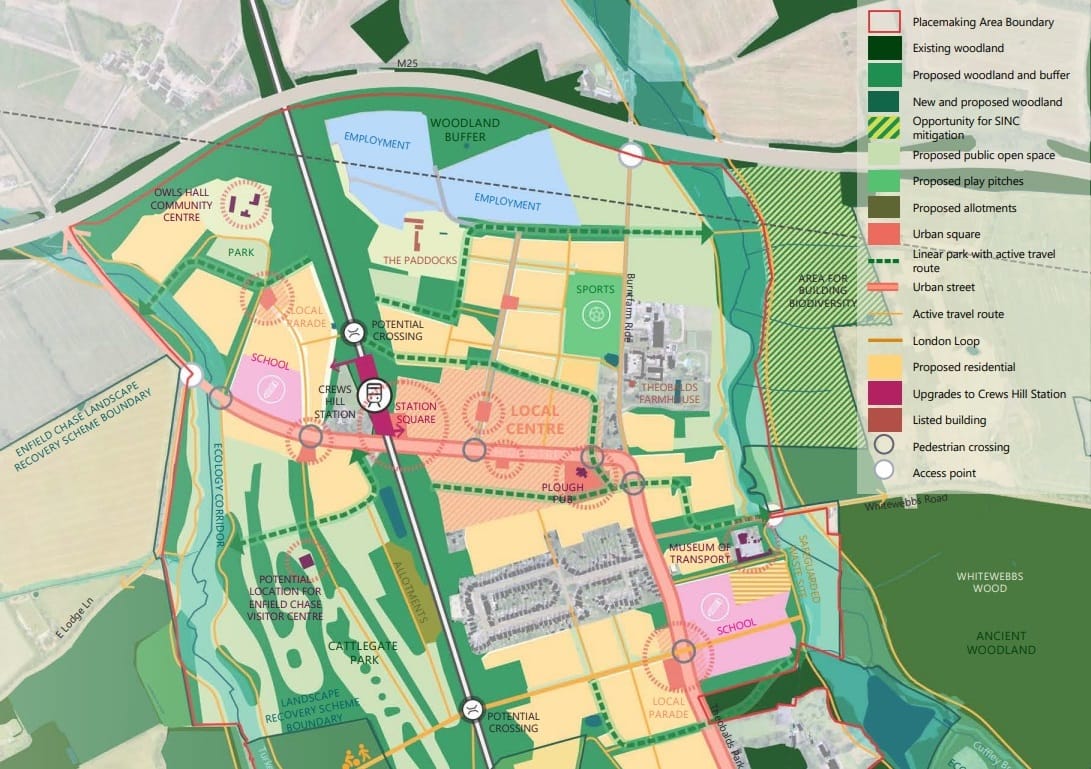
That is, apart from an intriguing comment contained in the report of the New Towns Task Force, issued alongside the government announcement. In its assessment of the Crews Hill site, it included the comment:
‘Train frequency at Crews Hill would need to be increased beyond the current 2 trains per hour during off-peak times and 4 trains per hour during peak-times. The government would need to explore options with the GLA and Transport for London (TfL), including the potential to devolve the Great Northern line, as previously happened with Greater Anglia.’
Increasing the train service is an obvious requirement, although it seems odd to implicitly link this to devolution of these services to TfL. In this article, I’ll explore both the options for increasing the train service calling at Crews Hill, and the arguments and practical implications of devolving the Great Northern ‘inner’ services to TfL.
Background
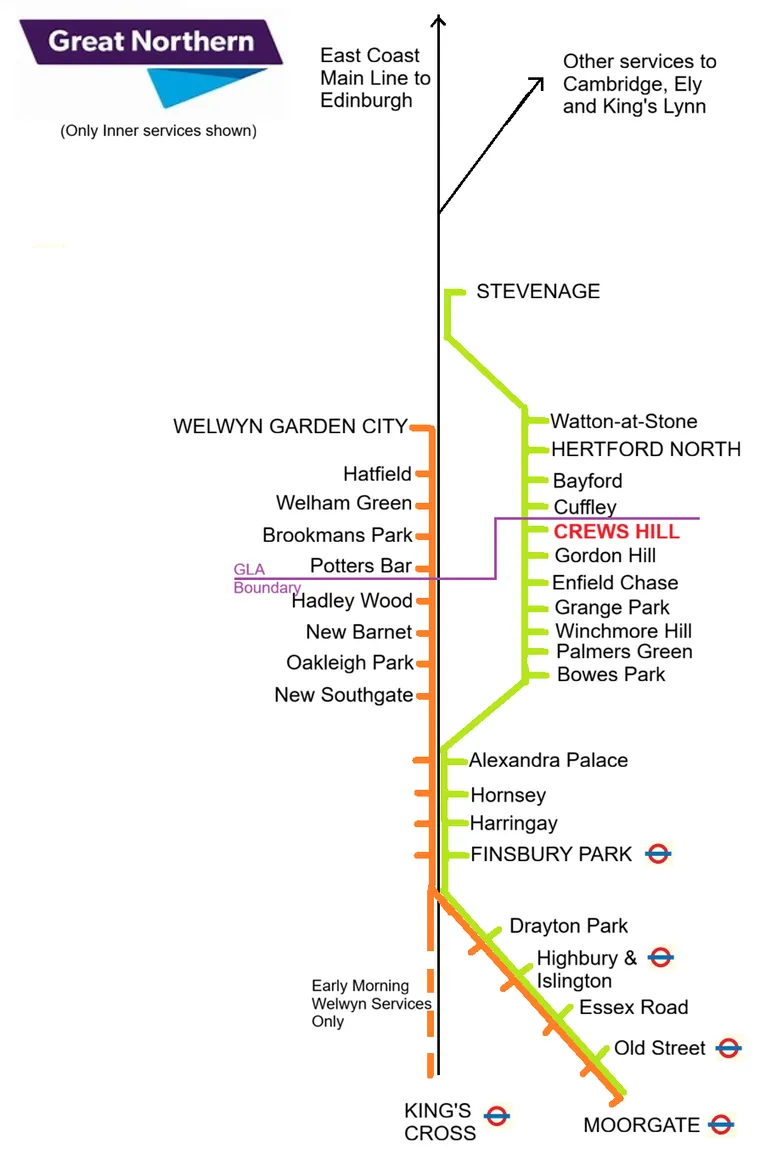
Crews Hill station lies just north of Enfield Chase, on the Hertford Loop line between Moorgate, Alexandra Palace, Hertford North, and Stevenage. There is only a small amount of residential property in the area around a station, the area being dominated by garden centres, nurseries, and other light industry, and so the station regularly features in lists of London’s least-used stations.
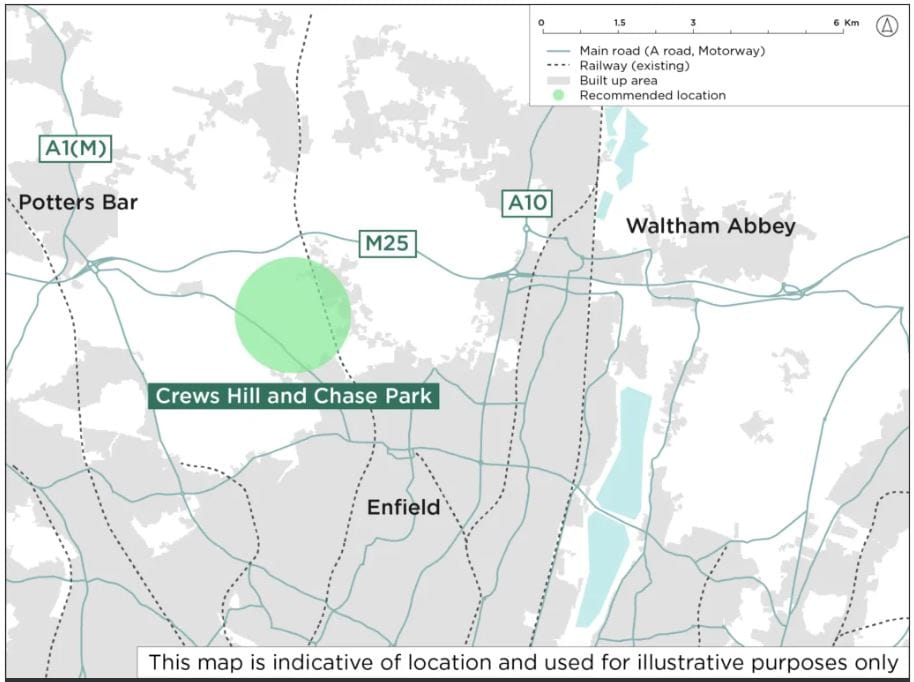
Its other claim to fame is that it’s the most northerly station in London, the boundary of Enfield Borough (and thus the Greater London area) being just to the north of the station. The current train service is 2 trains per hour (2 tph in timetable speak) off-peak, with 4 trains per hour during the peak periods, calling at all stations to Moorgate.
A better timetable?
Clearly, the current timetable would be inadequate for a town the size of the proposed settlement at Crews Hill. Even if more enlightened planning policies result in suitable local facilities such as schools, shops, and GP surgeries being provided, the inhabitants will still want to travel further afield for work (most probably London), education and leisure activities. However, the current timetable is largely a legacy of the post-pandemic changes in demand for travel (particularly commuting), a Treasury-inspired requirement to reduce costs, and more frequent services that have been provided in the past. The last pre-pandemic timetable in December 2019 included 8 trains per hour in the 08 00 - 08 59 ‘high peak’ hour on the Hertford Loop, which was possibly the line’s best-ever service, and provided an effective metro-style frequency at the south end of the line. The off-peak service was 4 trains per hour, which is close to the point at which passengers may feel that they don’t need a timetable, or to check trains times much in advance.
Therefore, providing an improved service for Crews Hill should just involve reinstating the previous pre-pandemic timetable, with some tweaks to ensure a suitable frequency at the station. Some peak-hour services only ran as far as Gordon Hill, to provide additional capacity at the south end of the route, and these could probably be extended to/from Hertford North to serve Crews Hill, and additional stops provided in the small number of trains which omitted the station. A 6 trains per hour service would provide a close to metro-style frequency at Crews Hill, whilst still leaving space for some additional services to/from Gordon Hill to provide additional capacity for passengers at the south end of the route. The fleet of Class 717 EMUs used on the route was ordered on the basis of the pre-pandemic timetable, so rolling stock availability would not be a problem.
The only complexity with this, which is probably a longer term issue, is how to serve the stations at the south end of the route. Even with changed working patterns post-pandemic, a town of 21 000 is likely to generate significant passenger numbers, particularly in the peaks. There is a possibility, therefore, that trains from Crews Hill will be full (even with the improved standing capacity from the new rolling stock) on arrival at stations further south, with no room for passengers to board. A straightforward solution would be to provide additional services starting from Gordon Hill to serve these stations, with trains from north of Enfield Chase omitting some or all of these calls to even out passenger loadings.
However, whilst the signalling system on the Hertford Loop would allow a 3-minute gap between services, and would allow such a service to be provided, the situation is more complicated on the section between Moorgate and Finsbury Park. Here, the headway (the minimum gap allowed between successive trains) is 4 minutes, which allows an absolute maximum of 15 trains in any one hour. In practice, this gives no leeway for any minor late running (such as a train taking slightly longer in a station because of a large number of passengers boarding), so a pragmatic maximum would probably be 13-14 trains per hour. The Welwyn Garden City service (the other component of the GN Inner service) has reverted to its pre-pandemic level of 4 trains per hour in the peaks, thus there may only be capacity for 1-2 additional services to/from Gordon Hill, which may not be quite enough to provide enough space for passengers. Unless some of the Welwyn services were diverted to the Thameslink route, this could lead to some difficult decisions about services into Moorgate.
That issue apart, though, Crews Hill and the rest of the Hertford Loop could look forward to a much-improved service to serve the New Town.
A TfL takeover?
TfL has been very open about its ambitions for taking over more inner-suburban services, including the GN Inners. Indeed, in January 2016, it set out a joint plan with the DfT to achieve this, based on the forecast expiry dates of the existing Train Operating Company (TOC) contracts. This was later taken forward under then then new Mayor, Sadiq Khan, with a business case being submitted to the DfT in October 2016, which was rejected by the new Transport Secretary, Chris Grayling, over concerns about the effect on passengers from outside the GLA area. It is perhaps one of the great ‘what might have beens’ whether this might have been more successful had David Cameron’s resignation in the wake of the unsuccessful EU referendum not resulted in Patrick McLoughlin’s replacement as Transport Secretary by Grayling, who was both more sceptical, and who seemed to have something of a personal antagonism towards Khan. On 30th September 2025, though, TfL decided to try again, and submitted a business case to the DfT for a takeover of the GN Inners, possibly influenced by the timing of the announcement of the New Town for Crews Hill. It may also have felt that the political climate was more favourable, with the Transport Secretary, Heidi Alexander, being the former Deputy Mayor with responsibility for transport under Sadiq Khan, and the former Deputy Chair of TfL.
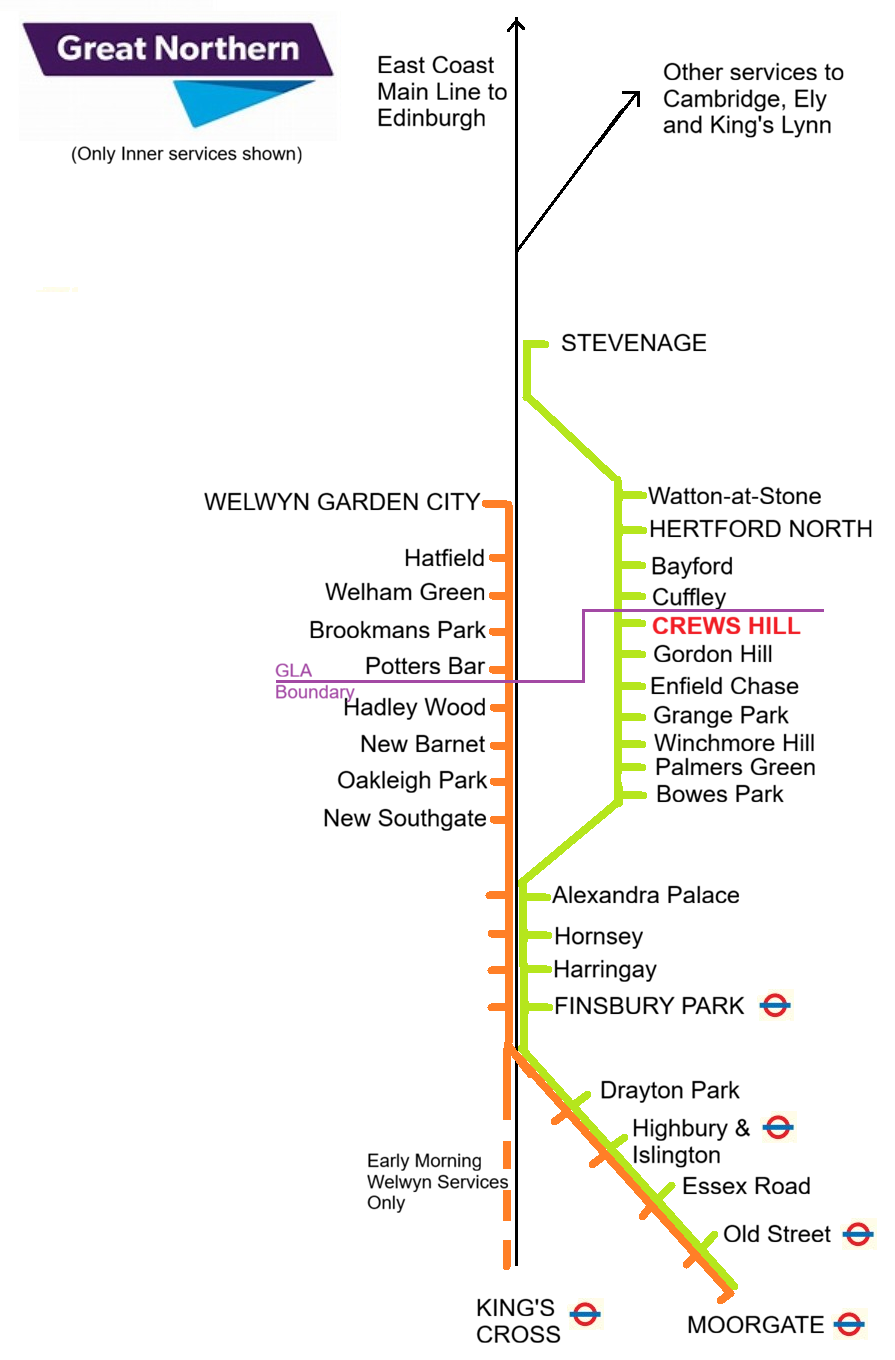
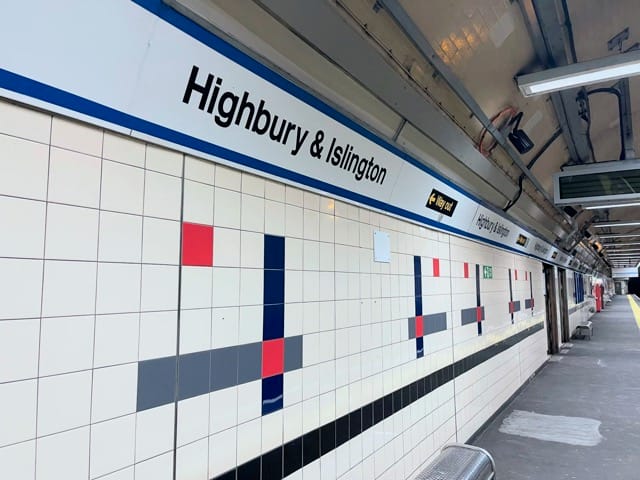
In many ways, the GN Inners would be a logical choice for a TfL takeover. They form a largely self-contained service operating on the Slow lines between Finsbury Park and Welwyn Garden City, and round the Hertford Loop, with minimal interactions with other services. They are already a type of metro service, normally calling at all stations, and only extend a limited way beyond the GLA boundary, with the exception of Stevenage.
Much of the support for TfL taking over suburban rail services seems to be based on the undoubted success of the original Overground network (now the Windrush and Mildmay lines), with neglected and disused railways reinvigorated and brought into use, with frequent services, new rolling stock, and consistently staffed stations. Indeed, in its public statements about its proposals for greater expansion, TfL has used these arguments itself. Much of the comment about a TfL takeover of services has been along the lines of ‘we’d like some of that as well, please’. However, looking at the GN Inners suggests that the situation in this case could be more nuanced.
Timetable
As described above, enhancing the timetable to provide a better service at Crews Hill ought to be possible without any wider organisational changes; this would not be dependent on a TfL takeover of the services. The pre-pandemic structure of contracts would have made this more difficult, involving negotiations with the relevant TOC, and most likely a recalibration of the complex financial models used to calculate payments to or from the TOC, all of which took time. However, since the pandemic these have changed to management contracts, with TOCs paid a fixed fee for providing a specified timetable, very similar to the contracts let and managed by TfL itself. In this case, the TOC could be instructed to provide an enhanced timetable and its management fee adjusted to reflect the increased costs. The main issue would be generating a suitable business case; the likely passenger numbers generated by a town of 21 000 would undoubtedly make this an easier prospect. The situation will be further changed when the Govia Thameslink Railway (GTR) contract is taken back ‘in house’ in May 2026. Whilst it is unclear, to say the least, how the DfT Operator (DFTO) TOCs will be managed in the interim period before the full establishment of Great British Railways, it should be easier to evaluate and progress changes to the timetable without the complex contractual overlay.
Rolling stock
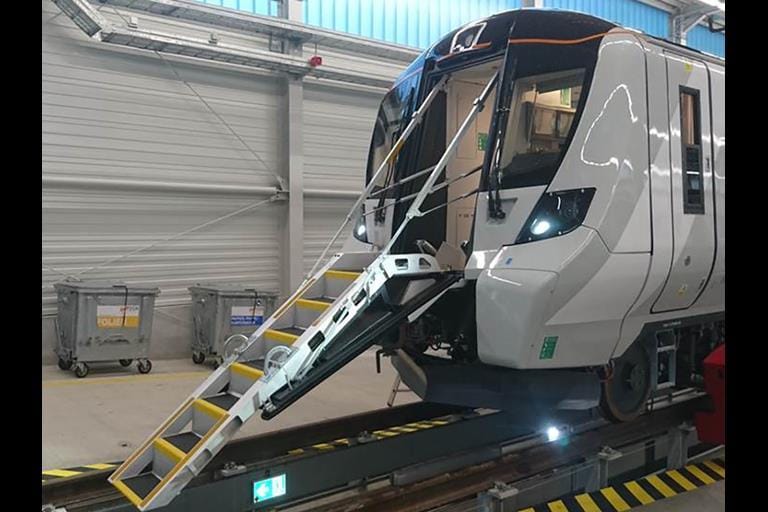
Replacement trains would seem to be unlikely in the event of a TfL takeover of the GN Inners. The Class 717 EMUs used on the Hertford Loop and Welwyn services were introduced from early 2019, and are thus still relatively new trains. Critically, they are adapted for use through the tunnels into Moorgate, with a 6-car formation, dual-voltage capability, and the emergency evacuation door and steps in the cab ends, and so may not have an obvious use on any other routes if replaced. Or to turn the argument round, any replacement rolling stock would also need these specific adaptations for operation into Moorgate, and would not therefore be a standard (and less expensive) design. The Class 717s are also modern EMUs, with air conditioning, wi-fi, plug sockets (although not USB ports), and comprehensive passenger information systems, so it’s hard to see what improvements in the passenger environment would be provided by replacing these trains.
More subjectively, the Class 717s have a more ‘main line’ seating layout, with 2+2 seating across the aisle, and wider spaces for standing in the aisles and around the doors, which allows a reasonable balance between seats for passengers making longer journeys and standing space for short-distance journeys. It’s hard to see the well-heeled passengers from the northern part of Enfield, Cuffley, and Hertford being happy with the longitudinal seating of the Class 378s and 710s used on existing TfL-controlled services, or the overall lack of seats.
Ticketing
Anyone living outside London must look with envy at TfL’s zonal fares structure, Oyster and contactless payment options and daily and weekly fares caps which give confidence about the maximum fare that will be charged. Not surprisingly, this has been one of the arguments often put forward for TfL taking over further services; the implication being that this will lead to further routes being incorporated in the fares zones. TfL itself has often referred to this as a benefit in its proposals to take over further services. This distinction, though, is slowly becoming more blurred.
Under the joint TfL/DfT ‘Project Oval’, contactless payment is gradually being extended to cover more of the South East rail network. This allows many of the benefits of the TfL Oyster and contactless fares, but without a full incorporation into the TfL fares zones. Fares are still National Rail fares, but are simplified with single-leg pricing, symmetrical in each direction, and a simpler peak/off-peak distinction. Essentially, it provides a halfway house between the current system and the full TfL zonal system. From 14th December 2025, contactless payments were extended to Stevenage via both the Welwyn and Hertford routes, so covering the whole of the GN Inners. A TfL takeover, then, could enable this final step, with the remaining stations outside the current fares zones incorporated into extended zones, as has happened with the Elizabeth Line stations to Brentwood, and Weaver Line trains to Cheshunt. Overall, though, it seems like a relatively small improvement, especially since contactless payment is now a majority method of payment for travel.
Station staffing
One area where a TfL takeover could make a tangible difference, though, is in station staffing. TfL makes great play of all of its stations being staffed from the first train to the last train. In contrast, some Hertford Loop stations are only staffed for a limited time each day, often during the morning and early afternoon, with sometimes no staffing at weekends. Whilst it may be hard to prove a causal line between providing staff at stations and reduced instances of fare evasion, anti-social behaviour, and vandalism, this should at least provide some deterrent effect. More importantly, staff at stations provide an important role in providing reassurance to passengers. Some groups feel uncomfortable or anxious using public transport at quieter times of the day, or late in the evening, so this can be a tangible way of addressing these concerns. This is important both from a position of basic humanity, in helping passengers feel safer and more confident, but also in terms of generating more revenue from passengers who may then feel more comfortable and willing to take public transport than before.
Station refurbishment to Overground standard?
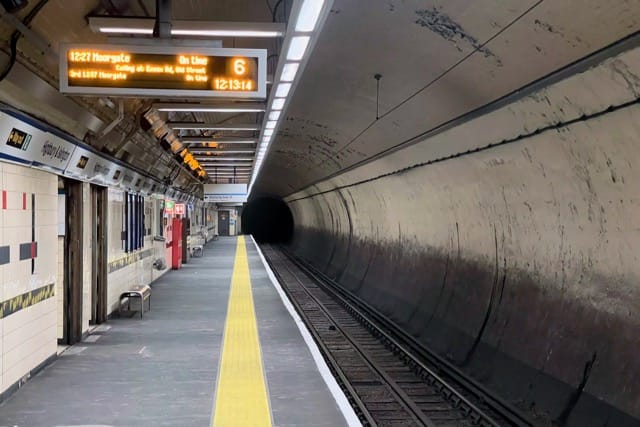
The photo of filthy track wall at Highbury & Islington's GN Inners platforms above illustrates perfectly the uninviting state of the GN line underground platforms. Essex Road is much worse.
Although TfL has been vague about what exactly an Overground takeover of the line would involve, the line's neglected and poorly maintained underground stations clearly need the ‘all-round upgrade’ of the TfL proposal. Furthermore, the six Overground lines' station deep cleaning and upgrades to TfL standard have been a large part of the network's success. The travelling public will definitely expect the same standard for all new suburban line Overground takeovers.
Conclusion
A TfL takeover of the GN Inners service seems to be quite achievable, and would have relatively few consequences for operations on the rest of the National Rail network. The political landscape is probably more favourable now than at any time since 2016, and Mayor Khan may well view this as providing a legacy from his final term in office. However, such a takeover may provide fewer noticeable benefits for passengers than previous takeovers. That’s not to say that there would be no point in doing this, or that TfL would be unable to provide any benefits; it’s more that the railway as a whole has moved forward over the last 10 years or so, and has caught up with TfL in some cases. The main effect, though, may be as much symbolic as anything. Taking over the GN Inners starts to make the TfL-controlled network look more like a regional transport network- slowly evolving into something like the Transilien network around Paris, or one of the networks around major German cities. Showing that it can effectively run such a network, and that greater co-ordination across the city and its surrounding areas brings benefits could strengthen the case for it taking over over further National Rail routes. Providing an improved service for Crews Hill New Town may not need TfL to operate the service; but perhaps the New Town provides the hook which finally tips the balance in favour of such an argument. Time will tell.