
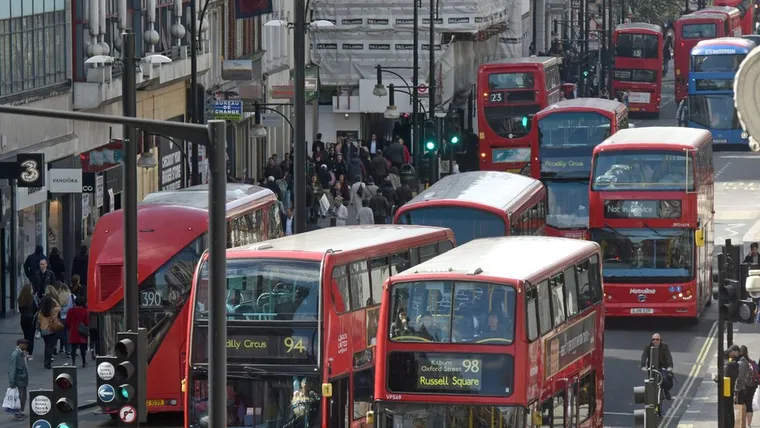
With all that has been going on in the world, it may have actually escaped your attention that TfL are now consulting on a new round of bus cuts in central London. This is nothing new – or unexpected. What may be surprising is the scale of the changes involved for this further round of cuts. I look at the background behind these and, possibly controversially, argue that these are no bad thing.
Much has recently been written about the forthcoming savage bus cuts in central London that take place in addition to recent cuts already implemented. At London Reconnections we normally try and be objective and not give a personal opinion but, on this occasion, we are breaking our normal guidelines and provide an alternative viewpoint editorial on this controversial issue. Please note that these opinions are not necessarily endorsed by the rest of the London Reconnections team. For a couple of other well-argued opinion pieces giving a different perspective on this issue, see IanVisits' and former TfL Managing Director Surface Transport Leon Daniels' takes.
Bus growth and decline
The history of buses in central London in the 21st Century is one of growth and then decline. The period of growth was in response to demand and the current period of decline is at least in part due to the current lack of demand. What has changed things for the future has been the aftermath of Covid and both the reduced level of demand and the uncertainty of how this will change in the future.
Ken Livingstone, former leader of the now-abolished GLC, came to power as the first ever London Mayor in 2000 as an independent candidate. He wanted to be the Labour candidate but the then prime minister, Tony Blair, was determined that this would not happen as he considered Livingstone both an electoral liability and a mayoral liability should he be elected.
Livingstone, determined to be the first London Mayor, stood as an independent candidate. In part due to the Labour choice of a competent but lack-lustre candidate without the charisma necessary for such a post, Livingstone was duly elected.
The problem Livingstone had
From the outset Livingstone knew that he had a major problem if he wanted to stay in office for a second term. Having learnt their mistake in the candidate chosen, Labour would not give an independent Ken Livingstone such an easy run at the next election. It was possible that he could be re-admitted into the Labour party but that was highly unlikely unless he could actually show that he could make a positive difference to the lives of Londoners in the four years until the next election. He could try a second term as an independent candidate but that encountered the same problem. The electorate might take a chance on him as first London Mayor but for a second term he was going to need a good track record.
By far the biggest London issue at the time that was within the powers the Mayor had was transport. He needed to make dramatic improvement in London’s deteriorating public transport system – and fast. The one big advantage Livingstone had was that, in his former role as leader of the GLC many years previously, he knew his way around public transport in London, both literally and figuratively, and had a good idea of what was, and what was not, possible.
Improving the bus service would not be Ken Livingstone’s ideal choice for improving public transport but something needed to be done and it needed to be done quickly. Various factors meant that bus service improvements were the inevitable target. One of these was talk of a future congestion charge and the fear of the accusation that it would be wrong to introduce this when there was no viable alternative. Another was the need to do things quickly and that there was really no other solution.
Undoubtedly, Livingstone would have liked Underground improvements but even station improvements take years and are not guaranteed to happen. Proposals at the time for a vastly improved and badly needed expansion of Camden Town station (‘doing nothing is not an option’) have still not been fulfilled despite the continuing political will and money being available in the early years of the proposal.
Increasing frequency (and hence much needed capacity) on an Underground line generally involves both a signalling upgrade with a long gestation time and a small order of new bespoke rolling stock which can both have a lead time measured in years and be prohibitively expensive.
If the time constraint making quick Underground improvements wasn’t bad enough, a further problem is that the way to get the best ‘bang for your buck’ is to go for big improvements with what the economists call ‘agglomeration benefits’. The trouble is that these are inevitably very expensive as well as taking a long time to implement. As it turned out, Livingstone’s hands would be further tied within a year of his appointment as his new Transport Commissioner, Bob Kiley from the USA, was quick to argue when appointed that the Sub-Surface Railway (Circle, District, Hammersmith & City and Metropolitan lines) that comprised of 35-40% of the Underground network needed a near homogenous rolling stock upgrade.
With National Rail, it wasn’t much better albeit for different reasons. The Mayor had the power to inject money into services to make improvements such as an increase in frequency. But this had to be done through negotiation with Train Operating Companies and didn’t provide the desired level of ability to oversee operations. Probably, more to the point, the improved services wouldn’t be identified by the average voter as something consequent on Mayoral policy. It would be different if branded as a TfL service.
It was improve the buses - or nothing
There was really nothing for it but to improve the bus services. The good news for the Mayor is that buses are rapidly scalable. With modern jacks suitable for buses and bus washers readily available for purchase it didn’t take much to convert a readily available industrial unit into a bus garage. New buses were relatively easy to purchase and people ready and willing to be trained as bus drivers were available on the labour market provided the wages were sufficient to attract them.
The downside of this bus expansion, as Ken Livingstone knew full well, was that the level of subsidy needed was really not sustainable. But, with a Mr Micawber attitude, Ken Livingstone was convinced that 'something will turn up'. This could be a disproportionate increase in ridership (which to some extent happened) or something else. It appeared to be a big risk but one Livingstone was prepared to take because he didn’t really have any alternative.
In all probability, Livingstone was not relying on luck but had a medium-term strategy. Whilst, despite what some motorists may claim, the primary aim of the subsequently-introduced Congestion Charge was to reduce congestion, a very beneficial side-effect of it was that it produced substantial revenue for the Mayor which, by law, had to be spent on improving public transport. The Congestion Charge, introduced in February 2003, was initially very successful but divisive. Over time it became less successful at reducing traffic levels, but consequently more successful at raising revenue.
Indeed, the former Commissioner for Transport, Sir Peter Hendy, has very openly talked about how, whatever the intention, the real long-term benefit of the congestion charge was providing the revenue stream to enable the improved bus service to continue.
The loss of operating subsidy
The good times were rolling and this was substantially helped by a £700m per annum operational grant from central government for the Mayor to spend, on his choosing on buses, trams, Underground, and/or road and pedestrian improvements.
It was therefore quite a dramatic shock when the subsequent Mayor, one Boris Johnson, agreed with the Chancellor, one George Osborne, that, on the basis that TfL was projected to be profitable on a day-to-day basis, London should forego this operational subsidy which was dramatically cut to zero over a short period of time. This fitted in well with the Conservative belief, strongly held by George Osborne, that capital investment was good for the country but day-to-day subsidy was a bad thing. It could also be argued that a Mayoral policy of maintaining a high prudent reserve (something Boris Johnson is keen to emphasise was the case on his watch) led a perception in the shires of TfL buses (and trains) being overfunded by the government compared to the subsidies offered rural services.
It should be noted that the capital expenditure revenue on transport from the government was unaffected so big construction projects should not have been impacted by the operational subsidy elimination. However, it should also be noted, as TfL board members were quick to point out, that, with the operational subsidy cut to zero, London received nothing from the road fund licence revenue (unlike other highway authorities) yet was expected to maintain roads managed by TfL in London. Effectively, it was argued, the tube passenger is subsidizing the motorist.
Even the revised arrangement, unsatisfactory as it was in many respects, could have been manageable. Despite what Prime Minister Boris Johnson may claim, the Mayor was managing TfL finances reasonably well and there was still a prudent reserve in case of unforeseen problems.
Unexpected problems
And then came the realization there would be a massive overspend on Crossrail and no revenue for months – possibly stretching to a year or two. And then came Covid.
Once Covid took hold, the situation changed dramatically. Grant Shapps, new in his job as Transport Minister, found himself spending his time trying to get people not to use transport – especially public transport – to reduce the spread of infection. At the same time transport operators were required to continue to run services for essential workers. Clearly all transport providers found next-to-no revenue combined with unchanged operating costs completely unsustainable. And so, the provider of last resort (the government) had to step in and bankroll practically all transport. This even extended to ferries at one point to avoid companies collapsing.
Whilst Covid had largely gone away from affecting our lives, although is now starting to make a comeback in terms of numbers of people catching it, numbers on public transport have not returned to pre-Covid numbers. The government is still providing an enormous subsidy to transport operators around the country, but naturally it wants some say in how the money is spent and wants to avoid waste. It was inevitable that the government would look at bus usage in London (central London in particular where demand is not holding up) and demand cutbacks. Of course, the government doesn’t actually tell the Mayor how to implement the cutbacks, just that he must get closer to balancing the books and impressions of a spendthrift policy leaves the government convinced that more must be done.
The situation we are in today is that the government wants a 4% cut in the bus service in London. This is, of course, on top of any cuts already made by TfL and the Mayor. And if there is a reluctance to cut services in the suburbs then the cuts in the central area need to be more brutal to compensate. The government also want the cuts to be made quickly now it is clear that usage is not going to return to pre-pandemic levels for a long time – if ever.
Where to cut services?
TfL and the Mayor’s attitude is that, if bus cuts have to be made, they should be made (at least initially) in central London. The initial reason for this is that services in central London can be ‘thinned out’ without passengers having no service at all. In contrast, bus services in the suburbs are tending to hold onto their ridership much better and some services, although very lightly used, fulfil a major social need and to withdraw them would mean that some communities would have no locally-available service at all.
It has to be said that the changes proposed by TfL are very drastic indeed. Long established, but largely duplicated, routes are withdrawn in their entirely, and other routes have major changes to cater for the withdrawn routes. One feels that TfL could have just reduced the level of service (further), but they decided this was the time when only major reorganization would be sufficient to offer something approaching a decent service.
It is unfortunate, but perhaps inevitable, that bus cuts in central London are seen solely in terms of a battle between the Mayor of London and the Transport Secretary. One question that doesn’t seem to get asked is why central London, today, should have such a high level of bus service? One could change this to a hypothetical question. If Ken Livingstone were in charge today, would he want to spend the money he had allocated to transport on a high-frequency bus or would he have chosen something else?
Another way of looking at things is to consider the highway space available in central London and decide how best use could be made of it. Would running a frequent service of lightly-loaded buses really be the best option? Although those in favour of public transport would generally argue for a good bus service, most of the rational members of that group would admit that buses are not a panacea. The majority still emit diesel fumes, they contribute to traffic which makes walking less pleasant and they don’t mix well with either pro-cycling policies or plans to increase pedestrianized area. And let’s not forget that a frequent bus service often leads to buses getting in the way of other buses – bus-on-bus delays.
What would Ken Livingstone have done?
Let us imagine what a wily Ken Livingstone might well have said and done if he were in charge today. To get some idea of this we have to see what has changed since 2000. One enormous change is we have Crossrail. Arguably, Ken Livingstone would have said that this is what he would have wanted to do if it were simply a case of waving a magic wand and choosing an option.
Often forgotten is how Thameslink in many ways complements Crossrail by running on a north-south environment rather than an east-west one. Sadly, for various reasons not limited to Covid and its after-effects, Thameslink probably won’t achieve 24tph, unlike Crossrail. However, let’s not forget some of the Thameslink trains are longer than those running on Crossrail infrastructure and have a similar capacity whilst offering more seats.
Whilst Crossrail and Thameslink won’t benefit everyone, it is surprising how much of central London is accessible by use of these two lines and being prepared to walk a reasonable distance. Of course, how pleasant the walk to the final destination is becomes a major factor in making this decision which in turn is dependent on how we allocate our highway space.
Another issue Ken Livingstone had was the Underground in 2000 was basically running to capacity so was unable to handle the expected growth. This is not the situation today. Covid has led to spare capacity and the Elizabeth line has relieved various other lines (the Central line in particular). As we have been at pains to point out on many occasions, cutting the level of Tube services saves very little money as the bulk of the cost is supporting the infrastructure which has to be paid for regardless of how frequently the trains run.
Make the most of the Underground
Indeed, it would make far more financial sense to encourage people to use the Underground where the additional cost of an extra journey is marginal and must be a matter of a few pence, whereas increasing bus services do not tend to lead to significant savings of scale – it can even be the opposite. And just as we emphasized that drivers can be quickly recruited and you can more-or-less have 'pop up' garages in buildings on industrial estates, you can quickly make savings by scaling down the infrastructure and selling off the buses or at least not ordering new ones. Of course, TfL does not buy buses – the contracted operator does – but the contract price will reflect the cost of these buses and the risk of the contractor getting stuck with the ‘asset’.
In contrast to buses, once you have bought an Underground train there is not much you can do with it other than run it along the track or leave it sitting in the sidings. In general, you can’t even transfer it to a different Tube line these days. If you sell it then you will probably only get the scrap value. You are even limited to how much you can reduce your staff at stations because of legal requirements at each below-surface station to have a minimum level of staffing.
Pedestrianise
Another favourite policy of Ken Livingstone was to pedestrianise, or part-pedestrianise, notable squares and tourist hotspots. One of his earliest policies (after banning pigeons from Trafalgar Square) was to arrange to pedestrianise the north side of Trafalgar Square. This was very successful and his next major traffic junction for this treatment was Parliament Square. This did not happen during his term as Mayor. His successor, Boris Johnson, vetoed the idea on the rather dubious grounds that, when combined with Crossrail construction traffic, it would have a severe adverse effect on traffic flow. One has to remember that one of the mantras of the first term of office of Boris Johnson as Mayor was ‘keep traffic moving’. This was clearly believed to be a popular policy that would have the support of Conservative voters in the suburbs, but it was also applied to central London to capitalise on, amongst other things, a resentment amongst some motorists of priority measures for buses.

A further question could be, if we weren’t constrained by the need to provide a through bus service, what further opportunities are there for making walking more pleasant? To some extent this is not an either-or question. Bus passengers are inevitably also pedestrians and pre-Covid it was quite clear that if bus speeds went below a certain level bus passengers chose another means to make their journey and that was often walking. Of course, what you don’t want is for the bus service to be reduced and the extra capacity made being filled up with unnecessary traffic of no benefit whatsoever to local travellers. So proper planning is key. You don’t really want to cut bus services without considering the full consequences and, where necessary, mitigating against them.
Where's the strategy?
What seems to be lacking in post-Covid planning is a cohesive agreed strategy about what the transport objective is in central London. Instead, the government seems to focus on cutting costs and the Mayor seems to concentrate on resisting those cuts. Yet Covid has really provided an opportunity to forget existing policies and rethink what we should be achieving. If that includes a frequent bus service then fair enough, but lets not demand that (and complain about it when it isn’t there) just because it was what was there before.
What also seems to be lacking is an appreciation by the majority of the population of any sense of the need to make savings where possible even if unpalatable. It is said that a commander on the battlefield always wants more resources than it has. That is no doubt also true for the NHS, the police, care homes, environmental agencies, teachers, and, of course, public transport operators. The weakness of case of public transport operators is that, unlike other services, pressure on their infrastructure and workforce is going down not up and so an obvious target for savings to be made to reflect this.
How does it all look?
A further consideration is how this looks to the government and the rest of the country. As the Americans would say, one has to ‘think of the optics’ i.e. how it looks like to others.
On the National Rail network in London there has been a big reduction in the number of trains arriving in central London in the peak. There have also been reductions in services due to Covid that have not been reinstated. In contrast to the Tube, these do make a lot of sense. If the passenger numbers aren’t there, there is no point in struggling to run a needlessly frequent service with all the delays that entail when you can run a slightly reduced service reliably.
Savings on National Rail can be made with rolling stock by having existing stock manage the current level of service and postponing or cancelling plans for new stock. Unlike on the Tube, you can easily shorten trains and move rolling stock around for optimum efficiency. Major capacity improvement schemes can be delayed or cancelled.
The effect of this is noticeable in the south of London where the Tube is largely absent. For example, South Eastern Metro generally currently operates a half-hourly cycle in the peaks (same as the off-peak) instead of 20 minute in the morning peaks and a 22 minute one in the less-intensive but longer evening peak. Cannon Street which had around 23 arrivals in the peak hour now has 17. Furthermore, those 17 trains are probably now shorter than they would have been pre-Covid.
The situation described is similar on other rail lines. What would be difficult for a lay person to understand is why, if train services are reduced into London, and there is more space on the Underground, do we have the same level of service of buses?
The current day situation
We are seeing Crossrail finally getting to the point where services on the Elizabeth line are now operating in central London. We are also seeing cutbacks to HS2 in the north of the country, as well as there being multiple exceptional demands on the Government and householders’ budgets. It looks bad to have many buses running nearly empty in central London when there are alternatives available and so much demand on the limited pot of public money available for spending.

Either one of two things will happen. Demand for buses in Central London may not increase, in which case services are going to be cut eventually. Alternatively, numbers can go up again. Tourists may return, office occupation levels may be restored to their former level. We may even have Hammersmith Bridge being available for buses to transverse it before the decade is out. In this case we can increase bus service levels fairly easily in response to these factors just like Ken Livingstone did at the start of the 21st century.
The TfL consultation on the specific route proposals are here, with the closing date for submitting feedback being Sunday 7 August 2022.
