
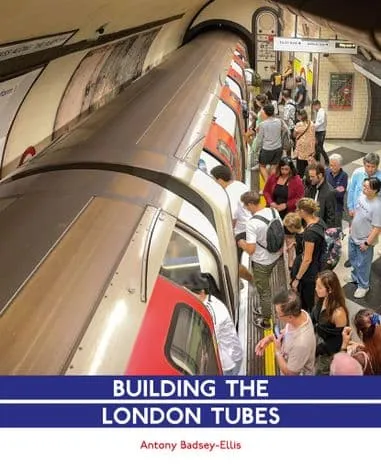
We have rarely done reviews of books. Fairly recently an opportunity presented itself to review a book on the subject of how Tube lines in London were constructed. The book in question is ‘Building The London Tubes’ by Antony Badsey-Ellis and it was published in October 2025 by Capital Transport. Given the reputation of the author, it was an opportunity too good to miss. We will look at this book and another of a similar nature as well as put it in the context of the past and current railway book market.
Declaration of Interest
It is very easy to write a review of a book and wholeheartedly recommend it when you have received a free copy for that purpose. This especially applies when it is a relatively expensive book which this one is as its cover price is £30. In all honesty normally I would not have considered purchasing it without an opportunity to sample it (either in a bookshop or online) had it not been for the name of the author.
The Subject Matter
There is a plethora of railway books published. It needs to be recognised that rarely does a railway publication lead to any financial benefit that justifies the hours of work an author puts in. A possible exception to this is a number of formulated books that rely heavily on photographs – either the author’s or historical ones out of copyright – and old maps. An example of this would be the Middleton Press series of railway lines initiated by Vic Mitchell and Keith Smith which are nevertheless very useful as reference books.
The point being made is that railway authors tend to write books out of love for the subject matter rather than profit being the primary objective. This means that they tend to choose a subject that interests them whether it is a particular type of steam locomotive or an obscure branch line for which they have a fascination. As a result, the market is completely swamped with obscure railway books. Jonathan Roberts points out, possibly not entirely accurately, the more obscure a railway, the more that gets written about it. ‘The Railways of Beckenham’ might be a wonderful book (it is by the way) but one could hardly recommended it even to the average railway enthusiast.
In contrast, many railway enthusiasts and even non-enthusiasts as well as those with an interest in engineering seem to be fascinated by the building of Tube lines and you would expect there to be many books on the subject. It is true that books on a specific Tube line tend to cover the initial construction of the line but not many concentrate entirely on Tube tunnel construction.
In a similar way, there are many accounts of the Brunels’ first Thames tunnel and construction of the first section of Metropolitan railway but these are not Tube tunnels in the strict sense of the phrase. Having mentioned that, Badsey-Ellis does cover both of these topics extremely briefly at the start of the book as part of the history of Tube tunnelling whilst making the point that these are not really Tube tunnels.
What has been surprising is that until now we have been totally lacking a book on how London’s Tube railways were constructed and this a gap that Badsey-Ellis has noticed and rectified. To be clear we are talking about tube (not cut-and-cover) passenger railways so there is no mention of the Post Office railway or other tube tunnels such as Thames Tideway. The book is not restricted to ones that traditionally were part of the underground railways so the Waterloo & City railway, Great Northern and Heathrow tunnels are included. Neither ‘Crossrail’ nor ‘Elizabeth line’ appear in the index so maybe that is a subject of a future book or maybe it is thought to be adequately covered by existing publications.
History of ‘Building The London Tubes’
In a way that we on London Reconnections can relate to (with articles), 'Building The London Tubes' came about more by accident than design. The original intention had been to issue a second edition of Badsey-Ellis’s previous book, 'Building London’s Underground' which, sadly, is out of print. This was a civil engineering history of both the sub-surface and the Tube lines. Originally the intention was to bring the book up-to-date but this proved impractical so a revised plan involved writing a new book called 'Building The London Tubes' and including a lot of material that was either new or simply had to be omitted from the original book for reasons of space.
It would be good if one day Badsey-Ellis could, in a similar manner, write ‘Building The London Sub-surface Underground’.
Reconstructing London’s Underground by H. G. Follenfant
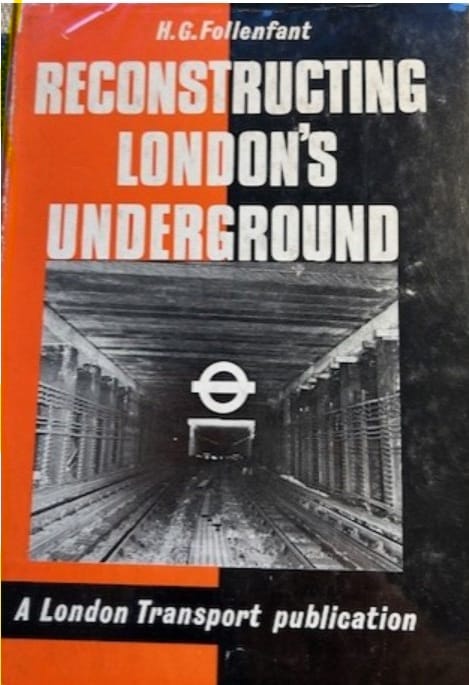
It is not easy to think of any predecessor to ‘Building The London Tubes’ but the one that does spring to mind is ‘Reconstructing London’s Underground’. The fact that this was published 50 years ago and is probably still the go-to reference book speaks volumes of what has been lacking. Interestingly and unusually, the book was one of a small number published by the London Transport Executive and in this case written by one of its civil engineers.
Obviously, one problem with a book written 50 years ago is that it was written 50 years ago so only refers to construction techniques of long ago. In contrast and despite its title, 'Building The London Tubes' also covers reconstruction and later chapters include station expansion at Victoria and Bank as well as the Battersea extension of the Northern line which, obviously, would not be covered by Mr Follenfant's book.
More noticeably, the 50 years difference shows just how much better a well-written modern book is. The quality of the paper and the use of a modern typeface instantly make the latest book so much easier to read. Whilst H.G. Follenfant’s book was entirely in black and white except for the colour dust cover, 'Building The London Tubes' features many photos and diagrams in colour as well as older ones in black and white. Another benefit of modern publishing is that photos can now appear on the same page as the relevant text rather than have unrelated photographs being grouped together which prevents one fully relating the subject matter to the photographs.
The Engineer v The Historian
One might think that a book that is basically about engineering would be better if it were written by a railway engineer rather than a railway historian. That is certainly potentially the case but I found the opposite to be true. Antony Badsey-Ellis clearly has a good understanding of engineering but, more importantly, I found his more rounded background made the subject a more interesting read.
The easy way to write a railway book is to read other books on the subject, decide on a theme and put together existing known facts in a different combination so that a new book can be created. This creates something which might make an enjoyable read but doesn’t really tell the knowledgeable reader anything new. Badsey-Ellis has clearly not done this and the number of new facts and hitherto unpublished photos presented is astounding.
The Author’s Previous Books …
It can be quite interesting to read some of the wide range of the author’s previous books and see how earlier books covered a wide range of railway and other London-related subjects and how they gradually gravitated towards construction (and reconstruction) of the London Underground whilst using his wider knowledge to provide a context for the story of construction of the London Underground.
In particular, 'The Hampstead Tube' could be considered the author’s first really detailed and original solo account of Underground subject matter that one could consider being the definitive book on the subject. It was noticeable that, in a recent video on Colindale Tube station, Jago Hazzard clearly relied on the book to a considerable extent to provide the historical details of his narration – something which he acknowledged at the end of the video.
One Still Learns Something New
Here are a few examples of facts that Badsey-Ellis points out that I either had not read in other books or that I had read but had completely forgotten about.
- The original southern terminus of the City & South London Railway was intended to be at Elephant & Castle. Unfortunately, Badsey-Ellis does not provide a reference for this but, for various reasons including a slight change in the size of the original tunnels north and south of Elephant & Castle, it fits in with various facts.
- Ponies were used in the early days of excavating Tube tunnels. The are multiple references to this and is evidenced by photos, illustrations and a reference. No other book, as far as I am aware, has even mentioned this.
- The early Tubes were dug by candlelight. This makes sense with the gas mantle not being invented until the late 19th century but the use of candles tends not to be pointed out. The practice continued despite the existence of electric arc lamps and use as street lamps by the 1870s.
The Photos
An unexpected pleasure was the quality and variety of photos that appeared most of which were previously unpublished in a book. Many were taken by the author or from the author’s collection.
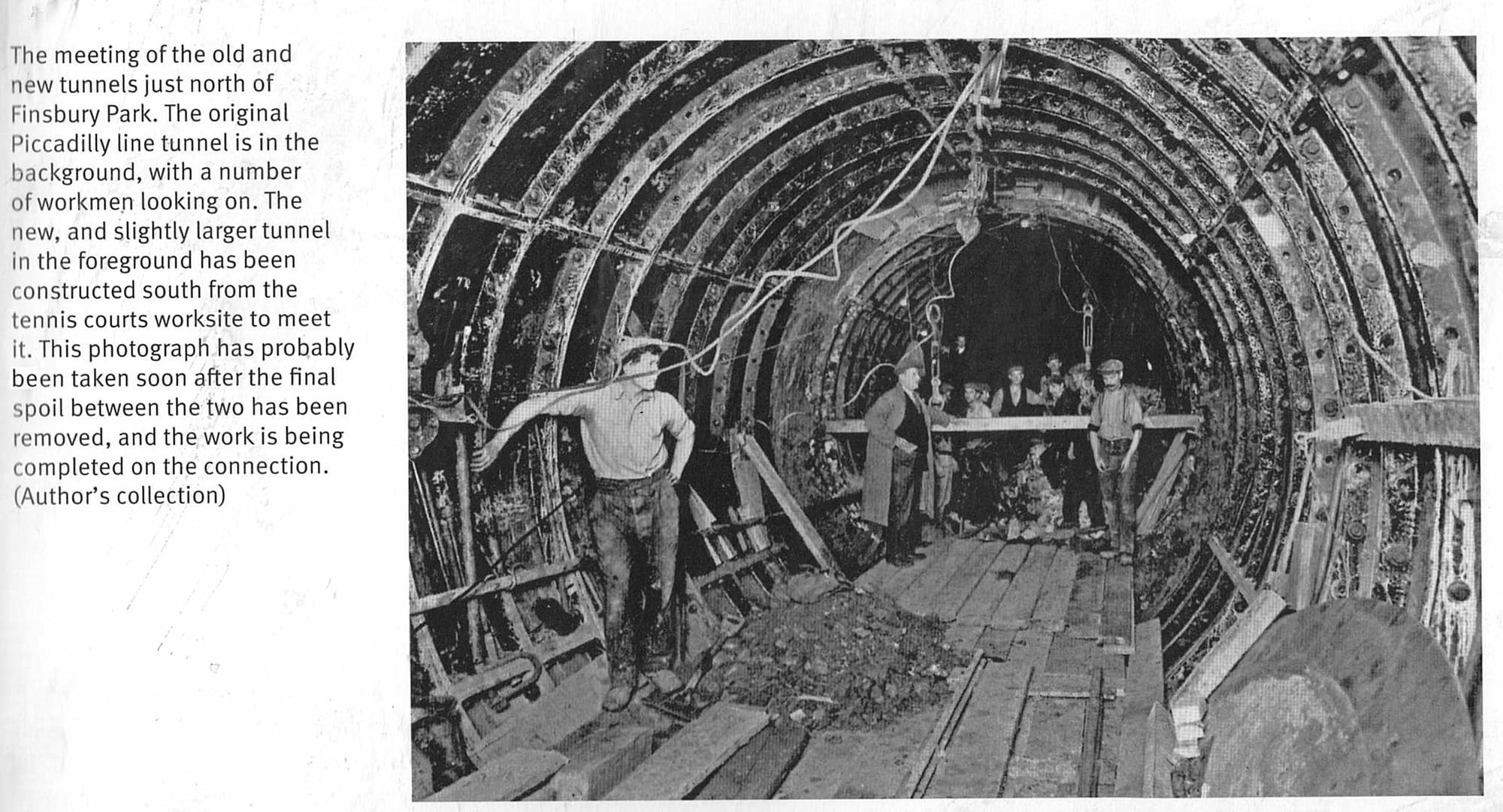
The photos are described in great detail and one could spend a pleasant hour just flicking through the book, looking at the photos and diagrams and reading the captions. Personally, I like to see detailed explanations of photos as has been provided. Some of the photos are well-known. These are generally from the LT Museum collection. Even here, details are pointed out that are easily missed and have not been commented on by previous authors using these photos.
The Appendix on Tiles
The book contains an appendix on Tiling the Stations. I must admit I did not initially read this but eventually thought I better do so if I was going to review the book. I don’t tend to get excited about Underground tiles but I know there are people that do. There is even a book on the subject – 'Tiles of the Unexpected' by Doug Rose. If you watch 'Secrets of the London Underground' on U&Yesterday you will be aware of how Siddy Holloway, one of the presenters, waxes lyrical about Tube tiling.
I was very pleasantly surprised by how interesting Badsey-Ellis made the subject of tiles. I think this is because of his writing style and the inclusive way that he writes so it is not just about the tiles but using the tiles to make a point about some other aspect of the story.
… And Video Presentation
As if to confirm the crown of being the popular authority on building London’s Underground, Badsey-Ellis is also the presenter of a talk on 'Engineering Works On London Underground' presented to the Permanent Way Institution which can be found on YouTube.
Why You Should Not Buy This Book
I can only think of a couple of reasons for this.
- The first reason is that the subject matter is not of interest to you but, given that you have read this review, this is unlikely. Maybe it is of some interest but you are someone who does not often buy railway books.
- The second reason is that £30 is more that you can afford to spend. That is fair enough but don’t let the ‘mere’ 176 pages fool you. These is a large book and there is a lot of detail on each page. Furthermore, there isn’t any waffle or anything to pad out the book. It is a detailed book and a lot of the text and many of the pictures will be new to you. You could buy two or three books, maybe second-hand, for £30 but it probably wouldn’t give you as much content as this one book.
It is probably also worth pointing out that Capital Transport Publishing often lets books go out of print and never seems to have a second print run. This applies particularly to its popular authors. Many of Badsey-Ellis’s previous books are out of print and some cannot be easily bought second-hand. This applies to his previous book on the subject, 'Building London’s Underground', already referred to, which is almost impossible to get hold of – new or second-hand.
Where To Buy This Book
Unsurprisingly the book can be found on Amazon and it is also available from the Capital Transport website. Postage is included in the price in both cases. It is also available from the LT Museum Shop in Covent Garden, but it doesn't appear to be available from their website, yet.
Your thoughts
A book review is inevitably the reviewer’s personal opinion so if anyone else has read it we would be interested to read your comments, so in the time-honoured YouTube tradition we ask what your thoughts are and to leave them in a comment below.
Thanks to Antony Badsey-Ellis for additional background information about his book.
