
Something we have been wanting to do for some years is an overall look at the update plans for London Underground rolling stock (aka trains) and, independently, line resignalling. With all the uncertainty around this subject, the time never seemed right. It is probably time to face reality and accept that, in the foreseeable future, the time never will be right.
It was also difficult to decide the right time to start this story. Arbitrarily, we look at this from the start of the 21st century which, as it happens, nicely fits in with the formation of Transport for London in its current form. It is slightly easier to decide when to stop. Any rolling stock upgrade programme really needs to take into account all of the Underground lines which roughly takes us to the 2050s.
With some of rolling stock on the deep-level tube lines (Jubilee, Northern, and Victoria) we really have no idea of what their actual life expectancy will eventually turn out to be – and we rather strongly suspect no-one else does either. For others (Sub-surface Railway) upgrading or refurbishing the existing stock to keep it fit for purpose is taking place now, and for some other deep-level lines (Central and Piccadilly) there are known plans to replace the signalling in future even if the timescale is uncertain.
The Importance of Looking to the Future
It might seem that looking twenty or thirty years ahead is unnecessary when the future is hard to predict and many of those alive today will be dead and so past caring about what may happen beyond our lifetime. However, it is a bit like buying a leasehold property. As time gets closer to the leasehold expiry date the value of property goes down. Even if you are not immediately worried about the property diminishing in value, the people behind you will be and this will need to be taken into account when considering personal future plans and how much the property is worth should you wish to sell it.
In the rail industry, financial planners need to identify future liabilities and that will, to some extent, determine what money is available to be spent today on infrastructure schemes. From TfL’s perspective, it is pointless starting to build the Bakerloo Line Extension with your own money if that money may be needed elsewhere just to prop up the existing system. The spectre of a half-completed project being abandoned is something one generally wishes to avoid.
A classic example affecting the Mayor of London and the Government would be Crossrail 2. If you know you are going to have a massive budgetary hole in the 2040s and Crossrail 2 is predicted to take over 10 years just to construct it (as it is), you are going to seriously hesitate about progressing with the project if the money is not going to be available later on in the project due to the known need to spend huge amounts of money elsewhere.
A potential further problem lies with future investment in London. If potential investors can see there is no credible strategy for keeping the main-line and Underground trains running in the future, they are not going to invest in a city they perceive as falling apart.
We will look at recent past and planned future investment on roughly a line-by-line basis.
Four Lines Modernisation – Trains
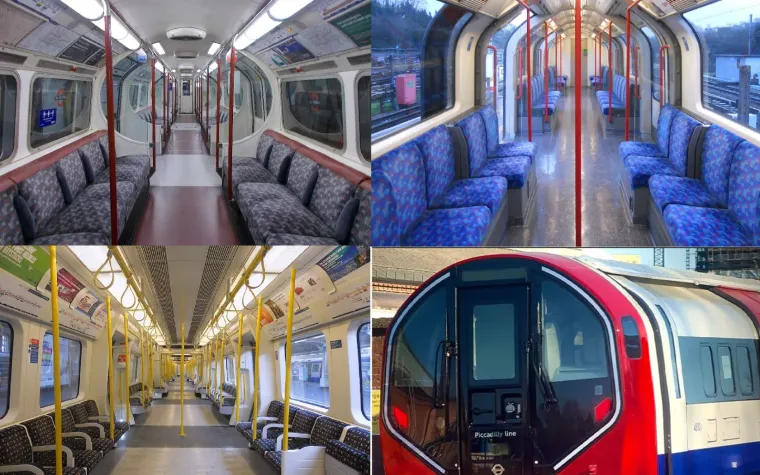
When it comes to the London Underground, possibly one of the best decisions made this century was when the first TfL Commissioner, Bob Kiley, fought hard for all the sub-surface lines rolling stock to be replaced as a single package. This for the first time enabled near-homogeneity on the sub-surface railway (Circle, District, Hammersmith & City, and Metropolitan lines). It was a golden opportunity to replace the following rolling stock:
- A60/62 – long overdue replacement.
- C69/77 – functional but disliked and dated.
- D78 – In many ways this had a potential for a longer life, but its single-leaf doors caused significant delays on an Underground line that was getting busier with each passing year.
Building of the replacement stock, known as S-stock, commenced in 2008 and so big was the order of 192 trains that construction didn’t finish until 2017.

These trains are longer and much more reliable than the trains they replaced. They still feel quite new despite having been around for more than 15 years. From the perspective of the passenger, the non-diffused fluorescent tubes are the only thing that really makes the rolling stock look dated. That said, the passenger information screens could probably benefit from a wholesale replacement more in the style of the Elizabeth line or Thameslink trains, which seems to be the modern way of doing things now.
Crucially S-stock is air-cooled. Air-cooling is effectively as good as air-conditioning in the dry air environment of the sub-surface lines and means that the trains should not be unbearably hot towards the end of their working life.
One would expect, with a decent mid-life refurbishment, that these trains would be suitable to remain in service for around forty to fifty years, like its A-stock predecessor, meaning we are looking around 2060 for a replacement and sufficiently far into the future not to worry about it. Fifty years may seem unduly optimistic, or pessimistic depending on how you look at it, but this is effectively modern well-built main-line stock not given the harsh hammering that deep-level tube trains in London are subject to due to the sharp curves prevalent on lines built to avoid tunnelling under private property wherever possible.
Four Lines Modernisation – Signalling
In many ways Four Lines Modernisation signalling is the London Underground 21st Century horror show and one loses track of just how delayed this resignalling project is. Originally destined to be complete around 2012-2014, two contracts got cancelled due to a lack of progress being made, and the current one looks like being finished almost a decade later than planned. It would have seemed that the final stage was due to be in December 2027 when the delta junction at Aldgate is was due to be relaid so as to be optimised for trains of S stock length. However, the latest report on renewals from TfL suggests this would be complete ‘by 2027/28’ which may mean there could be a further delay. When complete, this will finally permit the long-planned 32tph timetable for central London sub-surface lines that was promised years ago.
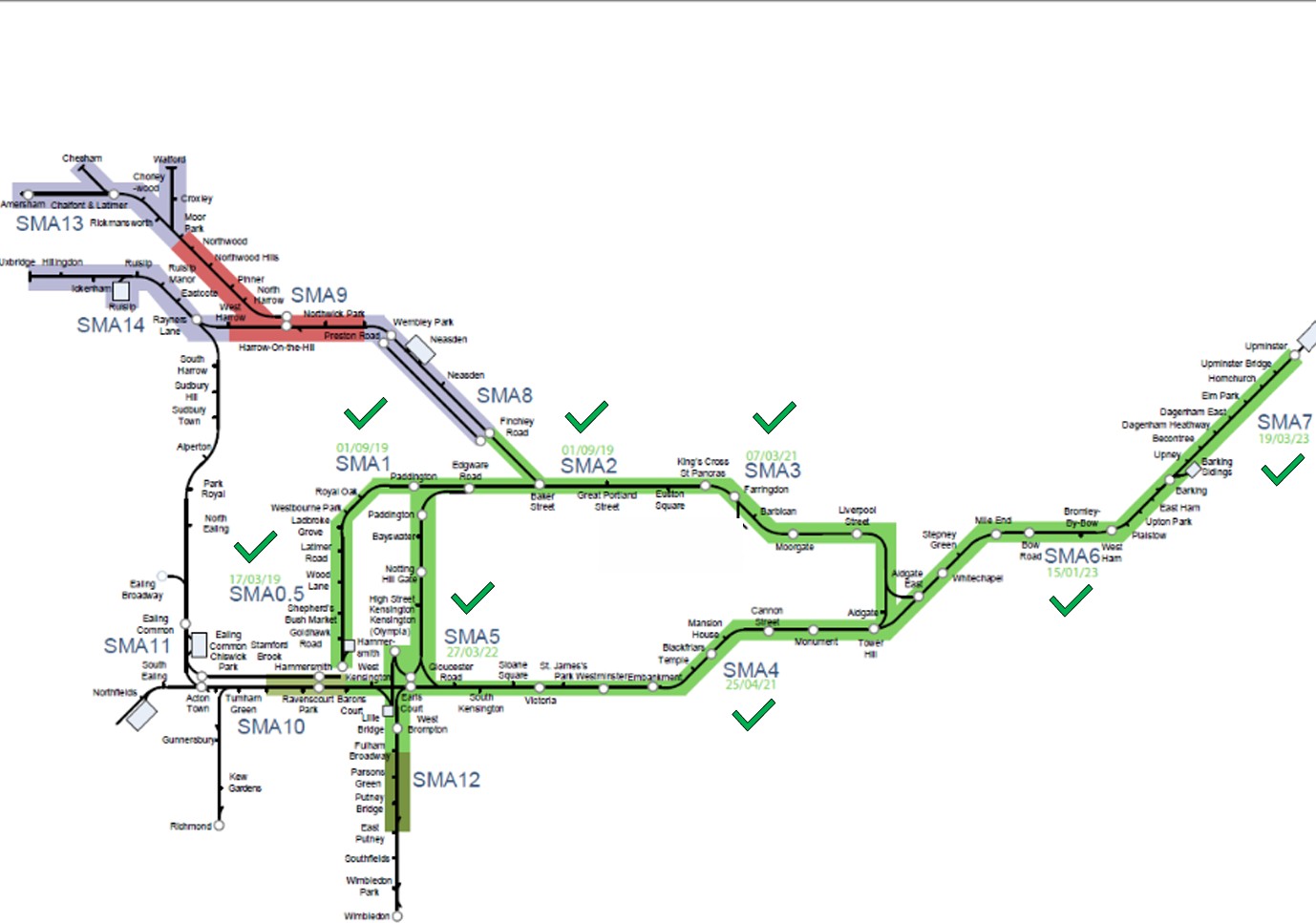
At one stage pre-Covid, progress on this was seen as urgent and management attempted to apply pressure to avoid delays. The delays on the Elizabeth line signalling took the focus away from this project (at least in this case there was an existing, working signalling system in place) and the reduction of passenger numbers post-Covid took away the urgency. Nowadays it seems to be a case of ‘go slowly if you must – but get it right’.
It should be the case that, once fully installed on the remaining sections of track on which it the signalling project has not been cancelled, it should be good for another 40 or 50 years and maybe longer. The use of radio frequency and the lack of lineside signals should help its longevity. If it does ever get replaced one would like to think that ETCS/ERTMS (European Train Control System/European Rail Traffic Management System) would be sufficiently mature and advanced by the middle of the 21st Century which would mean a standardised replacement signalling system rather than being forced to specify a bespoke one.
Victoria line 2009 stock and signalling
At the time of its introduction, the 2009 stock Victoria line trains was seen as the ultimate in deep-level tube stock technology in London. The 36tph service made possible with the complementary Siemens advanced automatic train system replaced the increasingly unreliable 1967 stock operating a 27tph timetable. The acceleration ability of the new trains was in contrast to that of the old and the seats were much more comfortable.
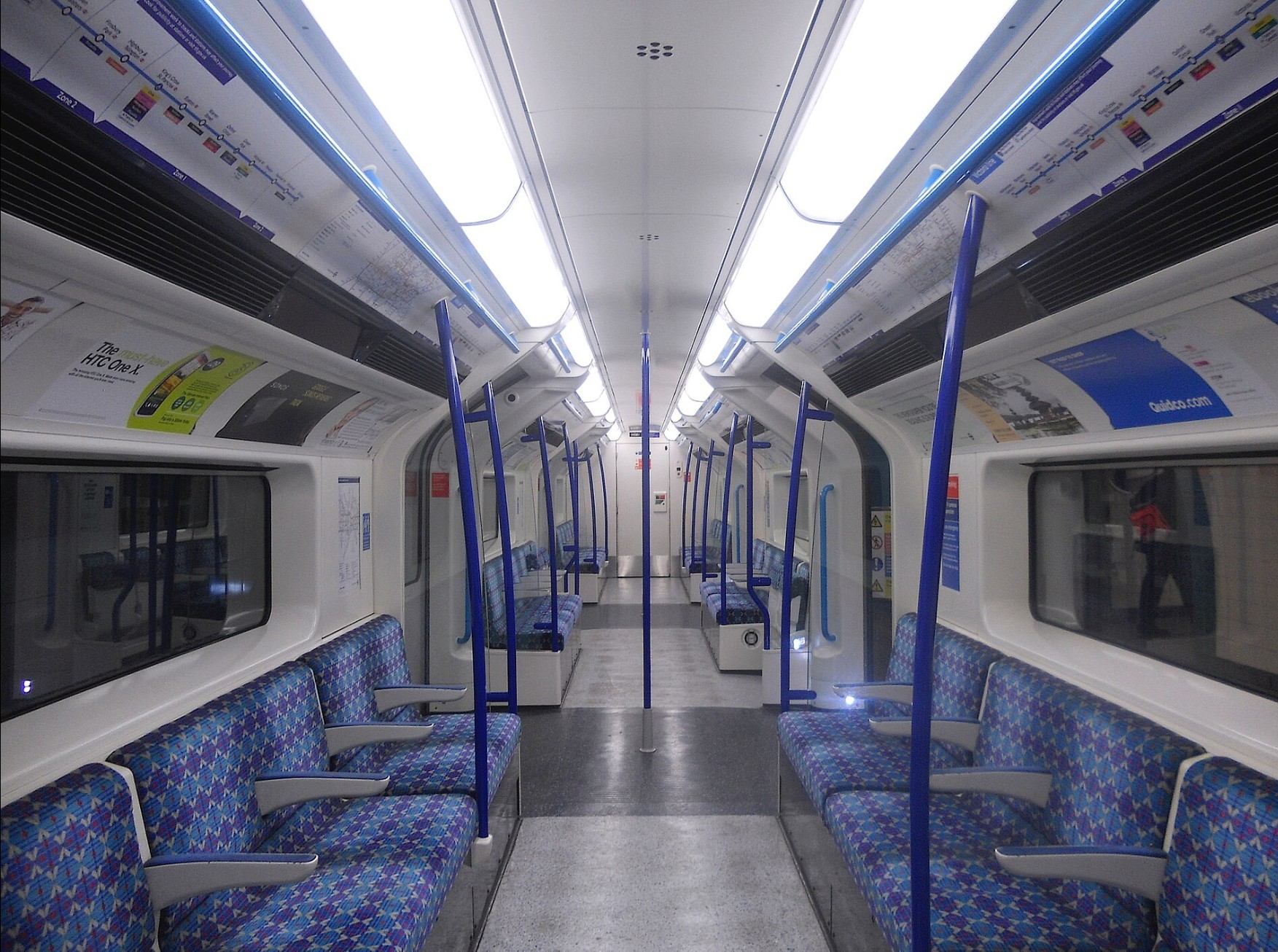
Today, the 36tph on the Victoria line is still impressive but the trains are already showing their age due to intensive use. The same could be said for the entire line that seemed so modern when opened by Queen Elizabeth II in 1969 and it now appears very dated and unambitious in design, with relatively little having been spent below ground level on stations (Victoria is a notable exception) since it was fully opened to Brixton in 1971.
The Victoria is now officially the hottest line on the Underground which is quite worrying when you consider that, when it first opened, they had a problem with signal faults due to damp, cold air. It shows how much it has heated up in less than less than 60 years and it would appear to be the case that it will only get hotter still.
The heat is bad enough in the platforms but at times it is almost unbearable in the trains which will almost certainly be the last ever built for London Underground without air-cooling. The worry is that, without sufficient remedial measures elsewhere, the trains will just become too hot to be useable forcing premature replacement. Otherwise, one would hope that they would last for the usual forty years which is generally the life-expectancy of deep-level Tube stock.
Another factor which may prompt premature replacement is the fact that, of all the Tube lines longer than the Waterloo & City line, driverless (unattended operation) is probably the most feasible on the Victoria line. With its straight platforms aiding installation of platform edge doors, its frequency and being entirely underground (which eliminates problems with wet rails and trespassers), it is the ideal candidate.
In the intervening decades, technology would have moved on and even today new metro systems being built for trains with drivers are getting very rare indeed, with both Sydney and Paris (amongst others) committed to making all new lines driverless. As regards the issue of unions and the need for drivers, it may well be that demographic changes and a demand for a universal shorter working week puts a greater pressure in the future to eliminate jobs that are not strictly necessary.
Heat and driverless trains lead to consideration of early replacement of trains, and possibly signalling, on the Victoria line. Thirty years would be a reasonable minimum working life of a deep-level tube train, with forty years being the expected length of time in use before replacement, so it looks like somewhere between 2040 and 2050 serious money will need to be spent on the Victoria line including its rolling stock.
The Stagnant Years – or were they?
After the introduction of the Victoria line 2009 stock there would appear to have been very little happening, infrastructure-wise, on London Underground for more than a decade. It is true no new trains appeared, but the Victoria Station Upgrade was completed and Bank Station Capacity Upgrade was well on its way to transforming a critical station. Following on from the Victoria line upgrade was the conversion of the Jubilee line to Automatic Train Operation (ATO) followed in turn by the Northern line.
More importantly to our story, a lot of development work was carried out on a programme referred to by Boris Johnson as ‘New Tube for London’. It was extremely ambitious including objectives beyond the state of the technology of the time.
Whilst it may be true that London Underground was not keeping up with the need to renew during this decade, this certainly was not true of TfL in general. The Elizabeth line (formerly Crossrail) was the biggest single transport construction project in London for years – if not ever. And this all happened at a time when the successful 2012 Olympic Games were a major distraction.
Finally New Investment: New Piccadilly line trains…
For quite some years it was clear what the next big investment needed to be. It was clearly an upgrade of the Piccadilly line with new trains and new signalling. The signalling was old but could more-or-less go on forever, although it would become more unreliable and limit frequencies to 27tph. With the implementation of Four Lines Resignalling there should be a huge stockpile of spare parts becoming available enabling an old but simple and fairly reliable signalling system to continue indefinitely. The same could not be said for the trains.
The existing trains, 1973 stock, were the first of a new generation of rolling stock in a digital age. These inevitably became obsolescent very quickly as technology marched on. They also suffered a problem with quality of the wiring used within the train which degraded over time. The stock is coming up to its fifty years anniversary in service and this is well past its design life and ‘best before’ date.
Out of the New Tube for London project came a more realistic plan for commissioning new trains. The Piccadilly line was prioritised due to condition of the existing trains – most notably with the aforementioned wiring. The implementation of new stock was intended to be followed shortly afterwards by resignalling the Piccadilly line thus enabling 36tph to be run, subject to some other critical upgrades. Given that the Piccadilly line cannot quite currently run 24tph in the Monday-Friday peak periods and that the new trains would be slightly longer, this would be a huge capacity increased on a heavily-used line.
It seemed inevitable that the new trains would be approved because it was becoming increasingly expensive and difficult to keep the old trains running, meaning that buying new trains was beginning to look line the cheapest option with the ‘do nothing’ scenario both risky and expensive.
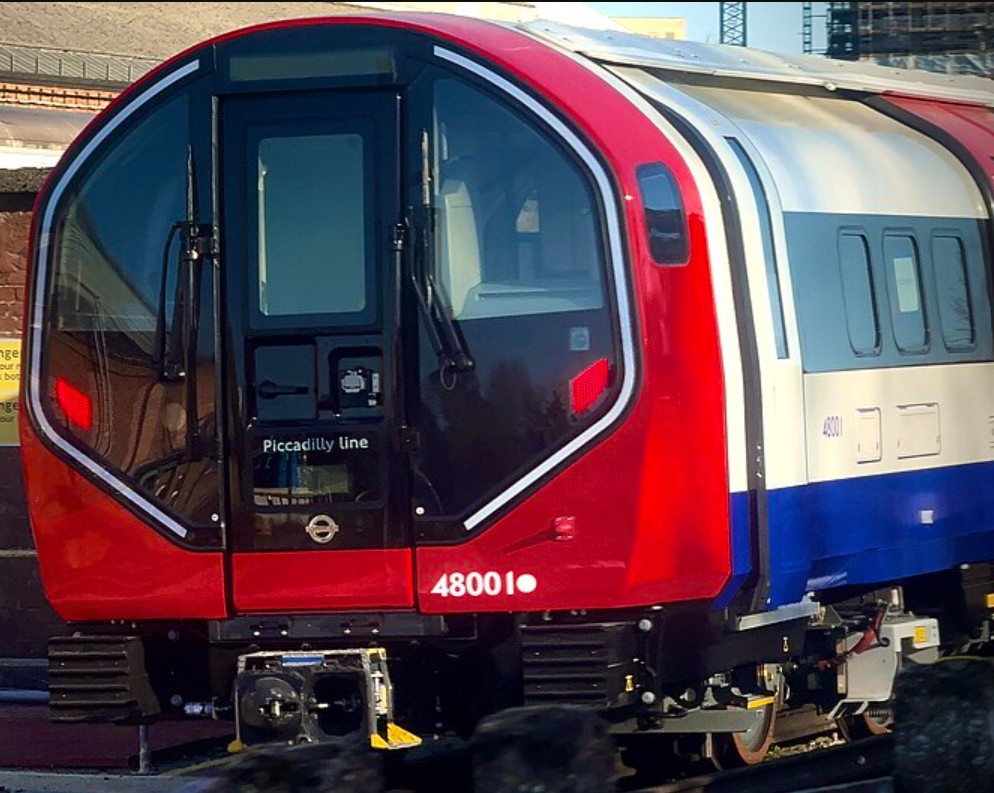
Siemens won the contract to build 94 new trains at a cost of £1.5 billion. This works out at £16 million per train. So far, they have not disappointed in innovation. The trains will be the first deep-level tube trains running on existing lines in London with air-cooling. Space was made available for the cooling units by an innovative design for trains (but common on trams abroad) of having an odd number of carriages with the odd numbers having wheels and the even numbers being wheelless and suspended from the adjacent carriages. The absence of wheels from the even number carriages means there is space to install the air-cooling below the floor of the train. A reduction in the number of wheels overall also makes the train lighter than it would otherwise be. It weighs roughly the same as an existing train despite being longer and containing air-cooling equipment. This also reduces track wear compared with what it would otherwise be. Along with more efficient state-of-the-art motors, fewer wheels helps contribute to the reduction in energy needed by the train, which in turn should help reduce the rate at which the tube tunnel heats up.
In addition to all the above innovations, Siemens have managed to implement open gangways between carriages – a first for deep-level London-sized tube trains. Almost at a stroke, Siemens are going to introduce rolling stock which will make all other deep-tube trains look very dated. One could argue that the last rolling stock on a deep-level tube in London which had the same level of innovation was the 1938 stock, which pioneered the locating of all equipment below the floor (more strictly the solebar, which is the outer longitudinal beam of the train chassis, to which several components and supporting cross members are attached), making almost all of the space above floor level available for passengers for the first time.
The new Piccadilly line trains were expected to start entering service later this year (2025) but this has been delayed – apparently because of some incompatibility between the trains and the tunnels which we are told was not foreseeable. Until recently the intention was to fully replace the Piccadilly line 1973 Tube stock by the end of 2027 but 2028 is now looking more realistic.
… But not new signalling or a critical station enhancement
By not introducing new signalling on the Piccadilly line, it has been calculated that a maximum of 27tph could be run with the new trains. This would therefore be a slight improvement of around 12% over the existing frequency.
However, even with new signalling, another limitation appears. Holborn station will be at passenger capacity with 27tph on the Piccadilly line. Worse still, to go beyond 27tph it is calculated that a new substation in central London will be needed and the current plans would see this incorporated into an enhanced Holborn station. The station upgrade was consulted on in 2017 when the estimated cost was put at £200 million. We suspect, with an increase in building costs and general inflation, it would be more like £500 million at current day prices.
Given the other projects that are pressing, we suspect that no money can be found at present beyond that required for the new trains, and that the new signalling and Holborn station upgrade will have to wait for some time in the future when money is more freely available.
Replacement trains for the Bakerloo line
If one thing has been currently giving overriding concern when it comes to capital investment has been replacement of the 1972 stock on the Bakerloo line. The Chancellor’s spending budget for TfL including the all-important commitment to provide the money for the next four years means that TfL should be at last in a more predictable position. Unfortunately, the amount allocated does not seem to be sufficient to enable new trains for the Bakerloo line to be ordered, when other essential projects are taken into account.
The 1972 stock on the Bakerloo line was actually introduced in 1972 (a rare thing for the year of manufacture to coincide with the year of introduction) meaning they are already 53 years old. Worse still, they are based on the 1967 Tube rolling stock built for the Victoria line as the trains were needed urgently. These were the last of the pre-digital-era trains and as such they could theoretically last indefinitely by being patched up and repaired, but the cost of doing so would continue to escalate. Already, the service on the Bakerloo line has had to be reduced to 20tph from 22tph because of the need to allow for more trains in the workshop for maintenance.
As reported by IanVisits, spare parts from existing Piccadilly line stock common to Bakerloo stock will be salvaged to help maintain Bakerloo trains. It comes to something when in 2026 or 2027 spare parts are taken from 1973 stock to help keep 1972 stock running.
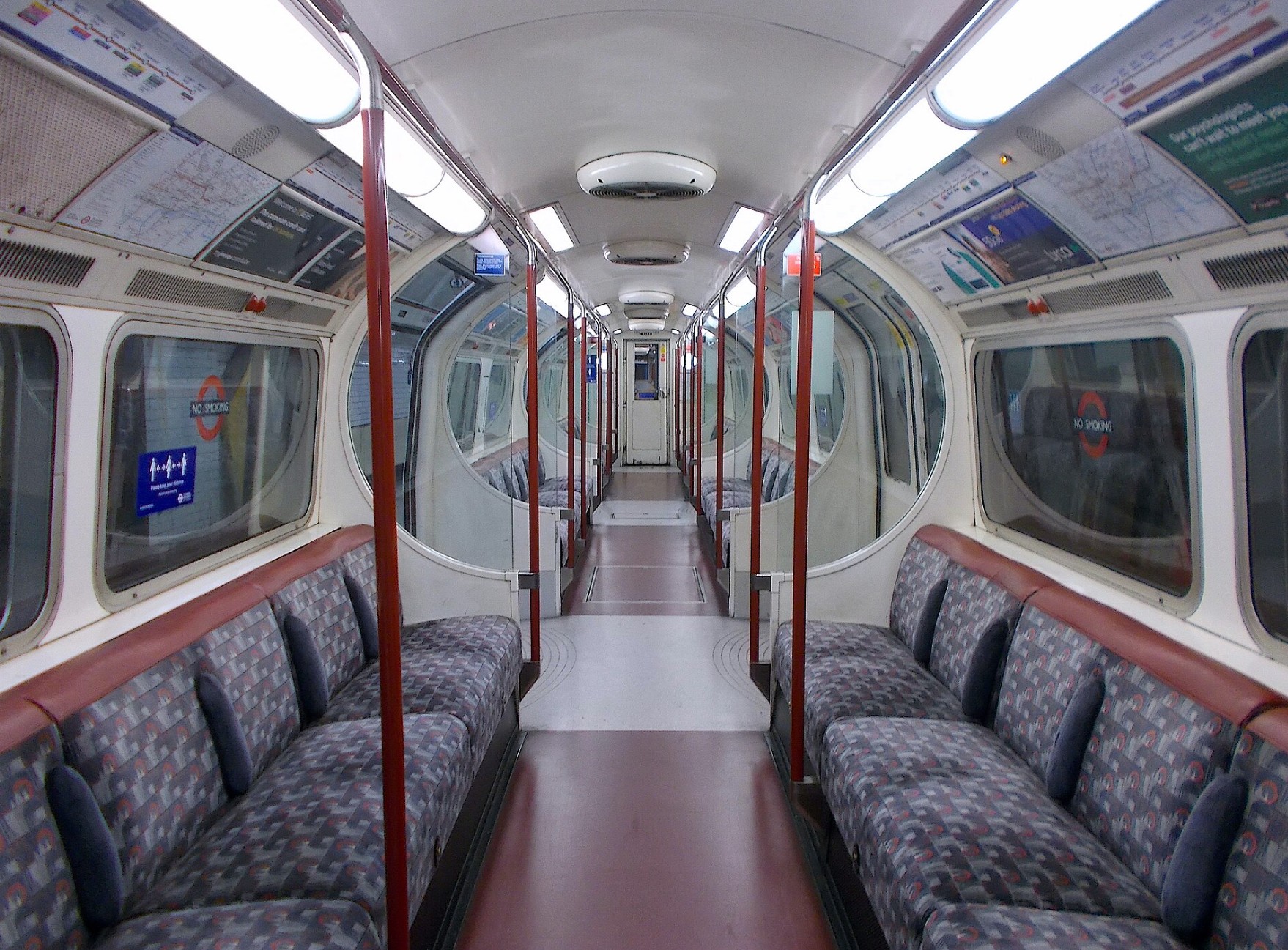
Currently there are 36 1972 stock trains which in normal circumstances could provide 22tph. Ordering 36 trains of 2024 stock would cost roughly £600 million but TfL may order fewer or more. Original plans were to provide a 27tph service but that assumes that the existing signalling on the Bakerloo line could handle that many trains. £600 million for the new trains would now seem to be at least possible, if challenging, using some of the money the government has allocated TfL over the next four years. With government finances tight, probably only an extreme optimist would expect the government to suddenly produce yet more money for these trains.
Unfortunately nowadays, even more than before, new underground trains need to be accompanied by considerable extra expense to other infrastucture to maximise the benefit of the new trains and ensure they can operate safely. We have absolutely no idea of how much this would cost, other than to suspect it is not cheap.
It may be that the government is keen for the Mayor to find extra funds to cover the shortfall by fare rises, a higher council tax precept, or another way of raising the money. In a way, the Mayor and TfL may be forced to take unpalatable measures, because they have long stated that continuing indefinitely with the current stock is not sensible from either a reliability or financial perspective. The tipping point has supposedly been reached where the sensible long-term cost-effective solution is to buy new rolling stock, almost matching that which has been designed and tested and due to see service on the Piccadilly line in the next year or so.
A further complication with Bakerloo line stock is that there is an option to buy further trains from Siemens to follow on from the Piccadilly line order which expires in late 2026. One wonders if TfL will order the trains anyway and somehow find the money, whatever it takes, to pay for them when payment becomes due.
The Central line Horror Story
Bad as the Bakerloo line saga is, at least one feels there is hope that the trains will be ordered within the next couple of years and trickle into service in the next decade. Despite the Central line trains (1992 stock) being around 20 years newer, in many ways the stock was worse than the Bakerloo line. The DC motors featured electric technology (Gate Turn-Off thyristors) that were about to be superseded by AC motors with electronic rectifiers. The latter would have been much better as they require less maintenance and, more critically, would reduce the number of trains out of service. The DC motors were also unreliable and, at one stage in 2003, the Central line was closed or partially closed for around six weeks whilst urgent remedial action was taken as a consequence of a traction motor falling onto the track.
Coupled with the bespoke and obsolescent automatic train operation signalling system, and the seats that never were comfortable and are now positively uncomfortable, the 1992 stock has not aged well.
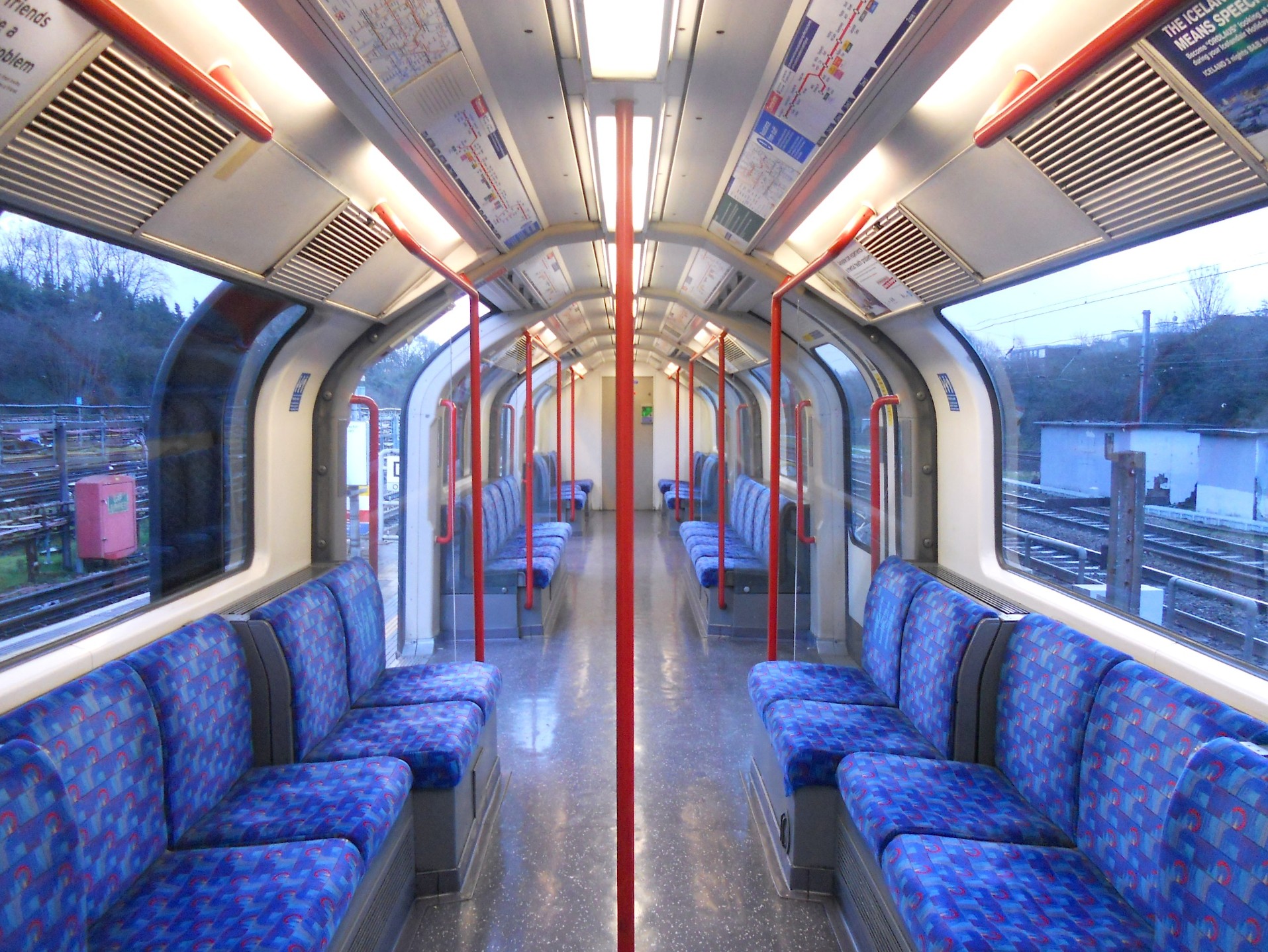
With new trains seemingly forever the wrong side of some transport planning event horizon, there emerged a somewhat bizarre and organic policy. It had its roots in a 2017 project for Bombardier to supply replacement motors for the Central line trains. It was clearly felt that TfL could not wait for the new trains which, realistically, were not going to arrive until the 2030s. The project was given the title of Central Line Improvement Programme (CLIP) though, at that stage, Central Line Motor Replacement Programme would be a more accurate description even if it didn’t result in a neat acronym.
As the expected date for replacement trains advanced it was recognised that other components were going to need replacing as well. It then followed that it made sense to do it at the same time as the motor replacement. Once the need to strip the carriage down became inevitable it then made more sense to add further updates to the programme rather than risk having to replace these at a later date.
In this way, a ‘simple’ replacement of old and unreliable DC motors that represented a past era of motor development would be replaced by modern AC motors that could work on 4-rail DC traction supplies, developed into a programme where just about everything that could be replaced on the rolling stock would be replaced.
To add to the ambitiousness of the project, it was decided to carry out the work in-house and become the largest in-house project ever undertaken on rolling stock. To this end, new workshops would have to be constructed at Acton and staff recruited. The feeling was that the previous methodology of sending the trains to various far-flung destinations including places in Scotland was neither appropriate nor offering value for money.
The eventual CLIP project, valued at £500 million seemed remarkably cheap compared to the cost of new trains. The biggest downside was the trains would not have air-cooling, air-conditioning, or anything to reduce the heat. With tunnels getting hotter and climate change, the worry is that, before the trains have otherwise come to the end of their useful life, the trains will have to be prematurely retired or the heat will become unbearable and passengers would be reluctant to travel by these trains.
Progress on CLIP has been described as ‘glacial’. Not surprisingly, what theoretically works when planned shows shortcomings when the plan hits reality. As of February 2025, only two trains (out of 85) were complete, with a further three trains due to be complete by January 2026. After that, a seemingly heroic push will see 25% of trains complete by November 2027 – so 16 further trains completed in 23 months. Then, miraculously, in the space of just over two years, a further 64 trains will be completed, enabling the ‘end of 2029’ deadline to be met. The argument goes that production will speed up rapidly once the initial teething troubles are sorted out.
A slight concern here is that TfL refers to ‘completed’ trains rather than ‘in service’ – there may be quite a lag between a train being ‘complete’ and ready to leave the Acton workshops, and being delivered to the Central line depot and having accumulated sufficient out-of-service fault-free running to enable passengers to travel on it.
What is more worrying is that one presumes that TfL intend to get at least 10 years useful life out of the CLIP-refurbished trains, which takes us at least to the end of 2039. This does appear to be confirmed in an answer to a question posed at Mayor’s Question Time.
By that time, the trains will be approaching being 50 years old. Even with a full mid-life refurbishment this seems to extending their desirable service life to the limit. But now replacement in the 2040s will probably clash with the desire to replace the Victoria line stock if something needs to be done about the heat on that line – and this clash of replacement timescales is going to get worse.
Central line Signalling Incremental upgrade Project (CSIP)
The chances are you have never heard of the Central line Signalling Incremental upgrade Project – and we hadn’t either. Below is a quote of the entirety of what we know about this project.
Central line Signalling Incremental upgrade Project (CSIP) within Signals – the Programme is undertaking a 15–20-year incremental upgrade of the current Central line signalling and control system. This will be replaced with a modern, digital Communications Based Train Control system.
We have to say it makes some sense. The Central line signalling is already obsolescent. It was implemented when Automatic Train Operation (ATO) was not nearly advanced as it is now. To give but one example, it actually has a separate train describer system that keeps track of the trains, their train number, and where they are heading. This interfaces with the ATO system. Today, no-one would dream of designing an ATO system that couldn’t drive the customer information screens or tell the controllers what train was where and where it was planned to terminate.
Clearly when it becomes time to replace Central line stock, one doesn’t want to have stock customised to run on the existing Central line signalling. It could be extremely beneficial to have a modern type of signalling already installed. Furthermore, it is uncertain how long the existing Central line signalling system could keep going. In particular one must worry about availability of spare parts and having the engineers with specialist knowledge to service it.
A phased approach for a new signalling system would seem to be the best approach. As parts are predicted to wear out or otherwise fail, portions could be switched over to the new system so avoiding catastrophic failure. And given the tendency of state-of-the-art signalling projects to overrun by many years, starting planning for this now would seem to be a sensible approach. One’s only concern is that signalling is not cheap and this is going to involve a huge sum of money to be spent from TfL’s internal budget – albeit spread over many years.
Waterloo & City line
Little is being said about when one can expect Waterloo & City line stock to be replaced. In the ‘New Tube for London’ plan, which changed considerably whilst the project had that name, Waterloo & City line stock at various stages of the plan occupied all four positions in the sequence of the four lines affected to receive the replacement rolling stock.
With only Monday-Friday working, peak flows in just one direction and extremely poor economics for the line which discourages investment, one can take a guess and suspect that some elements of CLIP will eventually be put together to partially upgrade the Waterloo & City line stock. This would enable the age-old tradition of running ancient rolling stock on the Waterloo & City line to continue. Given the total current allocation of trains is just five 4-car units, replacement of Waterloo & City line trains with an equivalent number (or maybe one extra) cannot be regarded as a major issue.
Northern line
So far, we have been mainly discussing replacing tube trains, with some mentions of upgrading signalling. The only feelers we have for replacement dates for Northern line 1995 Stock is that, in the past, the date of 2040 has been suggested in TfL papers. This would mean that the stock would be in service for 42 years. This figure is slightly on the high side (40 years is generally regarded as a desirable maximum for deep-level tube stock) but not unreasonable.

If it were a simple case of replacing the rolling stock, this would not be a big deal, although the sheer number of trains (currently 106 6-car trains) would make it a big project. What makes this replacement a particularly big deal is the long-standing desire to increase capacity in central London by effectively running the Northern line as two separate lines, which would be High Barnet – Morden and Edgware – Battersea Power Station.
To make best use of the opportunity presented, you would need to run many more trains in order to get a service of at least 32tph in central London and all the way down to Morden. More trains mean more stabling sidings and more workshop space. Finding stabling sidings for the extra trains, should this upgrade take place, is going to be extremely challenging and would probably call for some inventive thinking.
The level of the challenge was put into perspective by a comment on the District Dave website. To fully upgrade the Northern line to run in two sections with significantly more frequent trains would require sidings to match the number currently at Morden depot. And Morden depot is currently the largest depot on the Underground serving just one line. For that number of trains it wouldn’t be sufficient just to build more sidings. The trains would have to be serviced. So, effectively, you would need the equivalent of a new depot the size of the existing Morden depot to provide facilities for the new trains to be maintained. To a find a space for such a depot or depots would be a considerable challenge and the cost would also be significant – for the land if nothing else.
Camden Town station would need to be enhanced to aid interchange at this critical station. There was a scheme for this but it had to be postponed indefinitely due to budgetary crises. The good news is that TfL have already acquired the land for this – the former Hawley Infants school. Like Holborn station enhancement we suspect that the original £200m estimated cost would probably end up being more like £500 million at today’s prices.
To largely separate the Northern line would be a golden opportunity and the ideal time to do it only comes around roughly once every 40 years. It would be a shame to miss the opportunity. A further factor here is that, eventually, Euston will see HS2 trains and, in all probability, work on Crossrail 2 will not have even commenced. Increasing Northern line capacity is the one thing that can relatively easily be done to help disperse HS2 passengers. As both central London sections of the Northern line serve Euston, a modest increase in Northern line frequency has a doubling effect.
Jubilee line
In many ways, the Jubilee line’s 1996 stock is practically the twin of the Northern line’s 1995 stock. Both were originally six car trains. Not surprisingly, the Jubilee stock will need replacing at around the same time as the Northern line stock.
In the case of the Jubilee line there are only 63 trains. Four of these trains were subsequently ordered as seven car trains and came into service in 2007 but the previously-existing ones had a carriage added. Like the Northern line, the Jubilee line will probably need more trains as there was a plan to increase the service from 32tph to 36tph which was abandoned because of the lack of rolling stock when a proposed purchase of extra trains was cancelled. Therefore, the Jubilee line will probably need an increase in the number of trains though not nearly as big an increase as on the Northern line.
It would be surprising if, in the late 2030s, there wasn’t a plan to replace Jubilee and Northern line stock with a common new stock – albeit of different lengths for the two lines.
The Crunch

What is becoming apparent is that, by our calculations, most of the deep-level tube stock will need replacing in the 2040s. By then, only the Piccadilly line and the Bakerloo line, hopefully, will have stock that could in any way be described as modern. Assuming, unrealistically, that money was no object, it seems that the only way this could happen is if your different train builders building new stock for different lines.
Together with signalling upgrades and some related station reconstruction, this would appear to be a huge budgetary spike that no-one is even thinking about yet. It is understandable. When the alligators are snapping at your feet it is hard to focus of the main objective of draining the swamp. Yet one day this must be faced and it is a problem far too large for any London Mayor to deal with on their own.
An obvious solution is to lease the rolling stock, but that probably won’t work because normally no lessor is going to take over leasing custom rolling stock designed for one Underground line and of virtually no value elsewhere. An exception to this is the Northern line stock which is leased. However this is exceptional and is probably related to the fact that Alstom (who built the trains) also had a long-term contract to maintain them rather than the normal situation of the trains being maintained by London Underground themselves.
Politically, any huge investment in London will have to have something like proportional investment in other parts of the country. One just hopes that the government of the day starts planning for this in the 2030s.
All photos have been taken from the relevant article on Wikipedia and sometimes cropped. Details of copyright restrictions can be found there.
Thanks to various members of the London Reconnections team who have provided a considerable amount of background information to make this article possible.
