
There weren't many answers received this year which did not surprise us. The subdued response matches the subdued passenger numbers and lack of positive transport news in 2021. We will endeavour to let you know soon how those who submitted answers got on.
Onto the answers.
Question 1

The question showed an incorrect diagram of the Northern line and asked what was wrong. This was a deliberately easy question to get you going. As Geoff Marshall pointed out in his Twitter post, the two things wrong are that Battersea Power Station and Nine Elms stations are transposed, and the service to Battersea Power Station is shown as a shuttle service from Kennington rather than a through service.
Question 2
The minister who fell off his bicycle was Grant Shapps – the transport minister. This was reported by various newspapers so should have been easy to answer. It was also reported on the BBC website.
Question 3

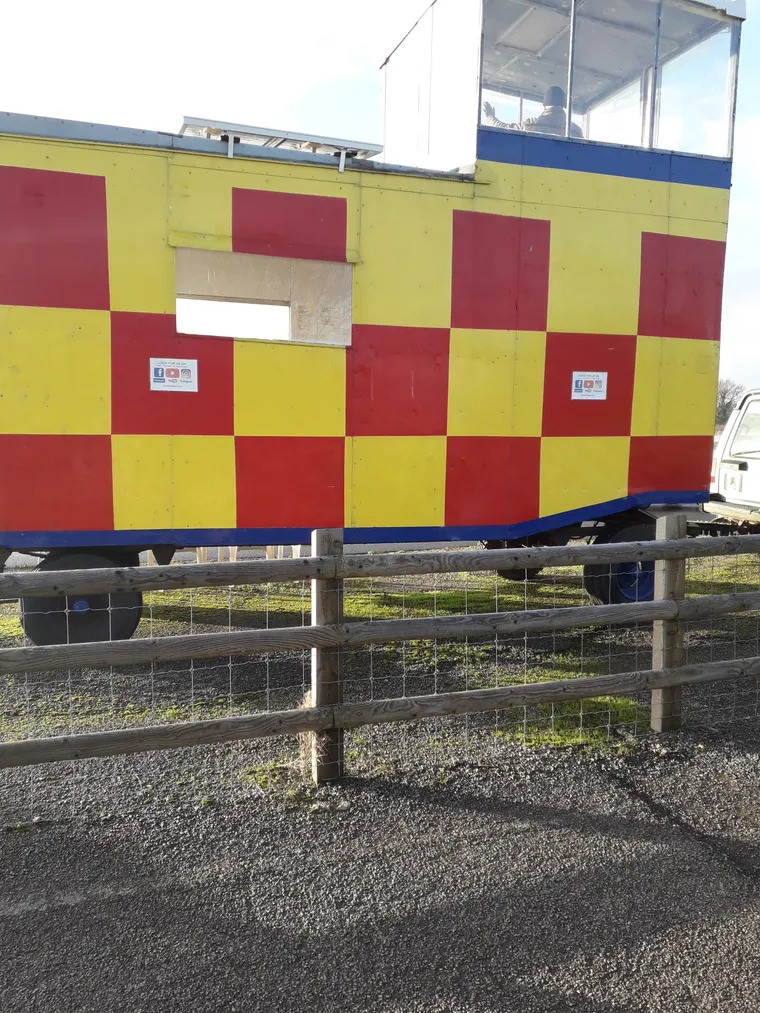
More difficult was Question 3. We deliberately try to include a very hard question to prevent too many people getting all the answers correct. So it was surprising that some people managed to work out at which active airfield in Greater London where the picture of the control tower was taken. Of course, there aren't many active airfields in the Greater London area which makes it a bit easer.
The answer we were looking for was RAF Kenley, though we will settle for Kenley. It is technically still an RAF active airfield though it is more of a memorial site these days. It is still owned by the Ministry of Defence and there are official notices warning you about trespassing. Despite this, people are welcome to walk across the airfield when there are no aircraft flying. It is in Greater London – just.
Nowadays it seems to be exclusively used by Surrey Hills Gliding Club who operate the control tower. As can be seen in the photo above (from which the picture in the quiz was cropped) it is on wheels as it is a mobile control tower so the unusual feature was that the control tower is mobile. It (or another one) is usually towed into the appropriate position by a Land Rover.

Question 4
The Thames Bridge that TfL has spent so much money on in recent years is the abandoned-before-construction-started Garden Bridge. Quite why TfL got suckered in to paying for this under former London Mayor, Boris Johnson, is open to debate – but not in the comments section here, please. We had published many of the subsequent enquiry's transcripts, such as this one.
The original, slightly misleading, article pointing this out was published by New Civil Engineer and can be found here.
The Thames crossing (note the subtlety of the wording) due to dwarf this is the Silvertown Tunnel. Hammersmith Bridge was suggested as the answer but it is unclear where the money for this will come from and, not being a TfL-maintained bridge, TfL hasn't committed a large contribution to this.
Question 5
We asked what station had no service at all for some weeks due to the 'pingdemic'.
The answer we were looking for was our favourite station in these situations – Birkbeck. So this station once again features as an answer in our quizzes.
Several people suggested 'Pimlico'. There was nothing in the question that made in Underground specific. We are not aware of Pimlico having no service for some weeks although, like many Underground stations, it did have pingdemic related closures for a number of hours at a time.
Question 6

We showed a blanked out road sign and asked where it was. In fact it is the same sign as used in the 2020 quiz – only that time it was not blanked out. So this must be a first for us not only having a same answer as before but a same question and answer as before. It is at the southern end of Beech Street in the Barbican.
The second part of the question asked why it was blanked out. There two are possible valid answers:
1) due to road closures in the area because of road works, Beech St became a diversionary route,
2) The traffic order implementing it was successfully challenged in court. Rather than try to rectify the situation, the City of London simply let it expire. You can read more about this in a post by Diamond Geezer (sixth photo down) who, yet again provided the original photo.
Question 7
We listed the following:
- An approach road to IKEA Wembley Park,
- Hogarth Roundabout,
- Sainsbury’s, Waitrose, and M&S Simply Food in South Woodford.
and asked what they had in common.
They all lie within the North and South Circular Roads but are excluded from the expanded Ultra Low Emission Zone which was introduced in October.
The reason for the IKEA approach road is fairly obvious. The IKEA branch is outside that North Circular but you need to turn off the North Circular and go inside the North/South Circular boundary to get to it and there is no alternative.
We cannot see why the other two instances are exempt. Perhaps someone will tell us in the comments.
Question 8
The question was:
In 2021 it became known that a train manufacturer is planning to build railway carriages without any wheels.
Which train manufacturer is intending to do this?
Why ?
The answer is to the first part is Siemens. The trains in question are the new Piccadilly line stock and it is a rather clever arrangement (not uncommon in trams) to suspend a carriage between two carriages that do have wheels.
The main benefit of this is that it allows fewer bogies whilst still being able to provide 'walk through' trains. The other benefit, which is also acceptable as an answer, is that it frees up space under the floor for bulky air-conditioning equipment.
An excellent article by Malcolm Dobell about this (and more) can be found here.
Question 9
We featured an article on the MyLondon website and asked why re-opening York Road station on the Piccadilly line might not benefit visitors to Granary Square in the way the article suggested.
We were quite relieved that people gave at least one of the reasons we intended them to give on such an open question.
Readers grasped that:
Granary Square is, in fact, closer to King's Cross Underground Station (even its most distant entrance) than it is to the former station at York Road. They could have added that the walk would be much more pleasant from King's Cross than it would be from York Road.
Some answers pointed out that, even if York Road was nearer, it wouldn't be worth the hassle of changing at King's Cross for one stop and you might as well just leave the station at King's Cross. So the only people who could possibly benefit would be those already on the Piccadilly line
In the second part of the question we asked why, if it were to be reopened, 'York Road' might not be a suitable name. Apart from the fact that York Road station was never on York Road, there is no longer a York Road as the road has been renamed York Way.
Question 10
We asked you to identify various projects:
a) A service due to be operational in Spring 2021 that still hasn’t started operating and, it was recently announced, will probably never do so. The need for it was created by an infrastructure failure that TfL wasn’t responsible for.
This was an oblique reference to the proposed Hammersmith Ferry to provide a service to cyclists and pedestrians when the bridge was closed to all users. Before it could become operational engineers decided that some fairly straightforward strengthening and monitoring would enable the bridge to re-open to pedestrians and cyclists.
b) upgrade that was due to complete around 2014 or 2018 or 2023 depending on whether you go by the original contract, the replacement contract or the current contract. In 2021 it did not even make all of the revised expected progress for the year. Some of the upgrade has now been abandoned and there is currently no published date for when the revised project will be completed.
This is the Four Lines Modernisation resignalling on the London Underground (LU). Over-ambitious during the PPP era it was immediately cancelled by TfLon the collapse of PP. They re-tendered but it became clear that the winning tender was based on technology that could not be demonstrated to work and it too was cancelled by TfL. The current works in place has been making progress but much slower than the agreed timetable and, due to the TfL budget issues, all non-essential parts of it have been abandoned.
To quote from Underground News (January 2022 issue):
... it does highlight the delays in SSR resignalling over the years - Westinghouse (40 stages from December 2008 to December 2014), Bombardier (12 stages from December 2015 to 2017 and Thales (originally planned in 14 stages March 2017 to September 2019 - now to be October 2024).
c) A critical upgrade in the long term plans of TfL but there are no current plans to begin work. However, the project was kept alive (safeguarded) by the purchase of a school.
This is Camden Town Station Capacity Upgrade which will cost well over £200 million and is completely unaffordable at present. The current scheme relies on the purchase of the former Hawley Infants School so this has been purchased in order to prevent the scheme becoming even more expensive if revived in future. It is not a scheme TfL would like to let go, as it is crucial to the long-term improvement of the Northern line.
d) It involves a temporary closure that was due in 2020 then 2021 and now 2022. The latest closure plans are slightly more radical than what was originally intended. A temporary replacement bus service will be provided.
This is Bank Station Capacity Upgrade which got delayed by a year then further delayed due to the pandemic. The temporary closure is now due to start in January and involves a temporary bus route (number 733). Plans to run an extra service northbound via the Charing Cross branch and southbound (only) via the Bank branch after the first seven weeks of closure have been abandoned.
Question 11
We asked what exceptions there were to the rule that London Underground Working Timetables are timed to the nearest half minute, except for lines with Automatic Train Operation (or the part of the line with Automatic Train Operation).
The answer we were originally looking for was the Piccadilly line. To quote from the working timetable:
Following the commissioning of the PICU signalling system, the resolution of the timetable has changed to a ¼ minute with the exception of the Rayners Lane – Uxbridge section.
It turns out that the current Waterloo & City line temporary timetable (introduced on 22nd November), and probably its predecessors, operates to the nearest quarter minute so the Waterloo & City line is also a valid answer.
Question 12
In reference to various literary references:
- In Love On a Branch Line, Jasper purchased a ticket at Liverpool Street to a station on a branch line that had been closed for four years. A video of the TV series can be found here.
- In the play Mrs Warren's Profession, Praed leaves for Italy from Holborn Viaduct station. Video here.
- In Agatha Christie's Why Didn't They Ask Evans published in 1934 we gave the following quote and asked you to identify the station.
The train drew up at a station and Frankie saw that it was XXXXXXXXXXX. She had overshot Oxford Circus, where she meant to have changed, by two stations.
We gave a bit if a clue by suggesting that this would help identify when the story was set. The answer, which, alternatively, could be obtained by simply searching the story online was British Museum. British Museum station closed in 1933.
Our final section was the classic first encounter in The Importance of Being Earnest between Jack and Lady Bracknell, and asked why Jack was so anxious to point out that it was the cloakroom on the 'Brighton Line' at Victoria station. Various descriptions were given but all either emphasised that 'the Brighton line' was considered superior and more up market (and serving a better class of clientele), or they pointed out that the other side of the station was the London, Chatham and Dover side of the station which served poverty-stricken towns such as the Medway towns and therefore one did not wish to associate with it. Any answer that conveys the message that the Brighton line was somewhat better than the Chatham lines would get the point.
Question 13
The Underground line with the most stations underground is the Northern line with 35. This is to-some-extent intuitive as it has two sections running (underground) through central London.
And the Underground line with the least number of stations underground is, fairly obviously, the Waterloo & City line.
Question 14
The question was:
In what year, did London buses prevent a German invasion of England? And which town were the Germans trying to occupy as a bridgehead?
This was a reference to an article written in 2012 by John Bull concerning a military exercise. This took place in 1908 and was based in Shoeburyness (part of the greater area of Southend-On-Sea).
Question 15
We hope that no-one was naïve enough to believe that the picture really was taken at Covent Garden – at least not at Covent Garden Underground Station. The floor is wrong and the usual clutter is absent which gives an unrestricted view of the pristine tiles. This is the whole point. This display can actually be found at Jackfield Tile Museum in Ironbridge whose website can be found here.
Announcing the winners
We will announce winners in the coming days. Meanwhile, we hope 2022 turns out to be somewhat better than 2020 or 2021 which will give us a better opportunity to investigate transport topics and provide quiz questions.
